Luke Larter’s journey into studying Austin’s nocturnal creatures began when the pandemic shifted his focus from Panama’s frogs to local species. His nightly walks in Hyde Park turned into a chance to identify frog and insect calls — and later, to share this knowledge through Science Under the Stars.
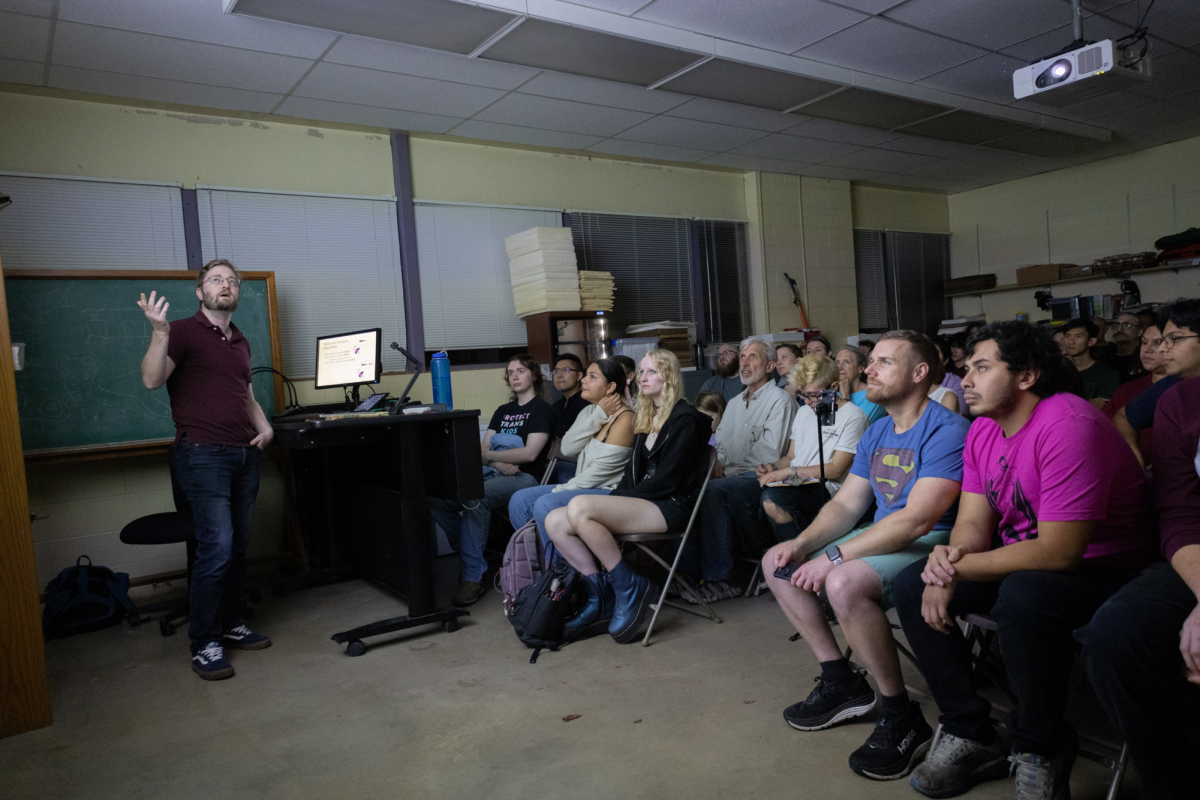
On Thursday, Science Under the Stars hosted an event at Brackenridge Field Laboratory, where integrative biology Ph.D. candidate Luke Larter took attendees on a journey through the sounds of Austin’s nocturnal creatures. Science Under the Stars is a free public outreach lecture series run by UT graduate students, aiming to bridge the gap between academic research and the community. The event offered guests an immersive experience in nature as Larter shared his knowledge of the local insects and frogs that fill the night air with their calls.
“The audience got a kick out of learning about all these insects and frogs that they might not have been able to identify before,” Larter said. “They might recognize the calls but couldn’t always match them to a mental image of a species — now they could.”
Smruti Pimplikar, an ecology, evolution and behavior graduate student and co-president of Science Under the Stars, said this event is important to her because of its emphasis on accessibility.
“The fact that I’m able to participate in something that helps somebody in the audience who wants to get into science feels like a job well done and a job that’s necessary to do,” Pimplikar said.
Tianyi Xu, co-president of Science Under the Stars and ecology, evolution and behavior Ph.D. candidate, said she finds satisfaction in seeing the audience’s engagement.
“They enjoy the guided tours we offer every month, and we often have a large audience that can fill all the seats or the entire classroom,” Xu said.
In addition to the event’s educational value, there was a sense of community building. Xu said that the organization provides a rare chance for UT students and staff to connect with the broader Austin community and for volunteers to develop valuable skills that will enhance their careers, especially in science communication.
“A lot of our volunteers are interested in pursuing academic positions, working at a museum or science communication-related careers,” Xu said. “This is a great way to help them build their CV, especially with activities engaging with the public.”
Pimplikar said the success of the event was a reminder of the importance of outreach in science.
“Everybody and anybody comes and enjoys these events, and it’s a great opportunity to interact with people outside of UT,” said Pimplikar.