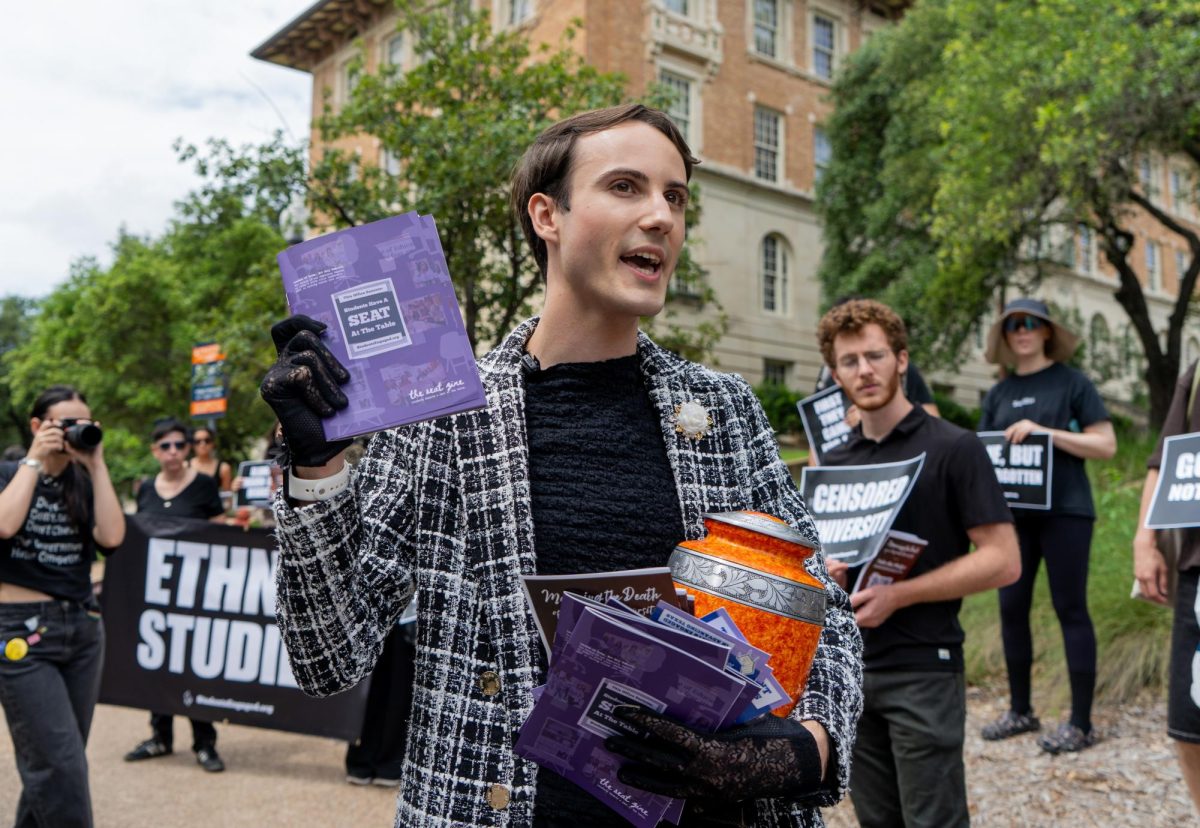
The Foundation for Individual Rights and Expression filed a lawsuit against the UT System on behalf of UT-Austin and UT-Dallas student organizations for the system’s compliance with the new Campus Protection Act, saying the Texas law limits First Amendment rights on campus.
The Campus Protection Act, which went into effect on Monday, reversed a 2019 law that made the common outdoor spaces of public universities “traditional public forums,” where anyone could engage in expressive activity. Now, expressive activity on college campuses is limited to only students and employees. State Sen. Brandon Creighton, R-Conroe, authored the bill in response to the large pro-Palestinian protests on campus in April 2024 that resulted in 136 arrests.
The bill also prohibits expressive student activity on campus from 10 p.m. to 8 a.m. and during the last two weeks of the semester, but UT-Austin officials can use their own “reasonable discretion” when determining if an activity is being disruptive, according to University policy. Previously, UT-Austin prohibited expressive activity between 10:30 p.m. and 8 a.m.
“We all go to college to express ourselves and be exposed to other people’s ideas and debate those ideas,” said JT Morris, the supervising senior attorney at the Foundation for Individual Rights and Expression. “When you clamp down on freedom of expression on campus for 10 hours a day … it (presents) a real concern for us.”
Among the plaintiffs are The Retrograde, UTD’s official student newspaper; The Fellowship of Christian University Students at UTD; Strings Attached, a UTD student music organization; the Texas Society of Unconventional Drummers from UT-Austin; and the UT-Austin chapter of Young Americans for Liberty.
The UT System Board of Regents was not immediately available for comment.
Maria Shaikh, the managing editor at The Retrograde, said the newspaper decided to join the lawsuit because the Campus Protection Act’s restrictions could impact work at the newspaper, which is typically done between the hours of 10 p.m. and 8 a.m.
“We just wouldn’t be able to be student journalists and do that journalism that we do: get the paper out on time, get articles edited in time,” Shaikh said. “We would fail our journalistic mission.”
Additionally, the bill prohibits expressive activities during the last two weeks of the semester, which could impact student organizations like the Texas Society of Unconventional Drummers, according to the lawsuit. The group’s president, Lincoln Schuler, said the organization hosts an end-of-semester show at the Texas Union every semester. He said this bill could prevent the show, which happens in the prohibited time frame.
Juke Matthews, the council chair of The Fellowship of Christian University Students at UT-Dallas, said the ministry often works after 10 p.m., running small groups and worship sessions. He said the last two weeks are a critical time for staff members to be on campus to manage the support network for students.
“My main hope is that we can continue protecting the rights that have already been given to us on campus and not have more burdens tacked on to how we operate as an organization,” Matthews said.