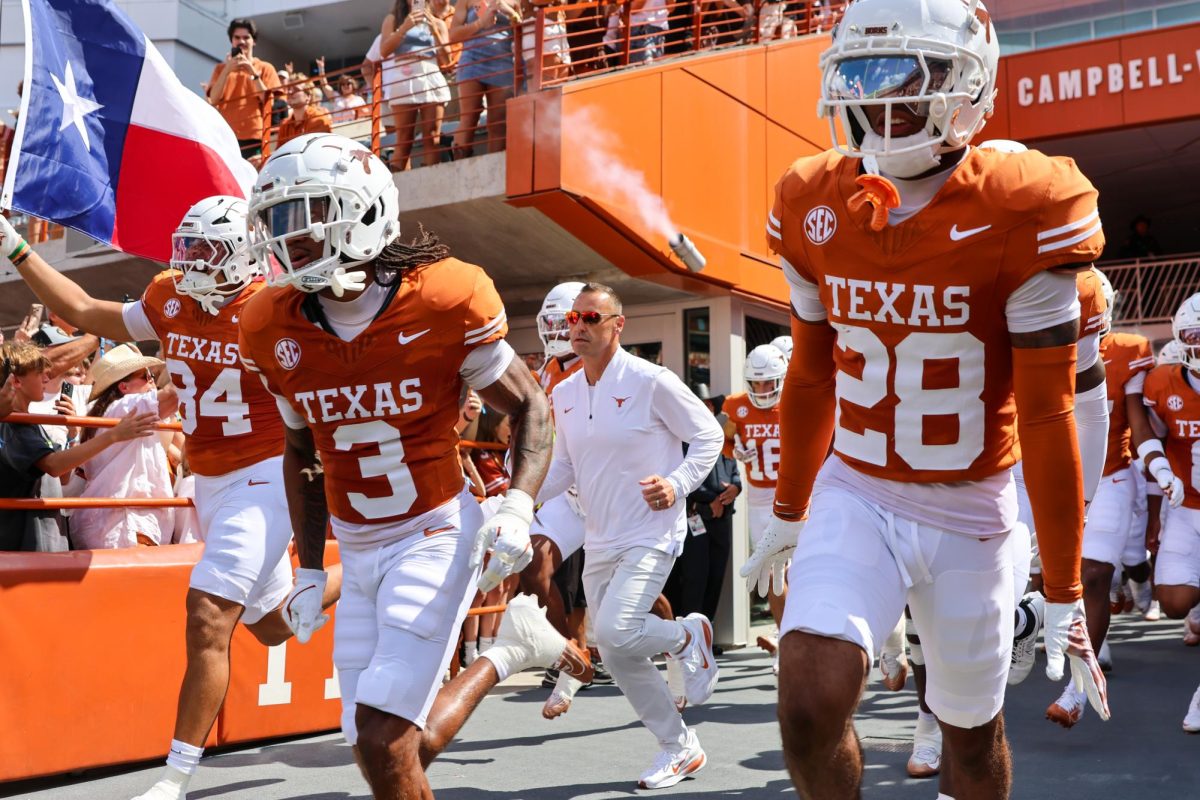
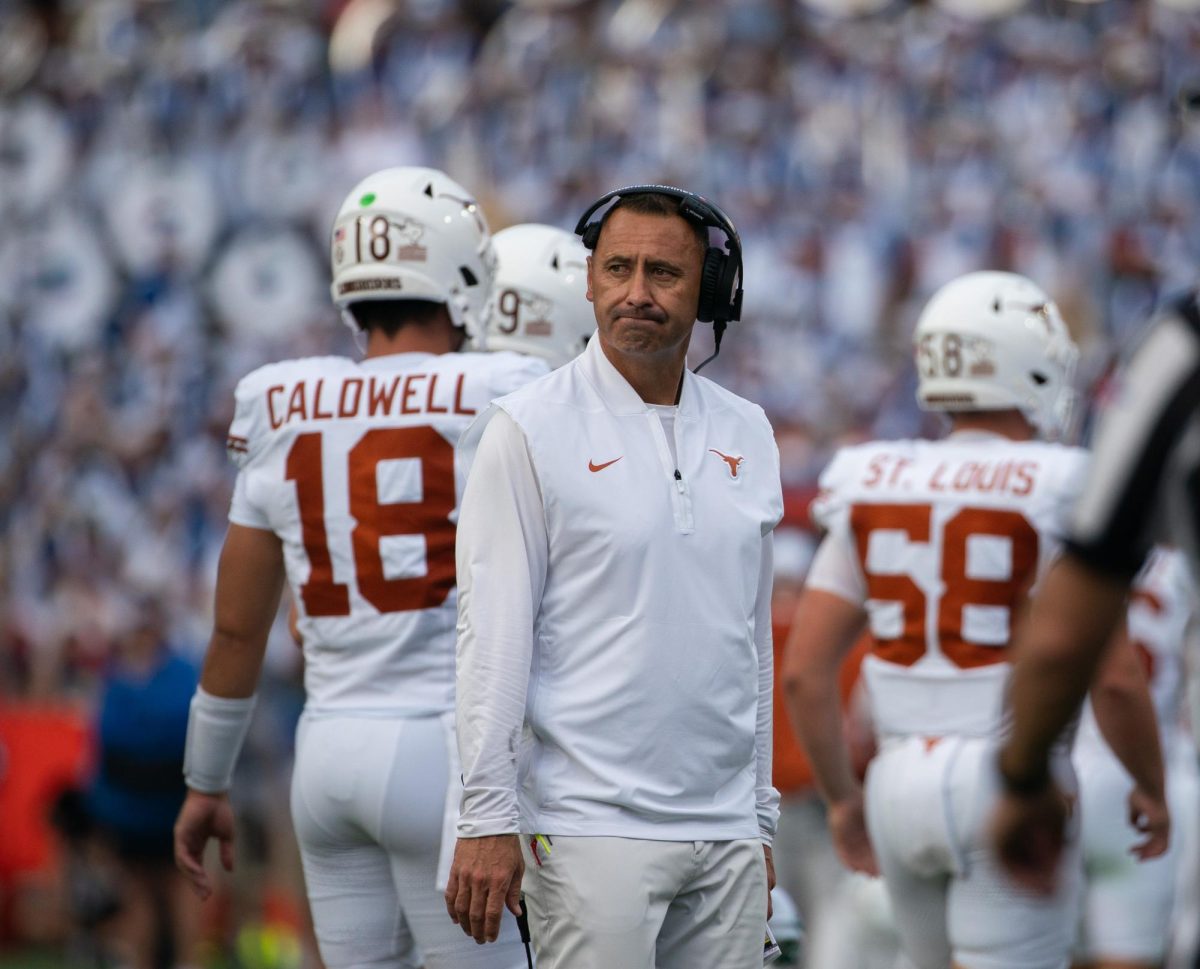
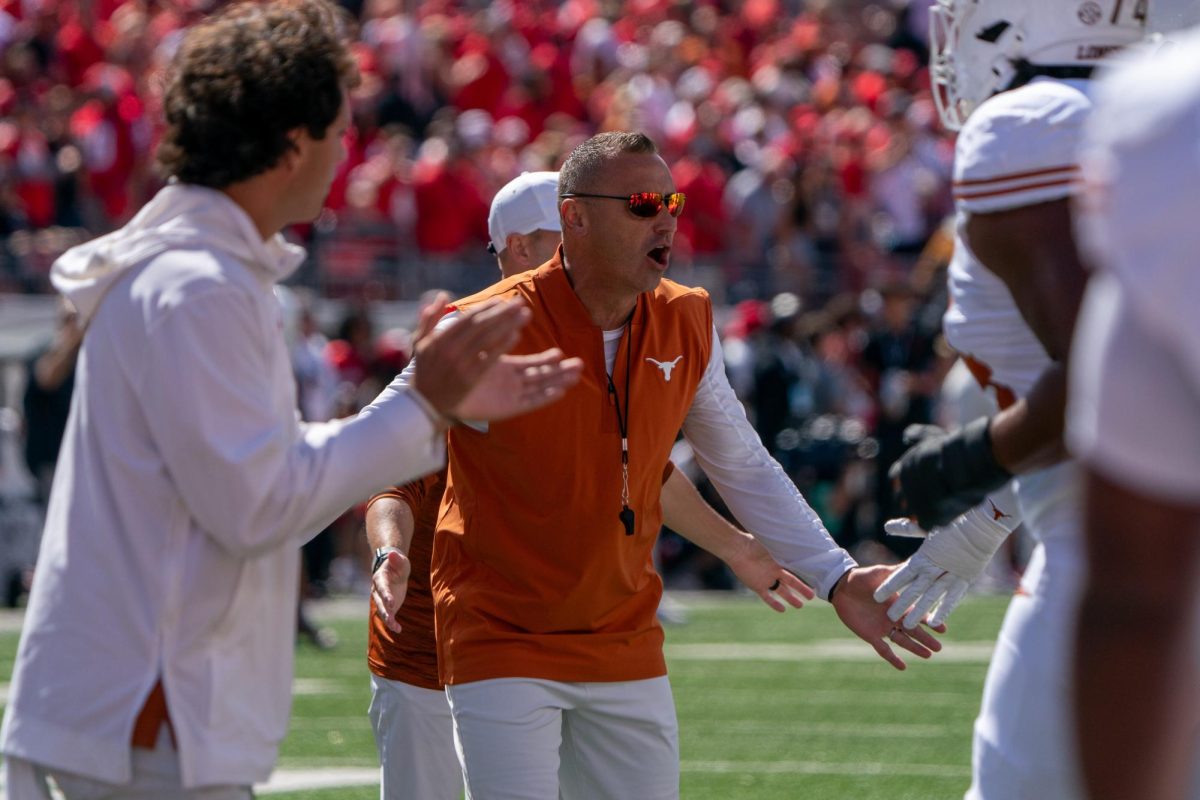
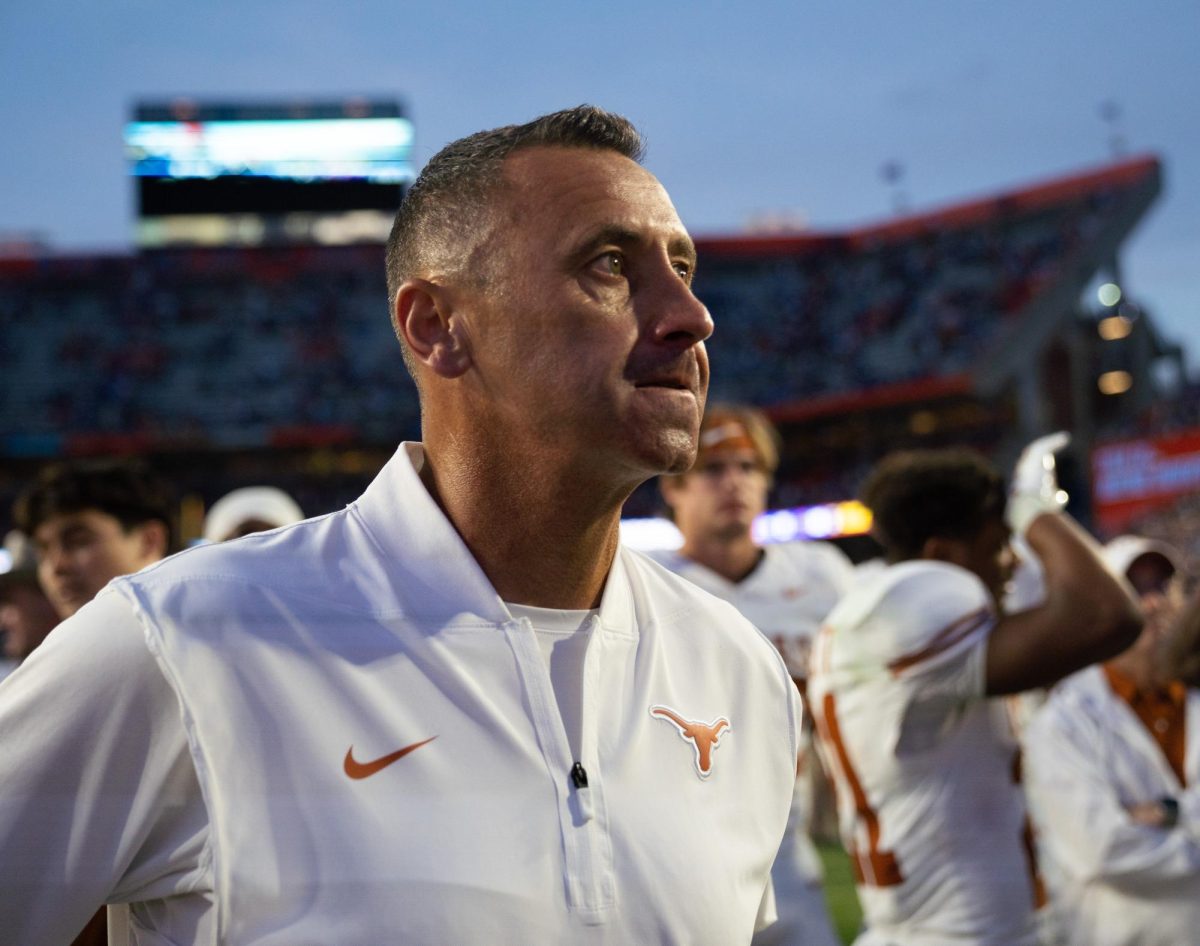
During his regular, run-of-the-mill Monday press conference, head coach Steve Sarkisian made a very good point about the coverage of Texas football.
“For the largest city in the United States that doesn’t have an NFL team or an NBA team or a Major League Baseball team, we’re covered like one,” Sarkisian said.
And it’s true — Austin has no professional sports besides Austin FC. Darrell K. Royal-Memorial Stadium might as well be AT&T in Dallas for all the media and fans that migrate to the stands, even if they never attended the school, attracted like moths to the bright lights.
Texas football is more than a collegiate game at this point. It’s an Austin attraction, and with that kind of spotlight, coverage of the sport becomes something more.
Add redshirt sophomore quarterback Arch Manning into the mix — who carried celebrity status before he even graduated high school — and there is virtually no difference between Texas football and the pros when it comes to media coverage and fanbase attention.
“Understanding what the coverage is going to feel like, to still focus on what you need to do and not get swayed by the pains of others, is a great lesson learned,” Sarkisian said. “We will benefit from that. Arch will, we all will. Down the road, that’s going to serve as something that I’m glad I went through.”
There’s no wonder that the expectations put on these players’ shoulders are so heavy, to the point that they’re idolized and vilified in tandem with each up-and-down game. It’s impossible not to buckle in some form under that kind of pressure.
Thus, the losses that ensue — and somehow make that pressure even worse.
Recently, Ole Miss head coach Lane Kiffin made some interesting statements regarding the end of dynasties within the Southeastern Conference.
“You’re going to have really good teams going 8-4 because we’re going to play nine conference teams, including five on the road,” Kiffin said to ESPN. “My concern for the programs and for the coaches is that fans aren’t going to be able to get used to the numbers being different, the wins and losses. If you’re a program that’s used to being a nine- or 10-win team and you go 7-5, your fans are going to think the team is terrible and the coach is terrible.”
There is no such thing as a perfect season — even the 2005 team, led by Vince Young, had its downs. Young didn’t look all too great in his visit to College Station, which may have contributed to his loss of the Heisman trophy that year to USC’s Reggie Bush. Yet he’s still regarded as one of the greatest players in Texas history.
“It’s a different time,” Sarkisian said. “And as much as college football has evolved, the coverage of college football has evolved, the constructive criticism has risen.”
Sarkisian doesn’t seem to quite know exactly where that pressure will lead — will it abate, or will it grow even worse with Name, Image and Likeness and revenue sharing?
One thing, though, is clear. This era of coverage is just going to have to be another area of off-field coaching for Sarkisian and his team to cover with his players.
“We have to evolve with the times and with the changing times, and we’ve got to do a better job as coaches,” Sarkisian said. “I have to do a better job with our players of understanding the coverage of our sport. It’s just evolved, but so has the game.”