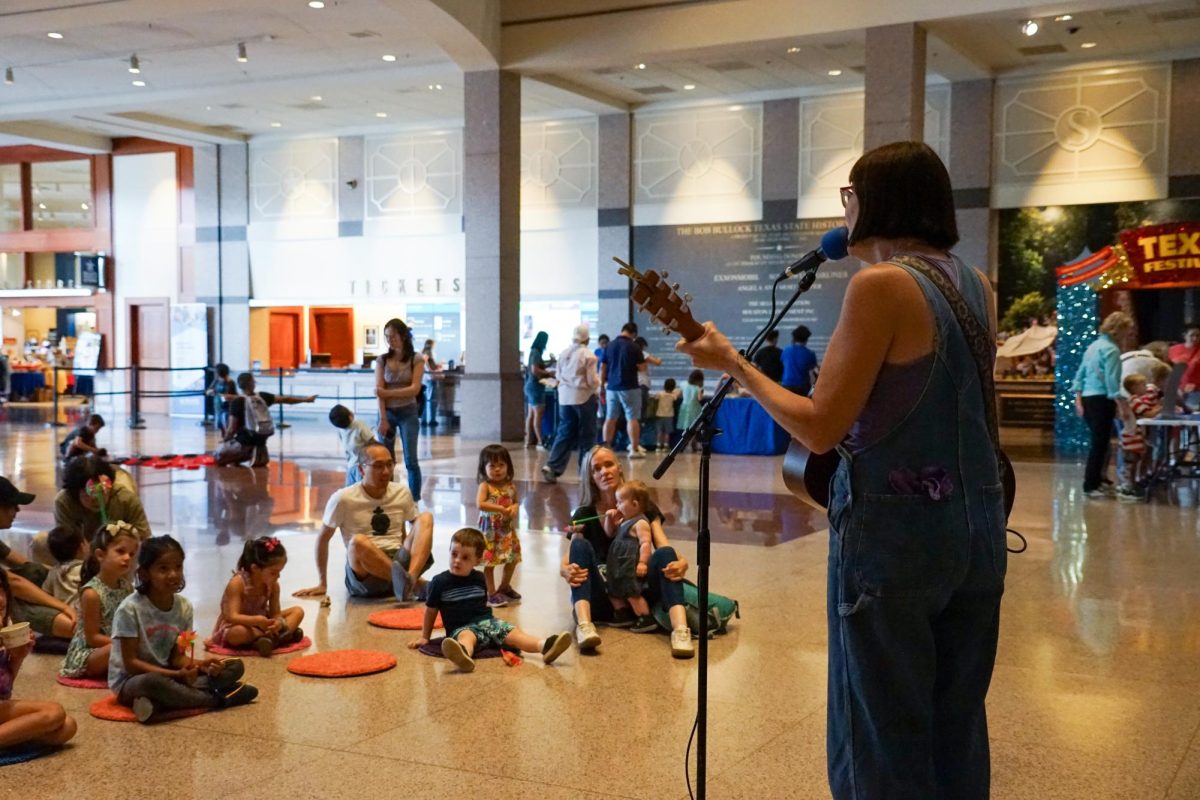
Crowded around a growing graffiti mural, children watched as spray paints exploded on a large canvas while Cap City Rockers, a breakdancing group, spun on their heads outside Lyndon B. Johnson Presidential Library. Meanwhile, KUTX’s radio show, The Breaks, filled the air with hip-hop tracks.
On Saturday, the GRAMMY Museum’s “Hip-Hop America: The Mixtape Exhibit” opened at the LBJ Presidential Library, welcoming almost 500 people with performances and live art to celebrate five decades of hip-hop history. Austin is the exhibit’s third stop, running through Jan. 4. UT students can enter for free with their student ID.
Inside, The Notorious B.I.G.’s red leather peacoat from Junior M.A.F.I.A.’s “Player’s Anthem” music video was displayed beside Tupac Shakur’s white tuxedo from the “I Ain’t Mad at Cha” music video — a reunion requested by both estates to recognize the artists’ earlier friendship.
“(A student) asked me if it was actually Biggie’s red leather coat,” said Kevin Solka, the LBJ Foundation’s marketing and digital strategy manager. “They couldn’t believe we actually had these items.”
The original exhibit began in 2023, coinciding with the 50th anniversary of hip-hop. Jasen Emmons, the GRAMMY Museum’s chief curator and vice president of curatorial affairs, said the milestone required maximum space. The exhibit took over the entire top floor of the museum’s Los Angeles location for the opening.
“I felt like that anniversary with the 50th was so important that we needed to do something that reflected how important hip-hop music and culture had been to America,” Emmons said.
The GRAMMY Museum had seven months to curate the exhibit and track artifacts scattered across the nation.
“Often, people would say, ‘Look, I really want to help you, but I have three different storage units, and they’re in three different cities in America … and I don’t know which storage unit (the artifact is) in,’” Emmons said.
The exhibit includes interactive touch screens where visitors can hear original samples alongside the tracks they inspired. Chuck D’s handwritten lyrics to “Fight the Power” are displayed near Egyptian Lover’s Roland 808, one of the first beat machines to shape hip-hop production. Lil Wayne’s “I Am Hip Hop” T-shirt from XXL magazine’s April 2007 cover also sits in the same case.
Some artifacts arrived with compelling stories. Lil Wayne’s management team called Emmons about a week after the initial press release.
“(The management team) said, ‘You cannot do a mixtape exhibit without Lil Wayne,’ … so they loaned us six things,” Emmons said.
The library decided to host the exhibit because of hip-hop’s thematic ties to former President Johnson’s era of social change.
“Even though hip-hop started a little bit after his time … you really see hip-hop use those similar themes for voice, for activism (and) for social change,” Solka said.
The Breaks co-host Confucius Jones said institutional recognition helps Austin’s hip-hop community. Jones also said Austin’s hip-hop scene has “more momentum now than it has in the past” through platforms like his show.
“I still think the city has a good way to go in terms of fully embracing hip-hop,” Jones said. “LBJ Library is a pretty famous presidential library of all the presidential libraries.”
The LBJ Foundation is funding the library’s operations through Oct. 15 amid the federal government shutdown, with updates on the library’s website.