The first thing you notice when you walk into the University of Texas Golf Academy isn’t the swing of a club — it’s the screens.
Step into a hitting bay, and it feels a lot less like a driving range and more like a classroom. Charts flash for each golfer with in-depth analysis of their swing from start to end. These numbers are vital for improvement, and they keep these golfers working towards perfection every single day.
The TrackMan at the UT Golf Academy is put to use every practice, providing real-time feedback for golfers on their club movement, launch angle and ball flight. Every single motion of the ball and swing is at the golfer’s disposal.
“It’ll tell you how far the ball carried, if there’s side spin, or how solid the contact was,” Texas men’s golf assistant coach Erik Henson said. “Sometimes it simply tells us they’re in the wrong equipment, or other times it can identify some swing flaws.”
Throughout the season, the golfers will play tournaments as close to home as North Texas and as far from home as Hawaii. Elevation has a massive impact on ball flight, affecting yardage by 10-12% men’s golf head coach John Fields said, so using the TrackMan to estimate where a ball would land is vital when preparing for tournaments that are hundreds of miles away.
“We’ll go to the West Coast and play at sea level, and when we do that, we can adjust the elevation on this before we leave and find out how far we’re going to hit the ball at sea level,” Henson said.
While the stats the TrackMan provides are extremely useful to these golfers, the coaches caution the athletes not to get too caught up in making the numbers perfect. It is a useful tool, but it doesn’t replicate the unpredictable environment that golf is played in.
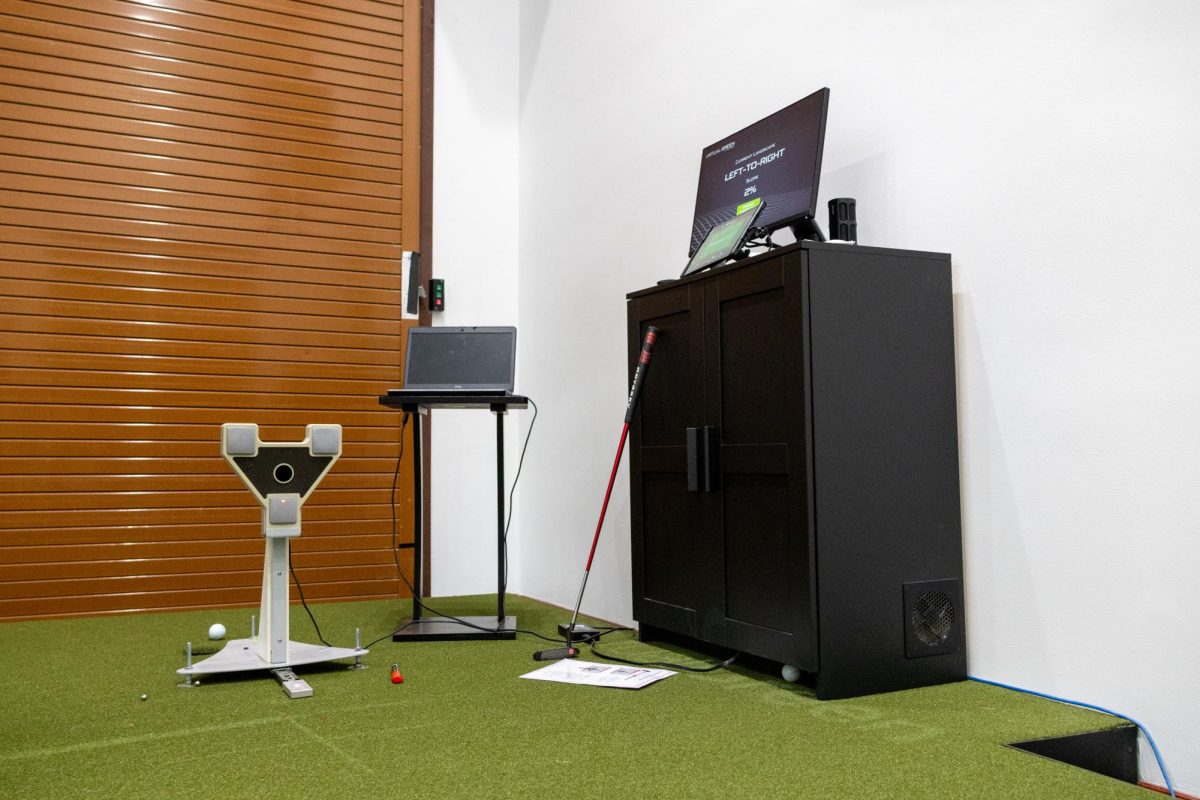
Walking further into the building is the PuttView Green. The platform looks unassuming at first: it’s just a flat putting green with a hole off to the side. However, with just a few clicks on a computer, the platform shifts and turns into a green with adjustable curves and contours.
Lines projected from above show the contours of the new slopes, allowing golfers to see if their reads were correct. It can also show the line the golfer should take for the putt, giving them practice with varying degrees of inclines. The coaching staff uses this technology to strengthen the golfers’ short game in hopes that they can develop consistency in their putting and the skill of reading greens.
“We spend a lot of time trying to help. Green reading is very much an art and a skill,” Henson said.
For the Longhorns, every screen and slope is there to turn practice and potential into performance. While the technology may be complicated, the vision behind it is not. The Texas golf program wants to produce golfers who can play, adjust and compete anywhere.