Mostly everyone comes into contact with Shakespeare’s work in the classroom with forced readings and analysis of his plays. The film “Hamnet” transforms Shakespeare’s work into an entirely new world, carving out a story that stands on its own, as well as choosing to focus on Shakespeare’s wife, Jessie Buckley, who plays Anne Hathaway in the film.
Directed, co-written and co-edited by Chloé Zhao (“Nomadland”), the film follows the relationship between Agnes and Shakespeare. With a limited release last Wednesday, the film takes real-life events of Hamnet, Shakespeare’s son who dies tragically at age 11, and postulates that his death inspired Shakespeare to write the play “Hamlet.”
Jessie Buckley (“The Lost Daughter”) delivers an incredibly powerful performance as fierce and fiery Agnes. Playing both a mother that lost her child and a child that lost their mother, Buckley brings an air of commanding femininity to the role. Buckley’s portrayal of Agnes’ grief and love for her family feels magnetic, grounding the film’s themes of parenthood and loss with depth.
Opposite her, Paul Mescal (“Normal People”) produces an equally impressive performance. Known for his emotionally complex roles, Mescal offers a refreshingly human interpretation of Shakespeare, playing him as a young man still figuring out who he is. Mescal’s Shakespeare isn’t a legend — he is a person shaped by his love for Agnes and grief for his son Hamnet, which he channels into writing and performing “Hamlet.”
Across the board, the cast’s performances prove stunning. Jacobi Jupe’s portrayal of Hamnet is astonishingly natural, especially for a child actor stepping into his first major role. Jupe’s older brother, Noah Jupe, also delivers a strong performance in the film’s finale as the first stage actor of Hamlet for the play, “Hamlet.”
Max Richter’s soundtrack for the film is wildly moving, enough to evoke tears on its own. His famous piece, “On the Nature of Daylight,” sweeps during the film’s final moments, accompanying the last looks between Agnes, Shakespeare and Hamnet.
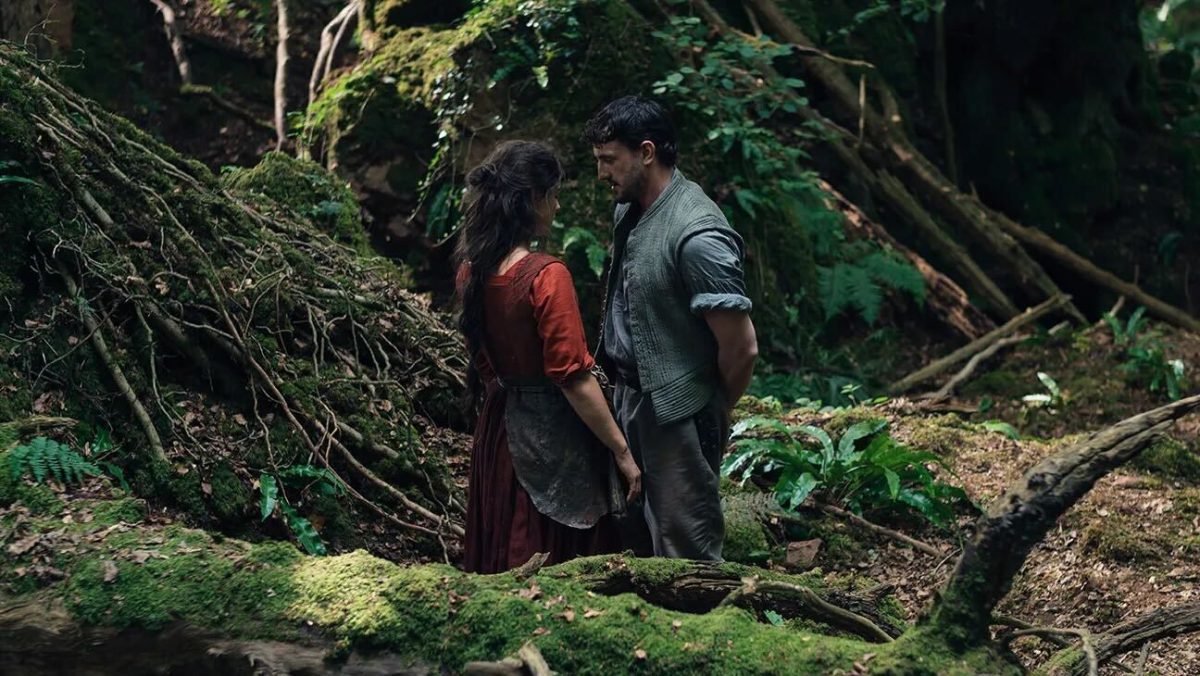
Both Zhao and the film’s cinematographer, Łukasz Żal, manage to bring even more beauty to the visuals. The film captures the forest as an entire living and breathing entity, being where Agnes feels most at home and where she also gives birth to her eldest child, Susannah. Relying on static shots, Zhao allows the characters and sets to speak for themselves. The forest’s colors are rich compared to the dreary London in which Shakespeare bases his work, and the striking red of Agnes’ signature dress feels apt for her presence in the film.
What makes “Hamnet” truly refreshing is its refusal to center solely around Shakespeare, the icon. Mescal’s Shakespeare is compelling — helped by modernized costume choices that reflect his interpretation — but the heart of the film belongs to Agnes.
“Hamnet” is a meditation on familial loss and grief, bringing new life to the age-old question, “To be, or not to be?”
5 tears out of 5