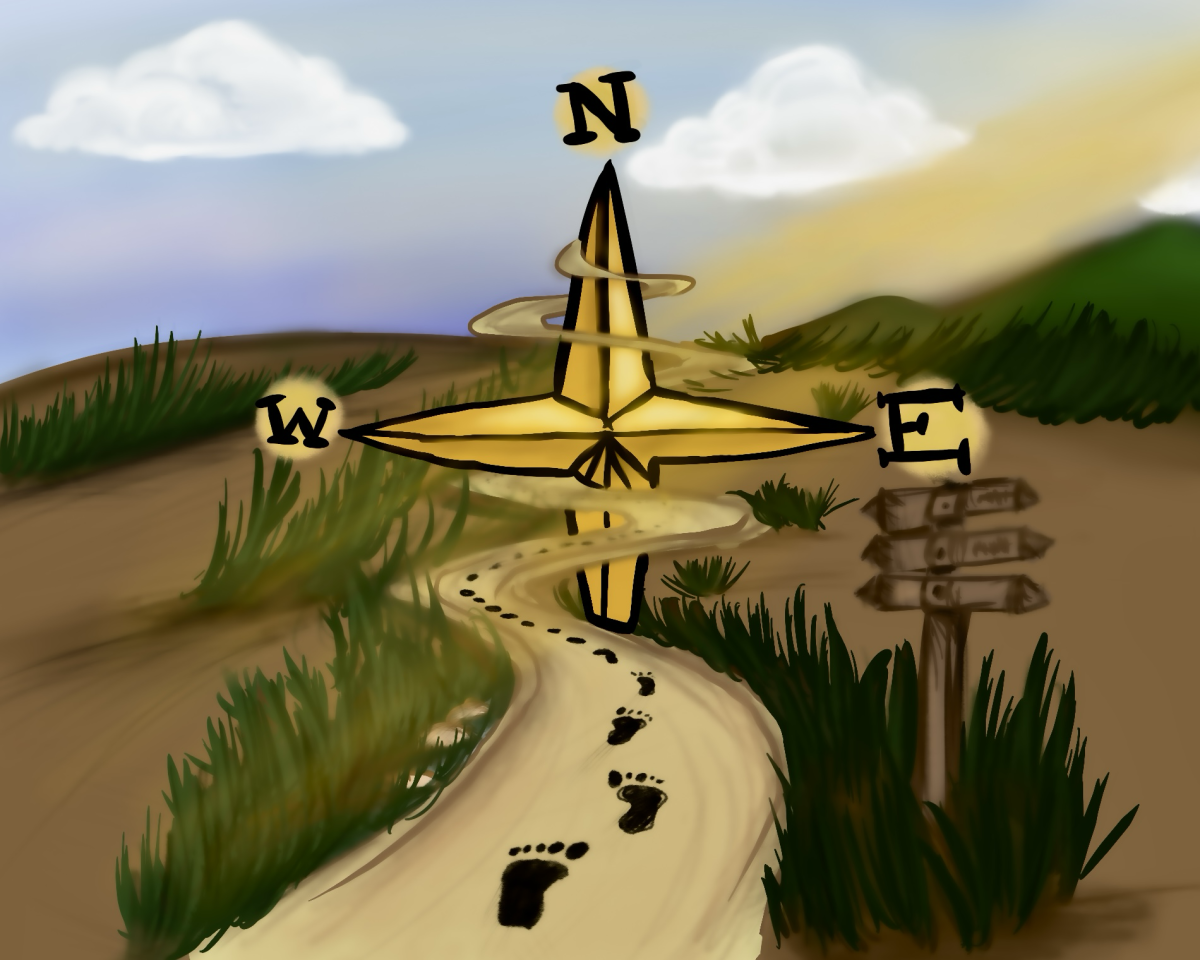
UT’s campus spans over 430 acres, so no one can blame students for relying on navigational apps to stop themselves from getting lost. While these applications provide practical assistance, the spatial learning and joy of natural exploration should not be disregarded.
Navigating using one’s own sense of direction requires greater awareness of the surrounding environment, helping develop spatial awareness.
“How you perceive, how you understand, how you interact with an environment will definitely shape your behaviors,” said Yuhao Kang, assistant professor in the Department of Geography and Environment.
Kang is also the director of the GISense Lab, which researches how AI can be utilized to understand how people experience a location. Kang said different dimensions of a place impact how one feels in the space.
“There are many other dimensions related to the environment: safety is another dimension, noise is another dimension,” Kang said. “Some places are beautiful. These are all different dimensions.”
The multifaceted nature by which humans experience their surroundings underscores the importance of choosing to be conscious of one’s environment. By hyperfocusing on navigational apps, people lose out on the opportunity to be fully aware, while overreliance can hamper spatial memory.
Beyond cognitive development, natural exploration also provides benefits for mental health through entertainment and interaction with nature. Choosing to explore campus with no idea of what you might find or simply taking a new path can be uniquely entertaining.
“There are so many different ways that you can take to class,” said James Butler, manager for Healthy Spaces and Mindfulness in the Longhorn Wellness Center. “When I talk to students and they try different routes, they’re always like ‘Oh, this was really cool’ (or) ‘I never knew that that little nook over there existed.’”
Constant reliance on apps like Google Maps, encourages students to always choose the fastest route. However, there is a special joy in finding hidden gems around campus by exploring independently. Additionally, taking more time to interact with nature can improve one’s mental health.
“Being in nature … 120 minutes a week has (a) profound impact on your psychological well-being,” said Butler. “You don’t have to do anything special; it can be just exploring or walking.”
For students seeking to find outdoor experiences, the University’s recreation department holds numerous opportunities.
“We try to offer new opportunities for students to explore via our adventure trip programs,” said Dixon Hankins, associate director for Outdoor Recreation. “We facilitate experiences like backpacking, canoeing (and) all kinds of outdoor activities”.
Students do not even have to venture off campus to explore the outdoors. UT has a Nature RX map that highlights different nature spaces on campus.
“The Nature RX map currently has 50 different spots on campus,” Butler said. “And it’s ever-growing … we are always open to adding things.”
In the busy days of college life, adventure is often something that can get lost. Thus, it is important to take the time to truly explore. Try taking a new way to class, or getting to a nature spot completely on your own. You may even end up finding a new one.
Stark is a chemical engineering freshman from Orange County, California.