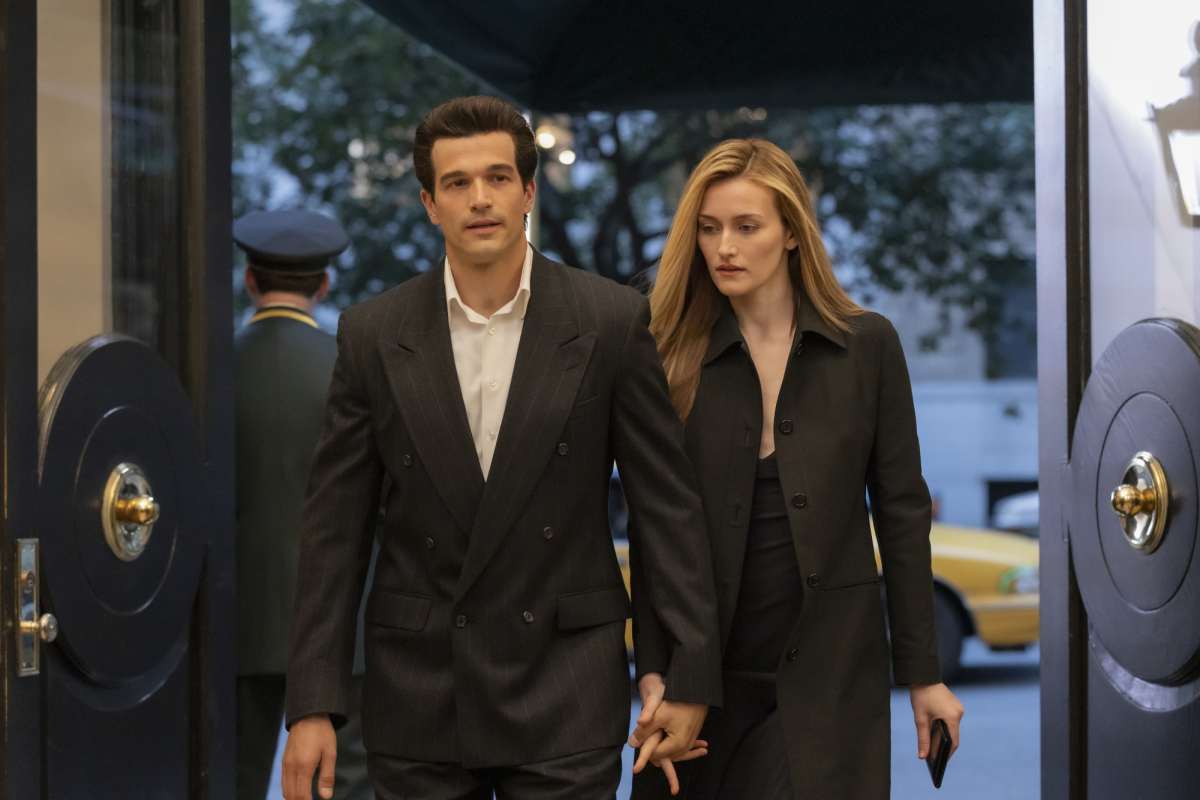
American culture never let the Kennedy family rest. Glamour and catastrophe solidified into romanticized stories, their private lives always seeming to make their way to the national spotlight. The latest installment arrives in the form of FX’s “Love Story,” executively produced by Ryan Murphy (“Monster” and “Glee”). Dramatizing the tragic romance between John F. Kennedy Jr. and Carolyn Bessette, the series, so far, appears more interested in the cultural zeitgeist of the time than in commemorating history and its victims.
Set in 1990s New York, the series acts as a curated mood board for the high-fashion realm, featuring Calvin Klein minimalism, glossy magazines and metropolitan newspapers. The soundtrack’s equally as curated, featuring ‘90s classics such as “Linger” by The Cranberries, “Lover, You Should’ve Come Over” by Jeff Buckley and “No Ordinary Love” by Sade. With the first four episodes out and the next airing on Thursday, the series treats the decade and the couple as a reconstruction from real people into symbols and a throwback to a time America refuses to stop lamenting.
Despite the show’s main focus on the iconic couple, the women in the series stand out. Most notably, Bessette, played by Sarah Pidgeon (“The Wilds”), stands as effortlessly cool and poised, akin to the now-deceased real-life Bessette. Pidgeon radiates confidence and a chic aura until Bessette’s world becomes heavily scrutinized by the media and public. Opposite her, Paul Anthony Kelly is solid as JFK Jr., but his performance truly comes alive when sharing the screen with Pidgeon. The pair’s chemistry acts as one of the series’ redeeming qualities — scenes featuring Kelly alone feel serviceable by comparison.
Another compelling woman in the series is Jackie Kennedy, played by Naomi Watts (“Mulholland Drive”). With Kennedy’s breathy and distinct accent, captured admirably by Watts, the character emerges as the most quietly fascinating figure. In scenes where she converses with her children, Kennedy wonders aloud how history might remember her if she weren’t “America’s widow,” a line of dialogue that intrigues a far richer narrative than JFK Jr.’s often repetitive anxiety about his fame. JFK Jr.’s sister, Caroline Kennedy, played by Grace Gummer (“Mr. Robot”), adds depth and wisdom to the series, most notably when she advises JFK Jr. in moments of struggle: “You were raised by judicious women.”
This respectable characterization of female characters stumbles with its depiction of Daryl Hannah (Dree Hemingway). With Hannah playing JFK Jr.’s ex-girlfriend, her character is villainized into the “other woman” trope, a caricature of a nagging and insecure ex. Shortfalls are prominent throughout the show, such as abrupt black cuts between scenes that pull viewers out of moments that deserve some lingering.
The theme that remains the leading force of the series is encapsulated by one of Jackie Kennedy’s lines of dialogue: “Public’s always holding a flower in one hand and a stone in the other.” “Love Story” centers around the social pressures and exploitative effects of living in fame, despite being a direct exploitation of the subjects it depicts. The series lives in contradiction of ethical boundaries, but because it is stylish and its stills could be added to a ‘90s-inspired Pinterest board, those questions of exploitation are forgotten.
3 newsboy caps out of 5