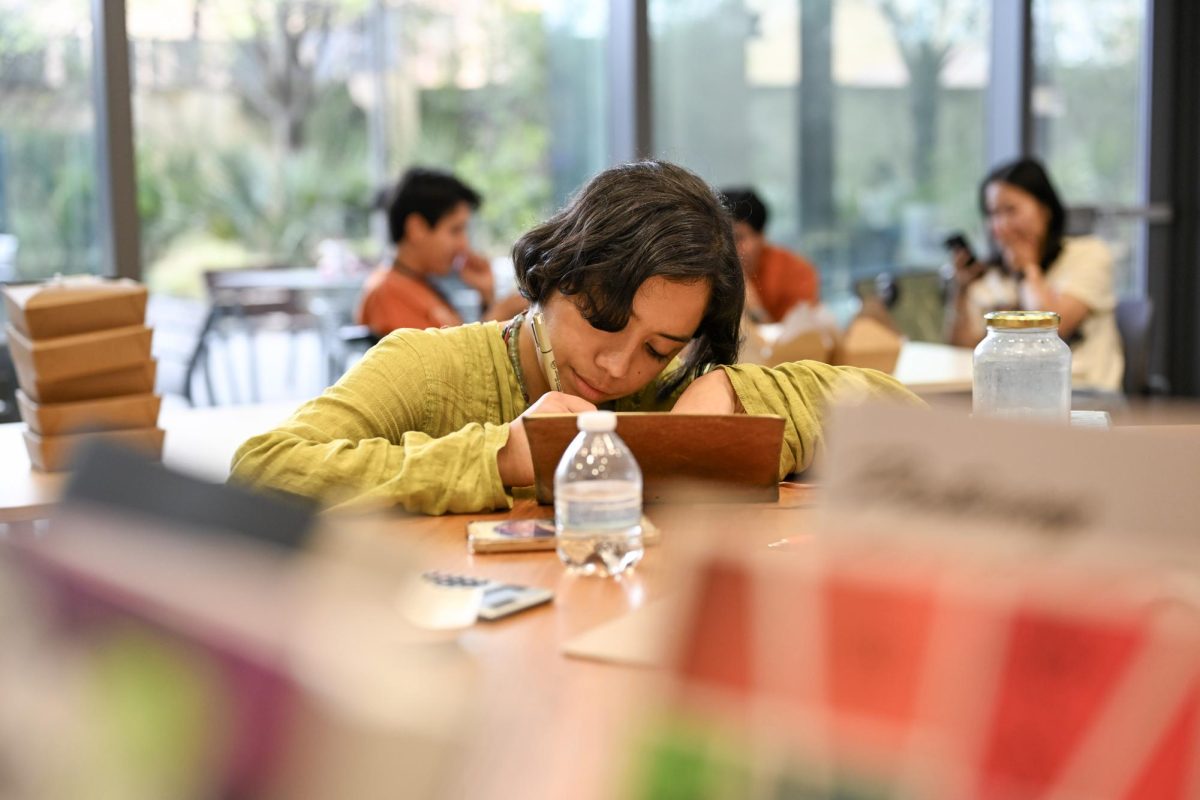
Every March, UT’s Latinx Pop Lab transforms Patton Hall’s Julius Glickman Conference Center into a haven for underrepresented creatives. BIPOC PoP, which stands for Black, Indigenous, people of color, ran Thursday through Saturday and gave students the opportunity to connect with acclaimed minority comic book writers, animators, video game designers and illustrators.
“You can come walk in and learn something and then go back to class,” said professor Frederick Luis Aldama, who founded the Latinx Pop Lab after joining UT in 2021. “There is no gate.”
Aldama, an award-winning scholar and comic book writer, brings contemporaries from across the country for BIPOC PoP. The three-day event features panels, round-table discussions, workshops and an “artist alley” lined with displays. In addition to artists, Aldama invites industry representatives, a dimension he said creates vital professional opportunities for students.
“I knew that I wanted an annual event every spring that would pull together and celebrate not just comic creators, but animators, video game writers and makers and industry people,” Aldama said. “You need to create the networks in order for something magical to happen.”
BIPOC PoP 2026 put the spotlight on female creators in underrepresented communities, a demographic Aldama said experiences “total erasure” in the male-dominated industries of comic books and animation. Samantha Ceballos, Aldama’s assistant in the Latinx Pop Lab and a doctoral English Literature student, began studying Latina representation in pop culture after discovering a love for comic books as an undergrad.
“The more I read, I was like, ‘I don’t really see my community, I don’t see my family, I don’t see myself in these comics,’” Ceballos said.
Melissa Flores, who headlined the event alongside five other women of color, said she grew up desperate to see herself represented in media. During a Friday panel, she talked about “The Dead Lucky,” a comic series she wrote about a queer female veteran battling post-traumatic stress disorder.
“I never want my stories to be seen as exclusively queer, exclusively Latino, exclusively female,” Flores said. “I want people to see those representations in these characters, but also see their emotion and where they came from and hopefully endear themselves to the character based on their shared experiences instead of who they are.”
Flores said her work has taken her to conventions whose attendances routinely reach over 100,000 people. She said BIPOC PoP, which drew around 750 this weekend, offers an intimate alternative and allows for meaningful connections between professionals and young artists.
“Had I seen something like that when I was in college, it would have inspired me and given me so much more encouragement to go after what I really wanted, instead of feeling so lost,” said Flores, who began writing comics after almost two decades in the entertainment industry.
Aldama said he rejected an offer to add BIPOC PoP to South by Southwest. Despite the prospect of increased exposure, he feels no desire to change the current scale.
“People lining up for hours to see a superstar — that has no real depth and meaning,” Aldama said. “We’re nowhere close to that, but I never want to be close to that. I want the depth, the texture and the meaning, and you don’t get that at San Diego Comic Con.”