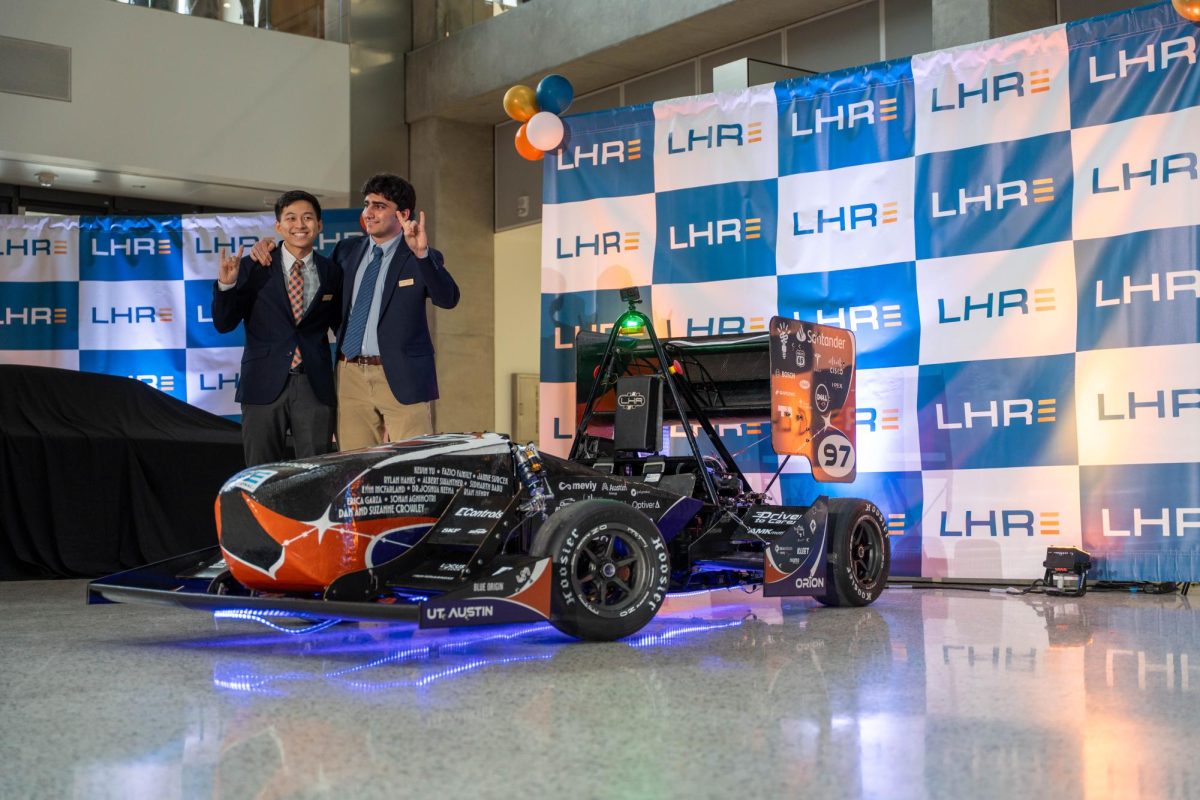
The electric formula-style racing car began the night with a total of 80 miles driven. Most of the team stuck around, anticipating they would reach their goal before the unveiling. Persevering through broken parts and dead batteries, the team finally hit 100 miles on the car they had spent the past year engineering. Driving a victory lap, the team sang “Texas Fight” as a UT flag waved in the air.
Longhorn Racing, UT’s chapter of Formula Society of Automotive Engineers and part of the American Solar Challenge, unveiled three cars on Saturday at the Engineering Education and Research Center that will be used in competition this summer. The teams — Electric, Combustion and Solar — introduced the vehicles they created for each design track, highlighting the organization’s motto, “We don’t build cars; we build engineers.”
“We are all about developing young engineers’ talent to become full-fledged engineers,” said Tyler Yan, mechanical engineering senior and Electric team captain. “(I) really enjoy investing in people and helping them grow on the team, providing mentorship, all of the aspects of motorsports engineering.”
At the start of last summer, the organization dealt with a forced work stoppage due to safety infractions regarding housekeeping in their garage. The members still in town at that time worked together to clean the garage. Longhorn Racing regained work permission a month after their normal starting time.
“(Longhorn Racing) went from being a bad example of environmental health and safety, of how student organizations mistreat a space, to being the example that environmental health and safety uses to show other student organizations how to do it,” said Jamie Svrcek, machine shop manager at the Walker Department of Mechanical Engineering and Longhorn Racing advisor.
Matthew Mekha, electrical and computer engineering senior, worked as Electric team chief engineer for this season. He said their goal this season was to ensure the older members of the team pass knowledge down to the new recruits. After the COVID-19 pandemic, the team struggled to recover, continuing to make the same mistakes as previous teams, such as not driving the car enough, Mekha said.
“We want to make sure that doesn’t happen again with good documentation and good mentorship,” Mekha said. “(We’re) making sure that we raise the next generation of freshmen and sophomores to be even smarter than their predecessors.”
From June 16-20, the Electric team will compete against 99 other colleges at Formula SAE Electric in Michigan, bringing about 35 of their 120 team members with them. Their car, Orion, will be judged on design, build, refinement and team understanding of the vehicle. Before June, the team hopes to double their mileage.
“In classes, you’re trying to get by, get the grade and move on,” Yan said. “In a club like Longhorn Racing, … (members) all have that shared vision of making something really, really difficult, something you couldn’t do by yourself, even if you spend all the time and money in the world. … That level of human centricness to engineering is what really makes engineering organizations like Longhorn Racing so appealing to others.”