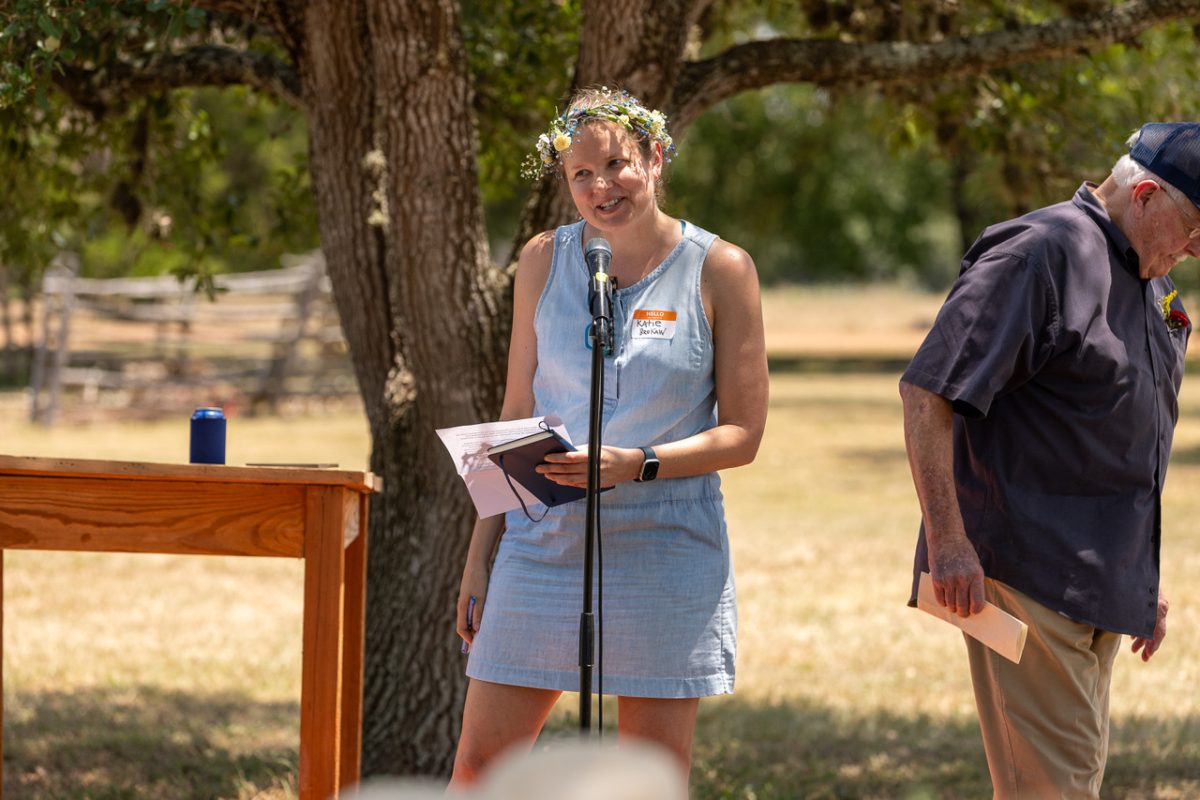
Founded in 1970, Shakespeare at Winedale, a UT English Department program, offers courses for students and summer camps for ages 11-16 focused on performing Shakespeare at Winedale Historical Center, a 19th-century farmstead near Round Top, Texas. Under new director Katherine Steele Brokaw, the program prepares for its first spring production of “The Winter’s Tale,” opening today at Calhoun Hall, alongside a reimagined summer season.
Brokaw spoke with The Daily Texan about honoring Winedale’s history while guiding it forward.
The Daily Texan: What drew you personally to Shakespeare at Winedale and to taking on this role as the new director?
Katherine Brokaw: I love that Winedale takes kids out of the city and brings them into nature and lets them have this experience where they are unplugging, they are getting away from their screens, they are building community and they’re making art together. … It’s all the things I love. It’s collaborative, it’s creative, it’s courageous.
DT: Shakespeare at Winedale has had a lasting impact at UT for decades. What aspects of that feel most important for you to carry forward?
KB: It has a tradition of being a safe space for kids to figure out who they are. … Both students in the mid ’70s and in 2026 are saying, … ‘It’s so beautiful out here. I’ve made friends that I think are going to be my friends for my entire life. I’m learning that I am braver than I ever thought I was.’ … All of those fundamental things that were part of the program with Doc Ayres and that James Loehlin and Madge Darlington continued in this century are never going to change with me.
DT: Are there any new approaches that you’re excited to introduce?
KB: We will be doing one play this summer that is an adaptation of an early Shakespeare play called “Love’s Labour’s Lost.” … We are adapting it to (be) set in Winedale in 1976, so there’s going to be ‘70s music and fashion and a lot of little inside jokes to Winedale. … So it will honor that tradition that Winedale has, while also bringing something new to the community.
DT: Why was this important for you to introduce?
KB: I really want students to feel like you don’t just have to do these plays as written. There’s a 400-year tradition of people taking the raw material of these plays and making them something that speaks to them. … I always say that Shakespeare is a renewable cultural resource that we can keep doing new, exciting things for.
DT: What made “The Winter’s Tale” the right choice for this moment at Winedale?
KB: It’s a play that my predecessor, James Loehlin, really loved, and I felt (it) was a sweet way to honor him. It’s a play that ends in forgiveness and in a fragile reconciliation, and I think that’s a story that is helpful to hear right now in a time of so much animosity. Bad things happen in “The Winter’s Tale” … but people work through those hard things.
DT: As audiences prepare to see “The Winter’s Tale,” what do you hope they take away?
KB: I hope they can feel the magic of that play, and that so much of what is at the heart of that magic is human forgiveness and our capacity to change and to become better people.
Editor’s Note: This article has been updated to reflect the accurate spelling of “Loehlin.” The Texan regrets this error.