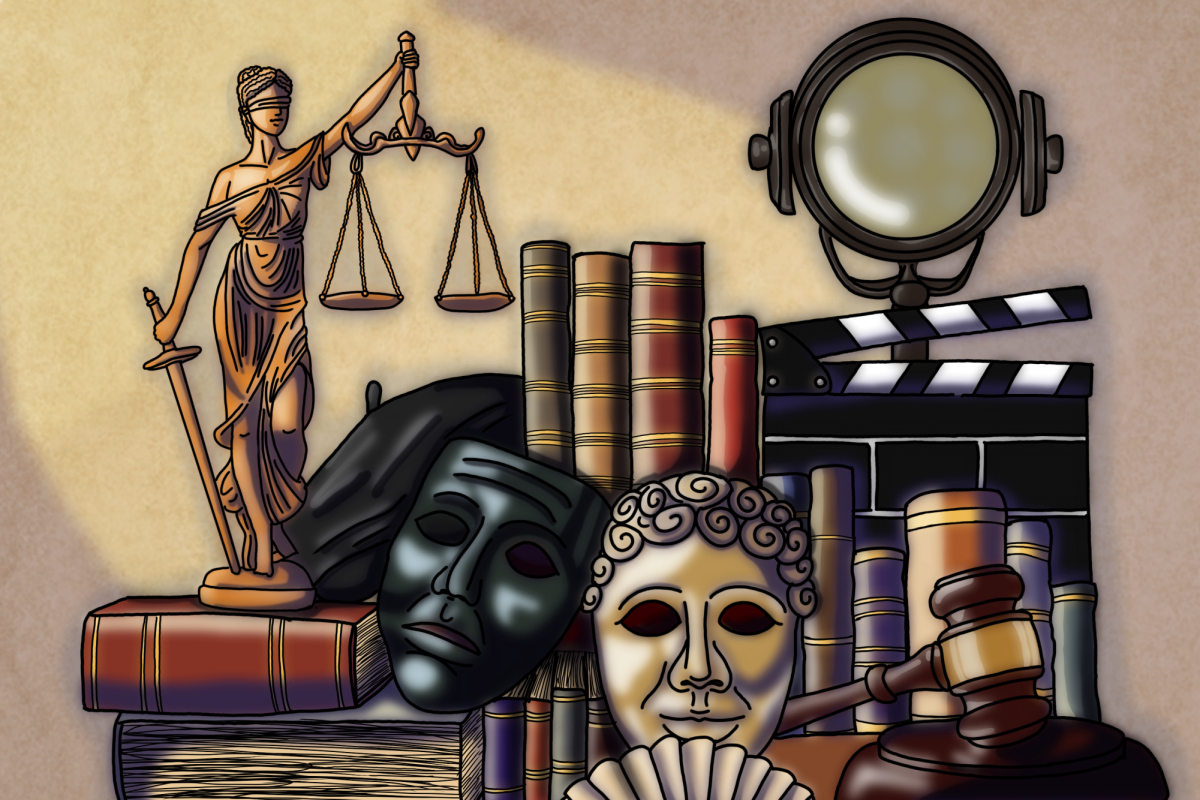
The art of bringing a character to life and establishing an emotional connection with your audience is nothing short of admirable, but is a show restricted to your presence on a stage? Or can it find a home in the courtroom where the stakes are even higher?
Much like the stage, the courtroom imposes the same anxiety-inducing feeling that actors experience as they stand before their audience, preparing for the performance of a lifetime.
The skills honed in theater — captivating an audience, crafting compelling narratives and delivering persuasive performances — are just as essential in the courtroom as they are on stage. Theater majors are uniquely equipped to excel in the legal field.
“Your training helps you know how effectively (to) hold your body, to modulate your voice, to use your hands, to use gestures in service of conveying an idea or an emotion,” said Brian Pérez-Daple, criminal law professor at the School of Law. “In the presentation of cases to juries, especially, but even to judges, these are important tools for successful advocacy. Having had theatrical training starts you off much farther down the road to success.”
Much like actors, lawyers must master the art of storytelling and persuasion. They don’t just recite legal facts. They craft compelling narratives, embody confidence and adapt their delivery to engage their audience. A skilled lawyer can control the room and convey emotion with precision. Whether arguing a case in court or negotiating behind closed doors, they shape perceptions and outcomes with their words, tone and presence.
“The way that I prepare for my mock trial competitions is really similar to the way that I would practice getting ready for a play,” said Caroline Lilly, a government and human dimensions of organization sophomore. “You are weaving a narrative and trying to tell a (story) with somebody, and you’re kind of doing the same thing in mock trial when you’re trying to prove that somebody murdered somebody else or that they didn’t.”
However, some may argue that law is a discipline grounded in logic, analysis and factual precision rather than performance.
While the two disciplines have their differences, it overlooks that a legal argument is only as effective as its delivery. Performance in the courtroom is not about acting in a theatrical sense, but rather using presence, tone and body language to strengthen a case.
“In acting, we always talk about objective, goal, intention, action. In other words, it’s not about saying the lines,” said Lucien Douglas, associate professor of acting at the College of Fine Arts. “It’s the need for the lines. (Actors) want to change something in you, do something to you. That’s intention.”
Actors have the unique task of breathing life into a character not by merely reading lines from a script but by delving beneath the words to create a character from within themselves. They do so to move an audience, commanding the space they inhabit with presence and purpose.
In a world where persuasion is power, a theater major may want to expand their stage beyond the footlights. The courtroom, much like the stage, demands a commanding presence — one capable of moving a room with a single narrative. And for those wanting to change the world, there may be no greater role than that of an advocate.
Huerta is a government sophomore from Victoria, Texas.