The federal government gave a key approval on Jan. 16 to Project Connect, a plan to implement a light rail in Austin, in an environmental review, bringing the $7.1 billion project closer to starting construction in 2027.
The Federal Transit Administration, an agency that provides technical and financial assistance to public transit systems, signed off on the project. The agency uses an Environmental Impact Statement to evaluate a proposal’s environmental and community effects and determine whether it meets federal requirements. The Austin Transit Partnership, the government corporation designing the light rail as part of Project Connect, wrote in a news release that this is the first time a major transit project finished an environmental statement in two years, a major step closer to potentially receiving federal funding for construction.
“We’re pursuing federal support for the capital funding for that project, so there are a number of different things we need to achieve to get there, and this is a big one,” said Jennifer Pyne, executive vice president of planning, community and federal programs for ATP. “It is the culmination of a two-year process that had a lot of public input and community participation.”
The original plans for Project Connect, which Austin voters approved in 2020, set out to create a 28-mile-long light rail transit system. However, the light rail was scaled down in 2023 to about 10 miles due to increased costs.
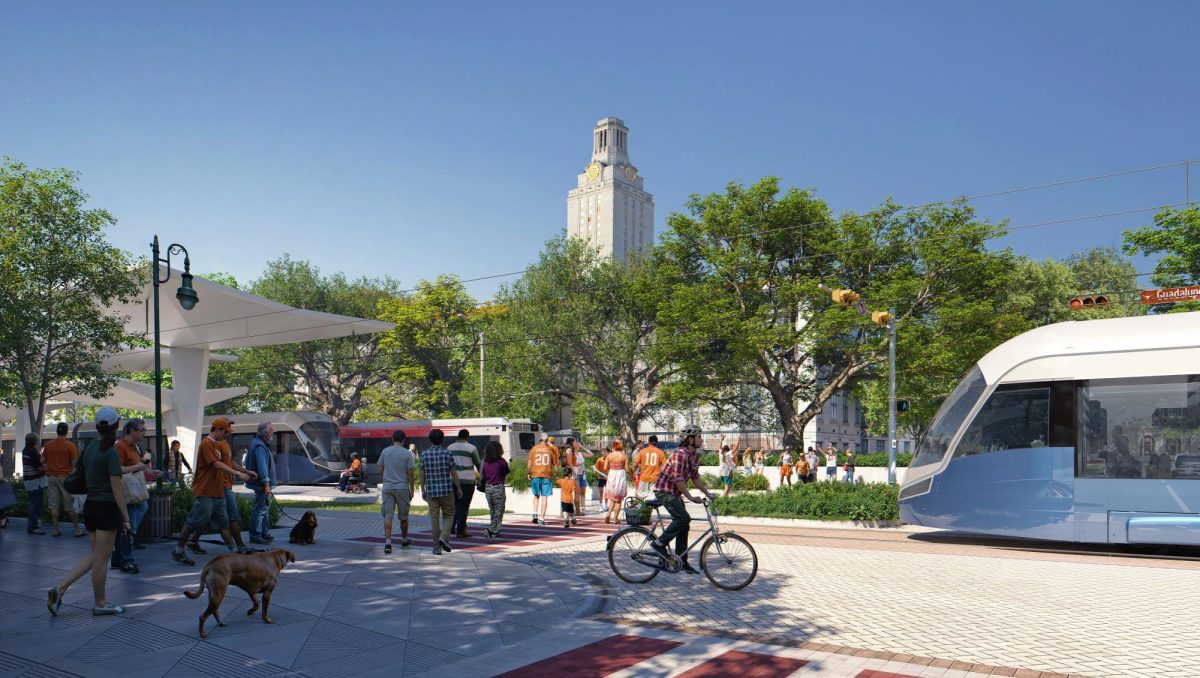
The current version of the federally approved proposal has a light rail line extending from 38th Street down to Lady Bird Lake, where the rail will split off into a South and East line, according to the Federal Transit Administration. In its North Section, the line will go down Martin Luther King Jr. Boulevard and Guadalupe Street, transforming the latter street into a transit mall.
Austin City Council member Zohaib “Zo” Qadri, who represents UT and West Campus, wrote in an email that the approval is a “milestone.” Qadri wrote that the light rail will make Guadalupe Street more pedestrian-safe for students and increase mobility in Austin’s urban core.
“Light rail means UT students will have access to more of Austin without needing a car, including destinations like South Congress and Riverside, and it will make it easier to reach basic necessities like grocery stores, jobs, and services downtown,” Qadri wrote.
Pyne said the next step for the project is to award contracts to a final designer and builder in preparation to begin constructing the light rail. The project is currently slated to open to the public in 2033, according to the ATP website.
“When Austin Light Rail is operating, after it’s constructed, it’s going to have a huge impact on the city to have more options, more ways to get around, have neighborhoods and places feel so much more connected,” Pyne said. “Even as the city grows, you will be able to kind of maintain that reliable connectivity through Austin.”