The Daily Texan sat down with UT President Jim Davis on Thursday for his first interview with outside press since he took office over a year ago. Davis discussed artificial intelligence, federal funding, the consolidation of ethnic and gender studies departments, and more in the 30-minute interview. The full transcript of the interview is below, and a full video is available here. This video was filmed and edited by Justin Doud.
DT: I really want to reiterate just what an honor it is to be able to interview you today, but it really begs the question as to, why is this your first interview after over a year in office?
Jim Davis: I’ll tell you that my approach has been to talk with this place as opposed to talking about the place. So this morning, I was at the women’s faculty breakfast. We had deep conversations about who we are, where we’re going. I was at a classroom earlier this week, so I’ve been orienting my time this first year to truly understand the people that are inside — faculty, students, staff — and to understand the context of what the public mission is intended to be from a variety of perspectives. And I ask this question to myself all the time of, “What should the president be doing to meet the mission of this university?” So I kind of separate myself a bit from that to make sure that I’m putting my time where I can (make) the biggest possible impact for the place. And as I asked that question, most recently, it has been to talk with the people here, understand as best I can, be part of the building of strategies to move us into where we are our best version of ourselves, and then come talk to you.
DT: Well, no complaints here about you coming to talk to me. One of the biggest challenges facing higher education right now is artificial intelligence. As generative AI becomes more prevalent, there’s a growing spectrum of beliefs as to what AI’s place is in higher education. So, to what extent do you believe that students and faculty should be incorporating AI into the classroom?
JD: That’s a really, really profound question because we are going through a transition in technology that feels to many to be different from anything else we’ve experienced in our lifetimes. The idea of AI and what it will do for us as workers, or in our communities, or in our businesses, it’s so unknown right now. At the same time, what I hear from companies that are hiring students and hiring new employees from people that are working in industries, that there’s this additional craving that I don’t know (if) I saw it two years ago, but it’s craving for building human intelligence at the same time. I’ve had this conversation in the past two weeks with Microsoft and AMD, who are thinking about how AI is both a business model and how it affects their employees. And they share the opinions of what they’re looking for are people of curiosity, who can be part of their company, people who have an ability to see ideas from different perspectives, and they locate a lot of that in the humanities. So while AI is arising and becoming a new thing in our world, the human intelligence is also rising, which makes me very happy as a liberal arts student here at UT Austin. So I view it as buckets of, “How can we, as a university, build the technology and then the process around using technology as a science research project.” “How can we extend and create AI that’s helpful and functional and good?” “How do we prepare our students to work in a world that includes AI in their fields?” There’s a training element for our students to be able to be leaders in their field that they choose. And how also to think about it from a societal perspective of, “What should a flagship public university in Texas contribute back to both the development of knowledge and human flourishing in a world that includes AI?” And that might mean, “How do we protect humanness of some of the things we might be facing, and how do we understand what that means?”
DT: Another one of the big challenges facing universities right now is federal funding. It’s been pretty uncertain for universities nationwide over the last few years, and one of the priorities that you have really emphasized is pushing UT towards the material sciences, creating a new shared focus on that. And so I wonder, do you believe that the material sciences is a path to more stable federal funding in the long term?
JD: I think I would separate those two and first look and recognize that we have actually not just sustained but grown our federal funding in the last year. And I think that was a surprise for a lot of people. There was uncertainty a year ago about whether there would be changes in the quantity or what parts could be paid for costs. And since then, we are the number one funded university for the National Science Foundation in the world. We are in the top four or five in Department of Energy and Department of Defense. I think the place where you’ll see growth is going to be in the health area. So the NIH dollars, which is another big source of federal funding, have been modest at UT, and they’ve been partly because they haven’t had an academic medical center. So if the question goes to, “Where do we think changes are going to drive research dollars?,” I would say academic medicine is more of a driver of that, but material science is a fundamental part that also drives healthcare and life science and energy. So if you think of material science as, “What are the next iterations of battery storage, battery power?,” that will have a Department of Energy interest in material science. For how materials can be used in a hospital, surgical setting, that also would come into a health-based funding. So I think it’s a baseline science that helps elevate multiple disciplines. But the driver of the research dollars, likely the biggest driver, will be the launching of the academic medical center.
DT: In the same vein of federal funding, I want to talk about the Compact for Academic Excellence in Higher Education that the Trump administration offered UT back in October 2025. There was a November deadline to decide on that compact that came and went, and UT has, from what I have seen, been pretty much radio silent on it. When can we expect a public decision about this?
JD: I hadn’t heard about that one in a long time, because it hasn’t really been on my radar for a long time. We got a letter back in October inviting the University to have feedback on a series of terms and conditions that has been described as the “Trump compact.” In the very first week, I gave them some feedback on things that function in a public university in the state of Texas, things that don’t, ways to think about what their goals were, of what they’re trying to solve. And then nothing much happened since then. I don’t know what the reasons are behind that, but there’s not a thing for me to sign. There’s no place for me to put my orange pen on the bottom line. There wasn’t in October, there wasn’t in November, and there’s not now. There could be changes over time, but as I see it, really, it feels more to me like an administration setting terms and conditions for research grants, which for us is the 15th administration we’ve done this with, starting with Truman going forward. Everyone has their own versions of terms and conditions, and so there may be things that are works in progress that are happening at the federal level, but it’s not related to UT Austin directly.
DT: I just asked because the other universities who were offered this initially, back in October, they made public very clearly that they are rejecting these, as you put it, “terms and conditions,” and UT hasn’t really offered a similar answer. So I wanted to get a timeline on that.
JD: I think that’s because of how you interpret what the question was. I didn’t perceive that we had a thing to accept or reject when it was sent over. I saw an invitation to comment about an idea, and so we commented about the idea, and it has not materialized into a thing that has grown from there. Other schools may have interpreted that differently. Maybe they felt the need to say something publicly about the invitation to comment about an idea. Here, we take the position that sometimes — this is not limited to higher education — but sometimes people feel like if they said something, they’ve done something. We tend to focus on, “What could we do to best support and build the mission of our university in the constellation of public education and private education at the higher level?”
DT: And so just to make sure that I am getting this right, UT’s lack of statement, as many other universities did on this compact, does that effectively mean that there will be no “signing or rejecting of the compact in the future?”
JD: I don’t know that the future holds all those things 100%. There’s nothing for me to sign, and I’m not in a conversation to debate or discuss or negotiate a thing to sign. We will always honor the Texas law about what we are as a public university, and we will always follow the mission of this university to sustain the public trust we’ve been given to develop human knowledge and flourishing. We’ll always do that. And if there’s a question that someone from a federal funder or state funder has for us, and they want our feedback, I’m going to give them our feedback
DT: And I actually wanted to ask about that public trust. You’ve spoken extensively about a loss of trust between the public and higher education. What would you say is the root cause of that mistrust?
JD: My observation about this is complex. There are missing expectations of what some believe higher ed ought to be delivering versus what higher ed believes it ought to be delivering. And part of that is definitional. We don’t use the same language sometimes, even though we have so many shared common values. So my navigating this past year through tons of conversations with people to understand their reflection or their response to our university is to understand more deeply what they expect and why. What I have found is that there is a high degree of common set of values, if you elevate the principles to the things that are about our mission, about the purpose of education, and there are differences in opinion about whether or not we’re meeting those expectations. So the method we engage in is how to better reveal what we are doing in an honest, authentic way, so people can better understand the value of a University of Texas degree and understand that we are doing an excellent job of changing our mission. And there’s areas to improve. We take those honestly and we improve those.
DT: I want to go back to your investiture speech. You talked about some priorities and ways to restore this trust as it relates to UT, and one of those was expanding the curriculum for the sake of balance and preventing these narrow degree programs. And actually, for this semester, several US history courses were removed from the core curriculum because they were “too narrow.” From your point of view, what makes a degree program or a course too narrow?
JD: Yeah, that’s an interesting question. They’re not quite connected to the core curriculum concept. So let me give an example of computer science. Computer science feels a little under threat about what is AI going to do in terms of coding, and so that may be viewed as too narrow of a field if it is limited to the skills and techniques of how to code well. So there is an expansion of that curriculum to include informatics, to include data and statistics, and to move the concept to computing, so that we are talking about how to use computers to solve important problems. That was totally built by the faculty to understand how they want to adapt and expand, to pull together strengths, to meet a mission during a changing time. So the School of Computing would be one of the examples of that. There are other areas that become very niche, and they start to lose their focus because they are limiting themselves too much to a single topic or field or range of topics, to bring them together in a more interdisciplinary way, to bring in a fullness around that so that the student going through that major has access to a range of views and ideas, to give a fullness to that degree. The biggest example of that is going to be in the core curriculum, and how the core curriculum that’s going through a faculty definition today would be the prime example of a fully interdisciplinary experience in humanities and in the stem fields. There are other examples that are happening, though, of pulling things together to create more gravity around the field so that we have more balance around that, and also balancing out the amount of resources we’re putting against the topic. Every time you build a department, you’re adding a layer of extra administrative around it, administrative expenses, administrative needs. And sometimes those are good and sometimes they can be duplicative. So, “How do you pull things organized in a way?” And importantly, “How do you do that through the input and the definitions by the faculty and the academic leadership?” So, Liberal Arts will look at liberal arts and weigh in on what they think are the good outcomes, as does natural sciences in School of Computing along with School of Information, and then material science that you mentioned is another example of pulling together various strengths to bring a fullness to a topic that otherwise is a little bit fractured and segmented around different fields.
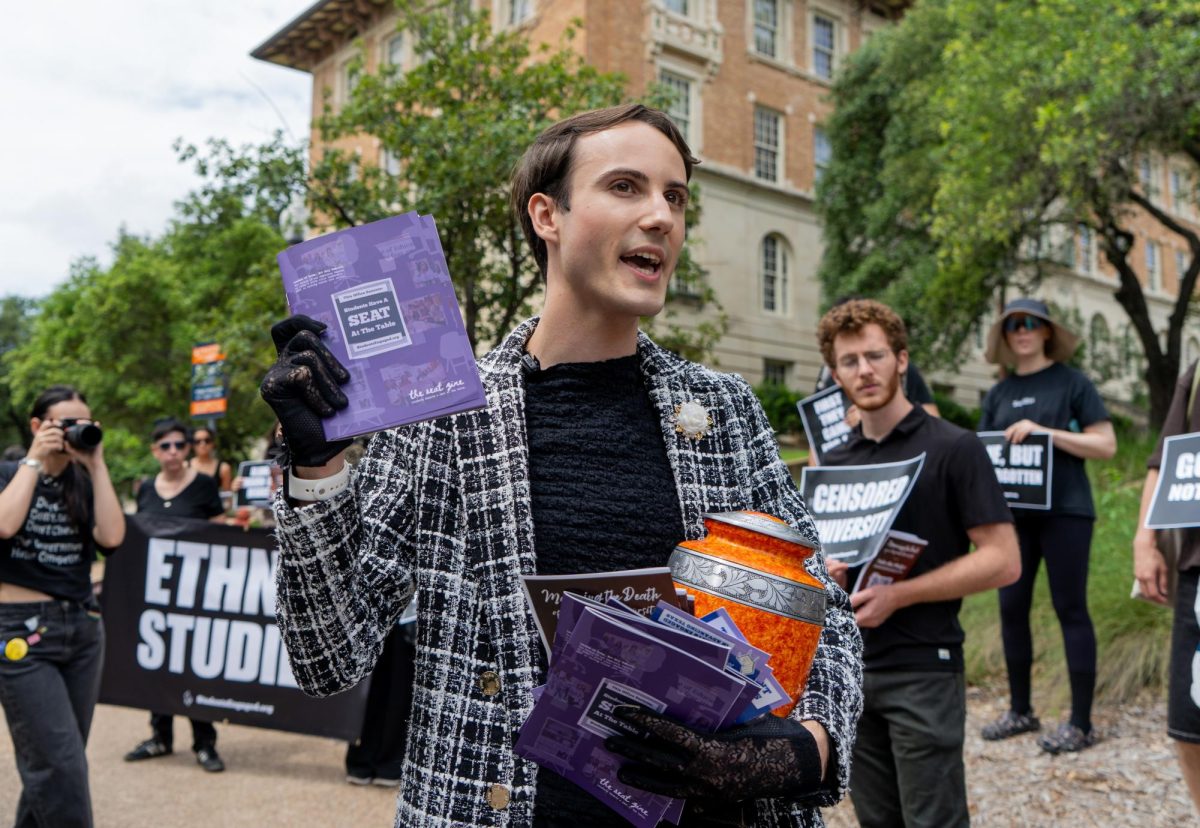
DT: And I want to take this concept of narrowness and fracturing, and I want to apply that to the consolidation of ethnic and genders in these programs within the College of Liberal Arts. You said that the idea is to bring these programs together in a more interdisciplinary way. Well, the chairs of these departments have expressed the concern that each of these departments are, on their own, already their own interdisciplinary units. What are you seeing from these departments that you think needs to be brought together more efficiently?
JD: Well, on that one in particular, that was run through the College of Liberal Arts, with Dean Sosa and our provost, and then many of the other academics in Liberal Arts were weighing in on that. I think the chairs were also included. And I’m not surprised that there is some difference of opinion about those things, but the consensus recommendation that came back was the one that I accepted.
DT: Can you please elaborate on exactly how this merger creates that more interdisciplinary vision you were talking about earlier?
JD: Sure. If you think about trying to understand cultures, if you are wanting to understand the role of a particular identity in the context of a larger set, if you can bring those things together in a way that you are observing those in different angles, different lenses, you can have a broader perspective. I believe that there is a really important role for us to understand humans and humans in all their iterations, individually, based on identity groups, based on how they fit together, from different combinations and values and experiences and lifestyles and backgrounds. And to do that well, I think invites having a larger, more robust conversation among the faculty and among the students.
DT: And the other concern that I’ve heard from the chairs of these departments that are being merged is that it will ultimately result in a loss of resources for funding. Can you give some insight as to whether these areas of study will lose these resources or funding?
JD: Nothing about nothing about the steps we’ve taken have changed the budget. The same people are there. The same students are there. Nothing about that has manifested into that. I don’t know their source of their fear for that necessarily. I don’t know how to react to that, to assuage them that that hasn’t happened, but there is an ongoing review, again, by the academics that are in (the) liberal arts to understand what should be the curriculum and the offerings, and how we stored that in in that department, and also overall in Liberal Arts.
DT: If you want to get more specific about their concerns, what I’ve heard is that there are currently seven departments that are being merged, so that’s seven funding channels, and now down to two funding channels. And the concern that I’ve heard is that if all of these areas of study are crammed into one department, that there’s ultimately less to go around. So that is the basis of their concern.
JD: Imagine this as being like a pie divided into five pieces, and then you put the pie together again. There’s not a difference in the scale or scope or volume of that, and nothing has changed in terms of the funding streams going into that particular group. I don’t see it that way if there is a definitional reduction in sources of funds. And I don’t know how you go from seven to two, unless you’re putting three and four together to get to two of those things. I’m not sure how the math works there, but nothing has changed fundamentally, from my perspective, about the funding sources.
DT: It’s less about what has changed and more about what would change. Obviously this has not been fully implemented yet. The concern is more, could this lead to a loss of funding in the future?
JD: I hear that then, yeah, I recognize that when we go through changes, there are a lot of uncertainties, and sometimes people have fear about that uncertainty, and they are wondering what’s going to happen next. That’s when we come together, work through the process and make sure we have informed choices we’re making, and we communicate those choices as they come out. So I would invite people to recognize that in uncertainty, there are multiple possible outcomes, and not to rest on a fear of what the outcomes will be.
DT: The natural next question is, do you anticipate that any funding or resources could be decreased to these departments?
JD: I don’t have any anticipation about one way or the other. I know that there are scholars and faculty members and leaders and academics looking at what to do about that. So I have a lot of trust in our faculty and a lot of trust in the academics that lead the university, and I trust that they are fair, thoughtful and mission-oriented, and so I’m eager to see what they recommend, but I don’t know what they’re going to do yet.
DT: And earlier, you mentioned a curriculum review of all of these courses and degree programs in these immersion departments. And so I also want to ask, at the end of that review, do you anticipate any courses or programs being eliminated?
JD: Possibly the same answer, I’m going to trust the process and trust the leadership and the stewardship that the academics bring to their liberal arts mission and then see what they say about it.
DT: I want to zoom out a little bit about this change. We’re all aware of the discourse surrounding ethnic and genders right now. It’s very much under scrutiny, both at the state level and national level. And so I just have to ask, did that political discourse at all influence the decision to merge these departments.
JD: No, this conversation started earlier in time. It’s a question of stewardship, from my perspective, not limited to liberal arts. (We’re) looking at natural sciences, School of Information, medicine, engineering and natural sciences with material science. These are questions of stewardship and mission to me. And so when I’ve asked the questions about, “Will you please look at this?,” and, “Let’s make sure we’re being delivered and intentional about how we manage our resources,” that’s how those happen. So it’s not done in the context of a pull or push from the left or the right, and both occur at a university where you have multiple perspectives that would seek to have a change or influence and an outcome. We seek to meet our mission. And the deans and the chairs and the faculty that I work with, my impression is that they’re deeply committed to the mission of the University.
DT: I want to move to the topic of shared governance. Of course, in compliance with Texas Senate Bill 37, UT dissolved its faculty council and in its place, you appointed a faculty advisory board. However, because these positions are appointed rather than elected as it used to be, some faculty maybe don’t feel fully heard under this new model. So what would you say to a faculty member who doesn’t feel fully represented under this new structure?
JD: Yeah, it’s not intended to be representative. It’s intended to be stewardship of the whole. And that’s been the big shift. We’ve brought together 14 different faculty members who think about problems differently. That’s the secret of how this really works. We have an economist, we have a physician, we have a finance professor, social worker, astronomer, scientists, humanists and technological folks who come together and look at things from a different lens, and we sit at this very table and we talk about the biggest, most important issues of the university. They’re fully invited to share a full perspective. And that is working out really, really well. I’ve observed then the benefits of that coming through some of the subgroups that have been created to do really purposeful work. One example would be the committee to do the academic integrity statement, and the other would be the committee working on the core curriculum. That is inviting multiple perspectives from different disciplines to think about how to deliver the mission of the university that would be very difficult for any one single perspective to be able to understand. That’s the real art of it, and then we see outcomes from that. So a faculty-created statement about our commitment to academic freedom, academic responsibility — that integrity statement then gets pulled, picked up by the Board of Regents and sent back down as an expectation. There’s a call and response that’s happening at this university between our faculty and the regents. That’s not common in the current higher ed climate. We have found a path to have faculty voices and regents voices come together around common core principles. There’s always more work to do. There’s always more to build on that relationship. But the true goal of faculty shared governance is to have informed decision making influenced by people who are experts in their field, and we are accomplishing that with this model.
DT: The old faculty council model created this sort of open forum for faculty to ask questions directly to UT’s administration. Without that forum as it used to be, what avenues do faculty have now for directing those kinds of feedback?
JD: Yes, we’ve had (one) this morning. I have dozens of ways to do this. The one that this morning was a meeting with a faculty group to talk about whatever’s on their mind, and then I have a faculty breakfast every two weeks, and different faculty come in, and then I’ve gone to the history department and sat down with the faculty for lunch. So, these are moments where I get to invite them to ask, truly, any question. And I will say, “Any topic, this is no limit. You will not offend me by anything you want to raise up as a topic.” I have done that, maybe at this point, 50 times in the past 60 to 75 weeks, and it is a fantastic way to get candor and conversations. The Faculty Council process, my observation watching that for the past several years, didn’t invite a lot of candor. It invited some discord, and sometimes there were lots of expressions of feelings, but I didn’t observe a lot of coming together to solve our problems from that process. That may be a failure of the system or something else, I don’t know. What I am observing is that I have honest access to feedback with people who are willing to give me their true opinions, and I can give them a true and honest reflection on that idea. It is giving us a better place, a better system to authentically elevate faculty input into really important decision making.
DT: We’ve had record-breaking enrollment for the last few years, and that has worsened an affordability crisis both on campus and West Campus. How are you working with the city to improve these issues in West Campus?
JD: We’re working with the city to see if we can better allocate the way they treat affordability, so that it goes to the actual student in the rent process. There are different mechanisms for how affordable units are paid for and structured that don’t necessarily move through that opportunity. We would prefer that affordability is put into the pockets of the students, and that’s important to us, people who live in that area. We address that through housing scholarships. So we take some rent, at this point, it’s over $5 million a year, to reduce the cost of housing for units that we control the price of and that has had a very positive benefit for access to students who live on campus. We would like there to be more of an affordable experience for our students. Our method to influence that, from an economics perspective, is to grow some supply. So adding another net 800 beds in the fall of 2027 will be a positive step. This is happening on Whitis Avenue under Kinsolving that will be another positive step towards supply. And as you have supply, then it oftentimes helps set pricing in a way that better matches the need of the demand.
DT: I want to ask about the controversial topics policy that was recently passed by the Board of Regents. The concern that I’ve heard from faculty about this is that it can be vague at times. I just wonder, how are you defining controversial, and how is this enforced in practice?
JD: The interesting part about that, to me is that this is from the faculty integrity statement, that when we asked them to define our character, otherwise it can be defined for us by somebody else, that was the mission of the faculty integrity statement, and then they pulled that together in a manner that honors the notion of, “How do we treat students in the classroom?” So it comments about the academic freedom we hold very dear, and recognizes the liberty interest of the student to go to a classroom and (have) access to the fullness of perspectives and views on topics where reasonable minds might differ on that topic. The Board of Regents agrees. We embrace all controversial topics, and we expect that they are taught in an honest and fair way, so that you can bring your values to the conversation and the student in the classroom. That’s what really matters to us. How to define controversial matters is still a work in progress, but generally, when reasonable people hold an honest difference of opinion about a topic that is rational and understood — and we know there are many right now in our modern world — when reasonable people can have an honest disagreement about an idea that gives you some insight, that if we have a duty to reveal the multitude of opinions. And so whether you say that’s controversial or not controversial, is not really the test. The real test is, “Are we offering a multitude of legitimate and honestly held opinions so that a student can bring her opinion to that classroom and be part of learning something important about humanity?”
DT: How is something like this reasonably enforced? Who puts it into practice and how?
JD: Yeah, that’s, again, another work of the faculty we’re working through as well to get a sense of how we make sure we’re providing an honest assessment of that, hold ourselves accountable fairly, and to make sure we have built that process. So, again, I am relying on our faculty to help build the governance of themselves so we can offer that as the best answer to how we do that.
DT: And is that the same faculty who worked on this statement of academic integrity?
JD: No, I think we want to bring another group of faculty together again so we can make sure we have a multitude of perspectives around that topic. It would be better, from my perspective, to include additional voices in that conversation.
DT: The other concern that I heard about this is that, without clear definitions of controversial or how it is enforced, faculty may feel the need to self censor in their courses, and that could hurt the academic experience. How do you respond to that concern?
JD: I don’t think there’s any need for self censoring, because my belief when I talk to faculty is that they understand the art of teaching. These are some of the best teachers in the world at our university, and they know how to unfurl ideas for others to understand and come to and learn that wisdom. And the method of teaching is to invite people to have that curiosity, and to be able to reach and form opinions based off of values and evidence, and our teachers are spectacular at that. So I don’t think there is a basis to be afraid of the skills they are so good at. There may be some, and I don’t know how to sway that concern at this moment, but I’m always hoping to find better ways.
DT: We’ve talked about a lot of decisions that you’ve made in your first year. It’s been a very eventful first year and I would like to congratulate you on that milestone. But of all of these things that we’ve talked about, what do you think is going to make up your legacy as UT president?
JD: There’s a poem from Walt Whitman that asked that question about legacy, meaning of life, “O Me! Oh Life!” The answer he provides is to recognize that we are here and that we get to add a verse. That’s the point of Walt Whitman’s story, that we can add a prose to a legacy of this place. My legacy is to be a good steward of what has been built here for generations. Great things, built for generations, how to steward that, to be its best version of itself and to prepare it well for the next generation to take this place that we all love so much and to continue the majesty of that vision.