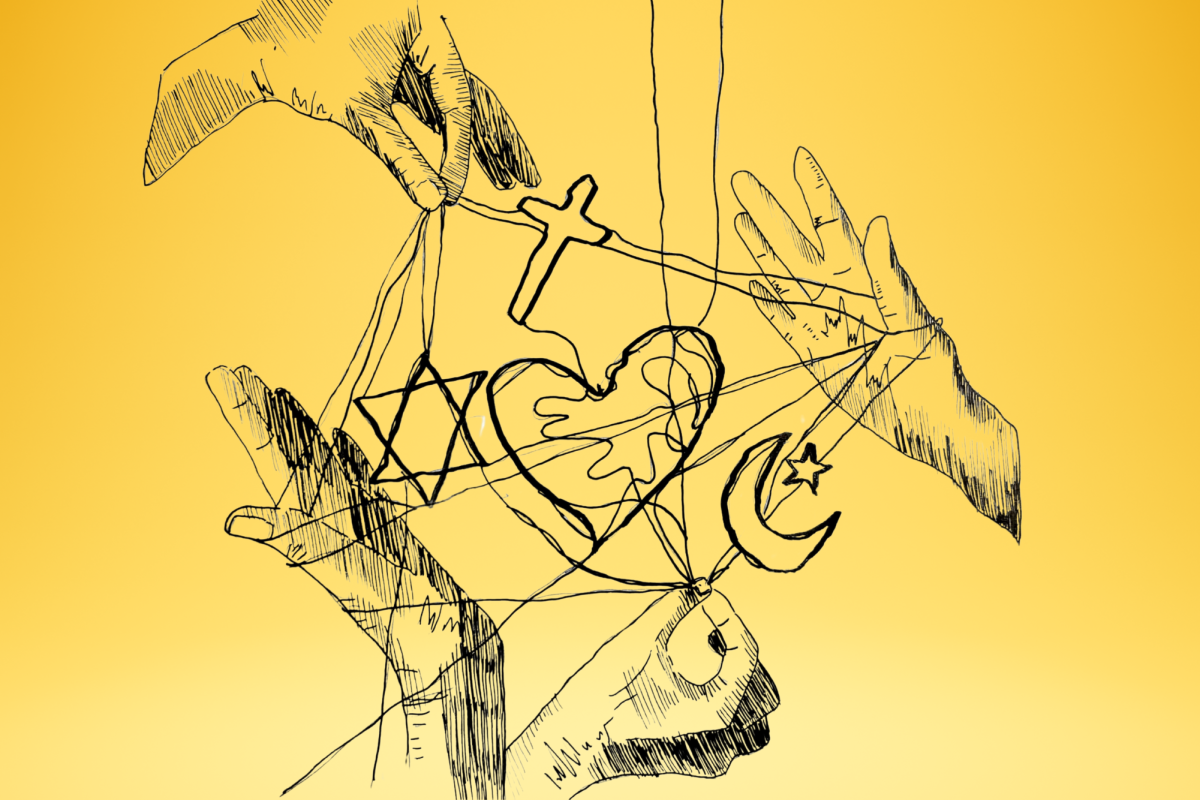
Political rhetoric is rooted in polarization. In America, religion is increasingly part of politicians’ favorite trick: creating an “us” and a “them.” We should recognize this strategy for what it is and not let political disagreement distance us from learning about or embracing other religions.
Politicians, especially the growing number of populist politicians, love to capitalize on “othering.” It encourages people to think they’re being attacked for different views and stirs emotions and action.
“Religion is a great way to get people fired up,” said Eric McDaniel, government professor and author of “The Everyday Crusade: Christian Nationalism in American Politics.” “One of the major problems is that when people do bring in religion, they use it as a trump card.”
This trump card promotes an authoritative speaker, rather than creating active discussion. Religion offers a fundamental moral backing and justification to issues and policies, especially in social politics, rather than broader institutional government, which intensifies the personal and emotional attack. On top of this, moderate religious leaders are ignored by the press, exacerbating the idea that religion is only for the extreme.
“There are a lot of voices out there within Christianity, but they have not been picked up on, and the press largely ignored them,” McDaniel said.
It’s a messy slope when religious beliefs lay the groundwork for deciding rights and policies. Everyone has a right to their own beliefs — as ensured by the First Amendment’s Establishment and Free Exercise clauses — but it doesn’t feel that way when other people’s beliefs fuel policies that limit your own.
“We’re in the midst of toxic politics where nobody sees humanity and the other group is easily painted as evil,” McDaniel said.
Charlie Kirk’s Turning Point USA exemplifies the dangers of online discourse fighting over the moral high ground. Heavily influenced by his Christian faith, Kirk’s controversial politics, such as his anti-abortion stance, encouraged division and led to inflammatory arguments rather than empathetic exchange.
“So many people (have) moral visions of how the world should work,” history professor Jennifer Graber said. “They don’t want to just order their world, they want to order the world, … and that means actually imposing upon others sometimes. … For a big swath of other Americans, it becomes very important to impose vision.”
This is the opposite of the interfaith engagement that should be encouraged in society. There are a lot of people talking online, but not a lot listening.
“(There are) online (communities), … and those are really different community dynamics, when you’re not actually in contact with other human beings,” Graber said.
The way forward is engaging in meaningful conversation that stems not from authoritative preaching, but from sharing. Preaching has room for single-faith communities. When it veers toward unwanted audiences, it risks taking a patronizing tone. The delivery should match the audience, and when the audience is diverse, open-minded collaboration should be the focus.
To counter these dangers, both McDaniel and Graber encourage students to go and talk to people. Don’t buy into the polarization. People are happy to speak about their religious beliefs and traditions.
“I actually really enjoy it,” said Samantha Rosen, speech, language and hearing sciences sophomore. “I would much rather someone ask a mildly offensive question than hold on to some weird belief (or misconception) about Jewish people or Judaism.”
After all, religion is about connection — whether that be with yourself, God or with a community.
Slimmon is a history junior from London, England.