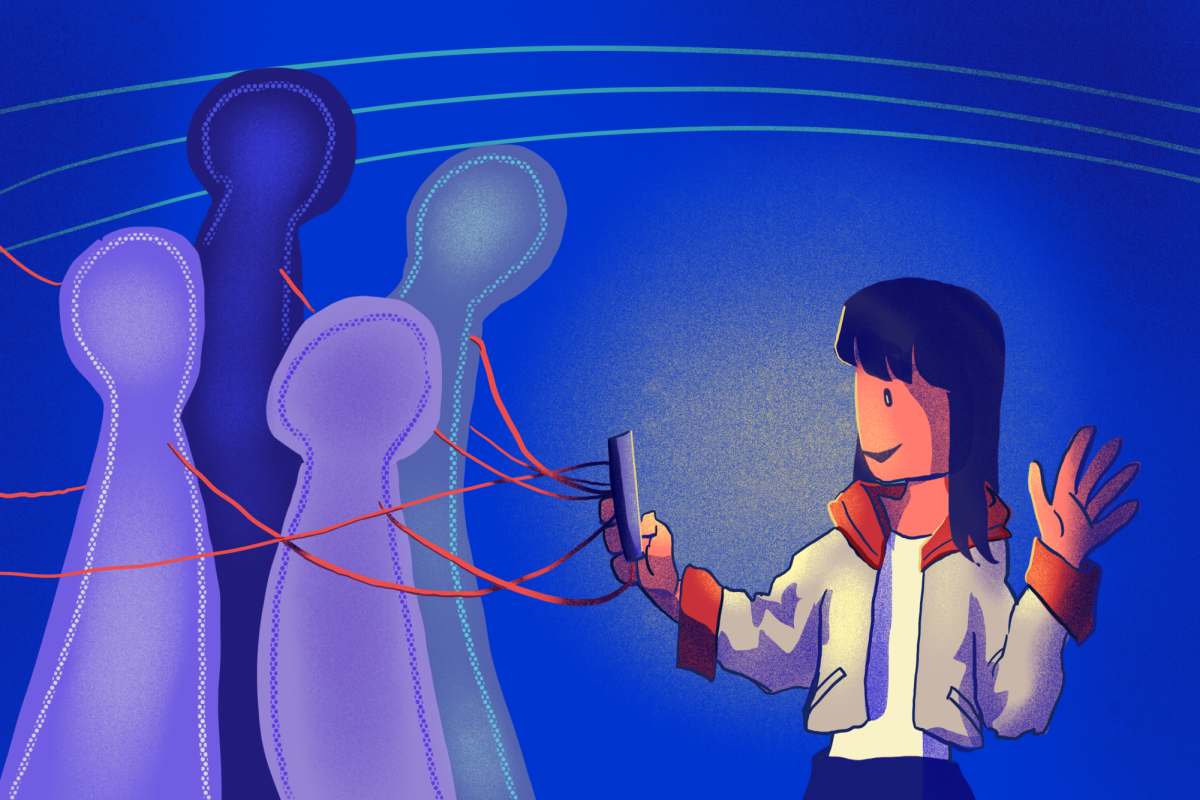
When pursuing romantic relationships, young adults tend to look towards social media as a way to meet new people. However, Snapchat and social media culture can foster unhealthy connections, as the apps’ designs are meant for spontaneity and temporary connections. When meeting people in person, it is easier to build a foundation of trust by facilitating new relationships face-to-face.
Functions on apps like Snapchat include disappearing messages after 24 hours, notification of screenshots and seeing when someone is looking at your messages. These temporal features make it easier for users to hide their interactions, which can allow for more discretionary relationships. Similarly, social media helps people interact with a drastically larger amount of people than ever before, letting users jump from conversation to conversation. Our interpersonal connections have less meaning than ever.
“I feel like Snapchat is so toxic because one of the reasons people are there is to meet new people, but you don’t make any genuine connections,” said business freshman Sayat Toleukadyr, who recently deleted Snapchat. “Everybody’s on a social media platform for a few reasons, and I think one of them is just to make very short-term relationships.”
Furthermore, there are dangers to social media when it comes to messaging private information. The temporary nature of these apps might give users the illusion of privacy, but sensitive information online can still easily be used against you. For example, external apps can override the function, so nothing can truly disappear on Snapchat. SnapSave was a popular app that would allow users to save every picture to their camera roll without the consent of the sender.
“A Snapchat picture of you doing (a) thing that you don’t want everyone to see disappears, (but) then somebody took a screenshot of it and is forwarding it to their friends,” said Anita Vangelisti, Interim Dean of Moody College and professor in the department of communication studies.
Moreover, meeting in person can let you observe someone’s behavior in real life. Physical presence allows you to gather cues that social media cannot replicate. Body language, tone of voice and the way someone carries themselves, which all contribute to someone’s personality, cannot be expressed through a screen.
“When people meet through their phone, it’s all just looks you’re basing it on. (There are the) pictures you see on their Instagram, (but) in an in-person interaction, you get to see their personality, how they’re walking, just how they bring themselves together,” said Evan Rama, a management sophomore and the creator of KUPID, an in-person dating show on campus.
While social media platforms can be fun and useful for initial introductions or conversations, relying on them exclusively for romantic connections can limit the potential for meaningful relationships. In-person interactions allow for a deeper, more authentic connection. They provide a chance to truly get to know someone — beyond filtered photos and text messages. So, while online connections can kickstart a relationship, there’s no substitute for the kind of connection you can only build when you’re physically present with someone.
It takes time and effort to put yourself out there, but building the self-confidence to reach out in person will lead to more genuine connections. Eventually, a successful relationship is built on in-person communication. So, before you spam your entire Quick-Add list on Snapchat, consider pursuing romantic relationships in person.
Xu is a government freshman from Fort Worth, Texas.