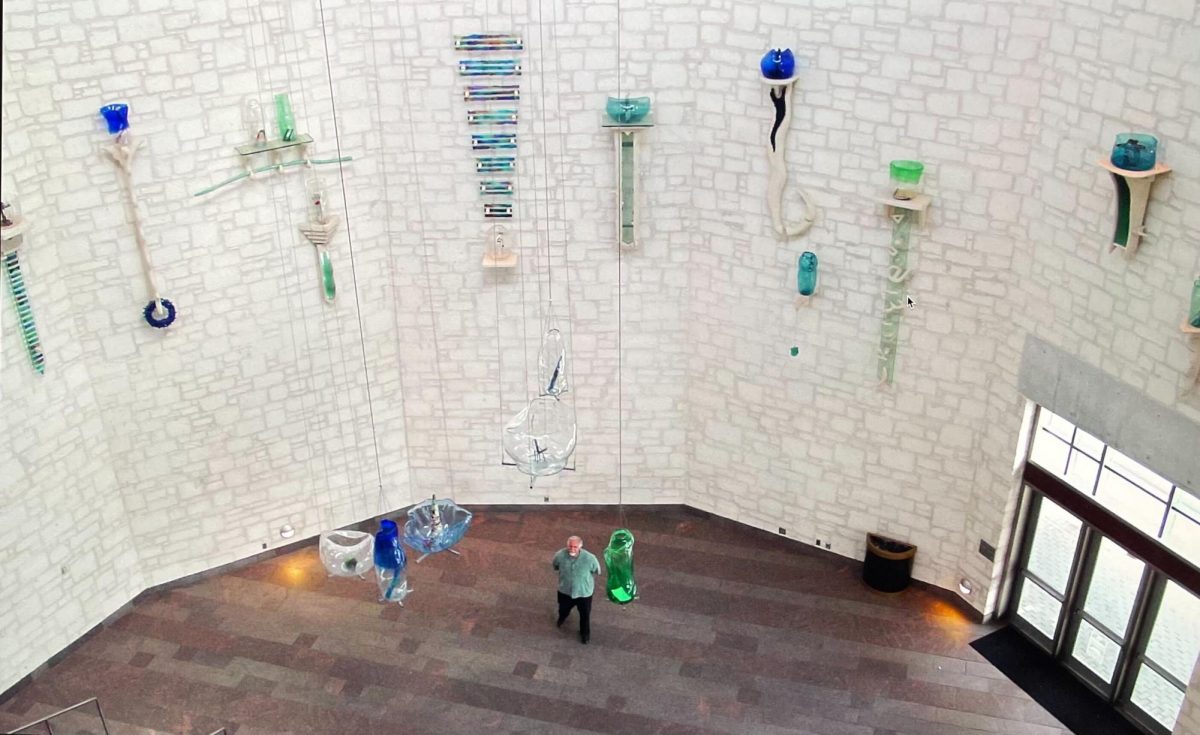
Thirty years ago, Paula Priour walked along Waller Creek with her husband, Damian, collecting debris along the creek for Damian’s commissioned sculpture for the Austin Convention Center. Now, Priour is pulling together $30,000 to save her deceased husband’s piece after it was named as one of four convention center large artworks deaccessed by the city’s new convention center project.
Local artists submitted competing proposals for mural and sculpture installations in the convention center in 1994 following the center’s 1992 completion. With the convention center being demolished and rebuilt starting in May, the new center’s project team chose which art pieces would be preserved for the new center and which would be deaccessed upon the Austin City Council’s approval.
In the council’s Jan. 30 meeting, the deaccession of the following pieces were approved, leaving the works’ fates in their artists’ hands: “Riffs and Rhythms” by UT studio art professor emeritus John Yancey, “Index for Contemplation” by UT studio art professor emerita Margo Sawyer, “Macro/Micro Culture” by Rolando Briseño and “Waller Creek Shelves” by UT alumnus Damian Priour.
“You’d think that in the budget for the millions of dollars they can spend to demolish the convention center, there would be enough money in there to be able to help take those pieces down, but we’re going to have to do that ourselves,” Priour said. “We would like to find some public place in Austin (to put them). … It really belongs to the public.”
Priour said her family came up with the funds to remove Damian’s sculptures within the two-week window the city is offering them in April to do so and that they have a barn to store it all in until they can find a new space.
“An artist’s wife always supports the artist,” Priour said.
Without financial support from the city, other artists have struggled to find solutions to the deaccession. After the month’s notice given by the city of the possibility of deaccession, Yancey said he does not have an estimated $7,000 for a preservationist to investigate if removing his 3 to 4-ton ceramic mural is a realistic possibility. Yancey said none of the three preservationist companies hired to look at the center’s artworks had ceramic mural expertise.
“If the city does the due diligence and has qualified preservationist conservations with expertise in mural and mosaic de-installation, and that person comes and says, ‘I don’t think this can happen,’ I’ll live with that,” Yancey said. “But the fact is, I know that it can happen, but it is expensive, and it’s complicated.”
Matthew Schmidt, the cultural arts division manager for the city, said because the majority of the funding the arts department uses is hotel occupancy taxes, state restrictions prevent the city from supporting the artists financially with the deaccession.
“Our economic development department (could) reevaluate some of those requirements and determine whether or not there is a commitment from our council … to identify additional fundings that could support artists in the future,” Schmidt said. “These (works) are cultural assets in our community.”