A team of researchers at UT developed a new artificial intelligence model that can assist in vaccine and drug discovery by predicting specific genetic sequences, according to a paper published July 25 in Nature. These sequences can produce vital proteins that trigger the body’s immune system.
The model, called RiboNN, was developed as a partnership with Sanofi, a multinational pharmaceutical and healthcare company. Can Cenik, co-researcher of the model and an associate professor of molecular biosciences, said that his research team began working on the model six years ago, but they did not plan to implement AI in the process. AI use only occurred in the past three years of the research, he said.
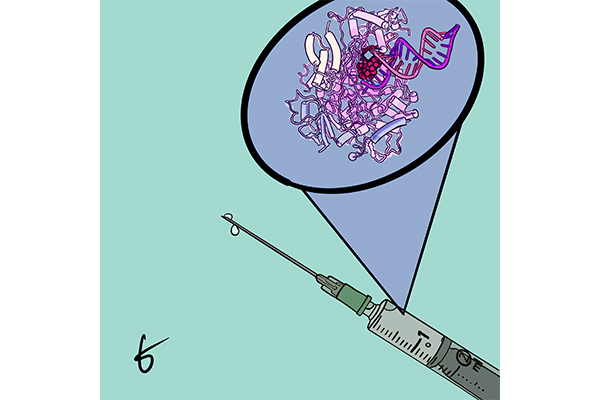
Cenik said translation is the process in which messenger RNA, or mRNA, is taken and converted into proteins. This process occurs in all cells and is essential for life, he said. It can also lead to the creation of mRNA vaccines, according to MedLinePlus.
The genetic code carried by mRNA can tell the body to create specific proteins that help fight an infection, according to MedLinePlus. Viruses have a distinct protein found on the outer edge of their cellular membranes. The code is sent into the body and produces the same protein found in the virus. The body’s immune system then responds to these foreign proteins by sending in specific antibodies to destroy and replicate them, which protects the body from further infection.
The model the team created can effectively predict the code for these specific mRNA sequences by accessing a data source created by the research lab, Cenik said. The data source contains the team’s research on mRNA production, which he said includes tests on human and mouse cell types. The model could lead researchers to expedite treatments for various cancer and infectious treatments, according to the news release. One potential use is to eventually assist in therapy treatments targeted toward particular cells.
Cenik said he does not feel that RiboNN is much of a departure from traditional ways of predicting mRNA sequences, as he previously used traditional computers or machine learning to perform this process.
“I have been doing machine learning, which is really using computers to make predictions about things — (for) 20 plus years,” Cenik said. “This is just the next generation of that.”
Cenik and his team made this tool publicly available for other research groups to use. He hopes others take advantage of it to advance findings in the scientific field.
“That’s always wonderful, when you see other people leveraging (your work) in many creative ways that you never imagined,” Cenik said. “That’s really where it has the biggest impact — when other people take it and use it in their research. That’s super satisfying for me.”