For the last decade of my life, I have written everything down.
When I was eleven years old, my parents gave me my first journal. There were no clear instructions attached other than to treat it with care, so I began to fill its empty pages with the endless murmur of my own thoughts.
I started off small with quick recaps of my day, but that changed as fast as the world around me did. Soon I was writing about more than my weekend plans with friends; I was documenting elections, headlines and protests. Without realizing it, I swapped my simple accounts for a living archive, a record of how it felt to grow up in a time defined by uncertainty.
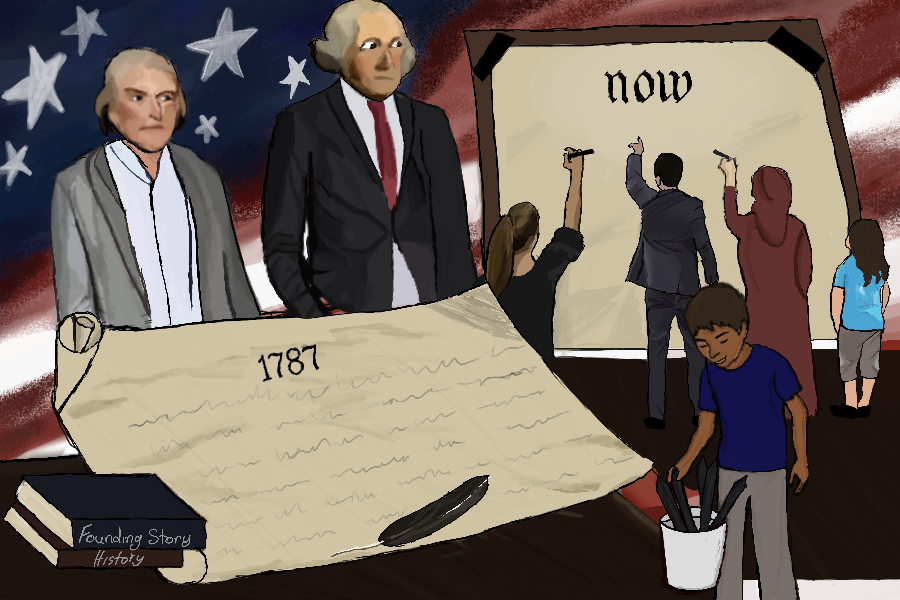
In moments defined by change and unpredictability, students should document the political and social upheavals shaping our lives with the intention of ensuring that personal accounts are preserved between the folds of history.
“When you’re living through big historical events, you don’t always understand that these are big historical events … (and) you don’t know you’re in the middle of (it) until afterwards,” said history professor Judith Coffin. “As it’s happening, you’re just existing as a person, trying to make sense of things.”
When shaping the context behind monumental events, historians rely on primary sources to provide direct and unfiltered accounts from specific periods in time. These sources are unique, created by eyewitnesses through journal entries, letters and photos, thus making them extremely valuable. These documents are essential when shaping history because they provide personal perspectives that could be later interpreted and woven into the textbooks we read.
However, primary sources aren’t just relics encased behind museum doors. They begin with ordinary people living through extraordinary change, and right now, that includes UT students. We aren’t just observing history from afar, we’re living it.
“It definitely does feel like we’ve been living through many historical moments, and it feels really weird,” radio-television-film senior Julianna Rios said.
On October 1st, 2025, the Trump administration sent out a compact to nine universities, one being UT. In this compact, universities were asked to make changes within their operations in exchange for preferred federal funding. And as of October 23, UT is the only university out of the original nine offered the compact that has not yet publicly stated its decision on the matter.
Whether UT signs or rejects the compact, the consequences can directly shape our speech and culture on campus. Recording students’ surroundings cements our legacies. From recounting a protest outside of the lecture hall to how peers reacted to the compact’s offer, each detail provides context for the larger picture. History will focus on administrations and their attempts to influence higher education but they can never encapsulate what it’s like to sit in a lecture hall, wondering how the final verdict will impact your student life at UT. That version of history can only be preserved by us.
If students don’t document what it’s like to live through these times of uncertainty, we risk our personal accounts being forgotten amongst the heaps of chaos. Documentation is more than reflection; it’s an act of resistance. Our experiences are those historians will search for to prove we mattered.
If our generation wants to be remembered as more than a line stuffed inside a textbook, we have to become our own primary sources. We must leave a trail of evidence that states just how much someone’s actions affect our community. History is being written with or without us, but it’s up to us to decide how we want to be included.
Huerta is a government junior from Victoria, Texas.