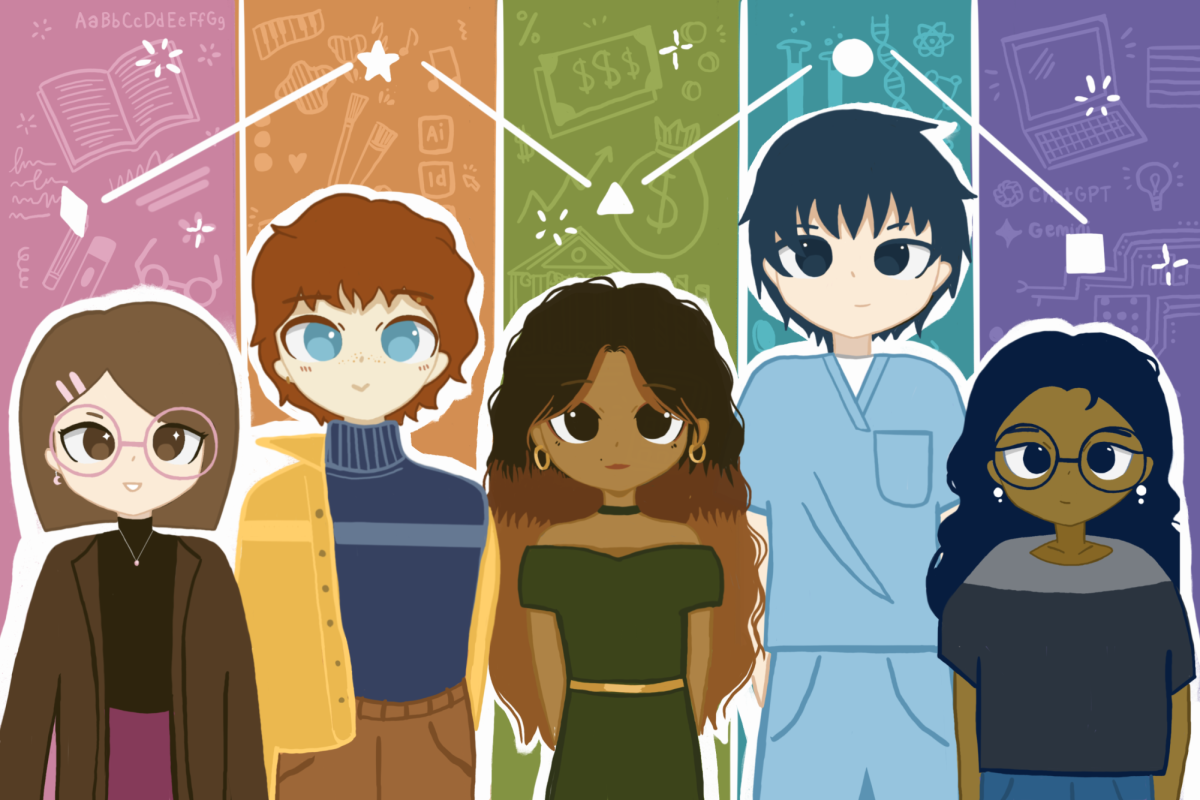
In this job market, everything seems to tie back to networking. Internships, research positions and job opportunities can be more accessible by having the pertinent connections. Most students focus on networking with individuals in or directly related to their major. However, the extended connections and unexpected opportunities that can come from networking outside your major should not be overlooked.
It’s not unusual for students to have interests outside their major, and some may even wish to pursue careers that branch outside their area of study. Engaging with diverse opportunities on campus can allow students to explore careers outside their major. Anthropology sophomore Bella-Imani Muniu has used resources at UT to explore her interest in the medical profession.
“I hadn’t found anyone who was pursuing medicine within anthropology like I was, so I took it upon myself to join different (organizations) that would help me nurture my passion for medicine,” Muniu said.
Muniu joined UT Global Medical Training (GMT) and the Black Health Professionals Organization (BHPO). GMT offers students practical healthcare experience through its volunteering events and clinics, which send students abroad to assist in Latin American countries.
Additionally, Muniu’s membership in BHPO has helped her establish valuable connections with medical professionals.
“I really like how they have a heavy emphasis on networking and finding doctors that you can shadow and mentor you,” Muniu said. “I got to meet a lot of really cool people and they gave us a lot of advice that, if I hadn’t joined the club or just looked outside of that scope of anthropology, I wouldn’t have learned all the things that I did.”
Despite Muniu’s ventures away from the field of anthropology, the knowledge she has built in her major has still been applicable to her medical pursuits.
“Anthropology is based on four pillars. It’s biology, culture, archaeology and linguistics,” Muniu said. “The culture and the biology have really helped me. … The foundation that anthropology offers me has really been helpful in applying what healthcare will mean to me in the future.”
This ability of a major’s utility to transcend professions is not unique to anthropology. Education in chemical engineering, or engineering as a whole, can be applied to a diverse set of industries.
“Many people have emphasized to me (that) they use their chemical engineering degree, not in a technical aspect moving forward. They use it to train themselves to think critically and to work hard. And that really helps in basically any field,” said Hannah Rodgers, UT’s President of the American Institute for Chemical Engineers and chemical engineering junior.
Rodgers continued, explaining how companies specifically seek out this engineering mindset.
“Recruiters who are recruiting for spots that aren’t necessarily technical chemical engineering say we want engineers because we know you can think critically, and you can problem solve,” Rodgers said.
Engineering is not the only major that provides students with transferable skills that can be used in other industries. Students should identify and take advantage of the skills they have developed, and be willing to scout out careers that may not traditionally connect to their major.
College life is often defined by one’s major, but this can often feel daunting as if one is supposed to decide their life career at 18. By networking beyond your circle, you can explore interests and find unforeseen career opportunities. Reworking your networking is key to exploring possibilities and knowing what you truly want to do.
Stark is a chemical engineering freshman from Orange County, California.