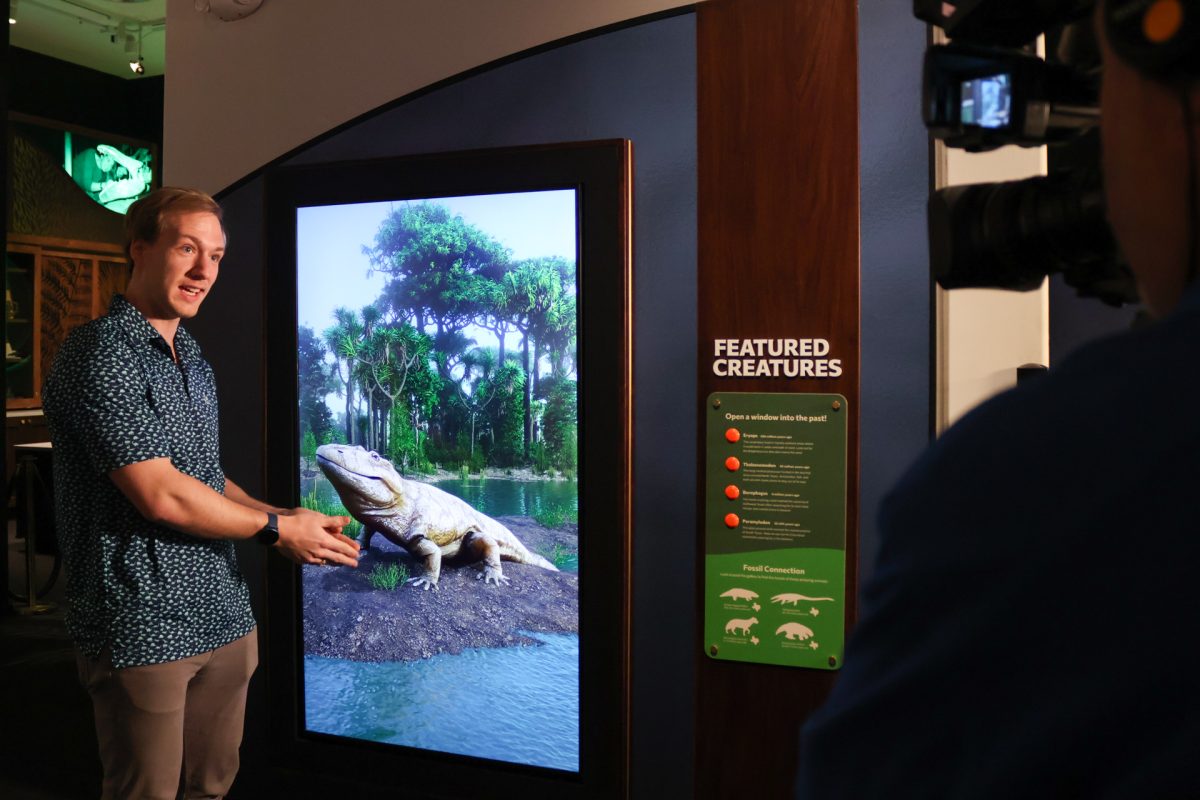
Tucked away on the bottom floor of the Texas Science and Natural History Museum on campus lies a newly updated paleontology exhibit exploring the prehistoric past of the state and stories of the organisms that lived here millions of years ago.
The exhibition, “Epic Encounters,” opened Jan. 28 with new elements aimed at engaging an audience of all ages. Pamela Owen, assistant director, and Liam Norris, exhibition and outreach associate, lead the renovations to the exhibit that began in 2023.
“It’s not just learning something new about the fossils, it’s actually experiencing them in this new setting,” Owen said. “I feel that our visitors will leave here with a better understanding of life in the past and a deeper connection with that. I think it really facilitates making connections with the living world.”
With the last update to the exhibit done in 2003, Norris and Owen said it proved important to ensure all of the information in the exhibit is up-to-date with the newest research available.
“I’m hopeful that students are going to recognize that we are a great resource beyond what is obviously academic,” Owen said. “As a community space and an opportunity for sharing and learning.”
Featuring new lighting, the updated exhibit reflects the natural environment of the fossils on the walls behind them.
“(We’re focusing) on telling small stories that paint a much bigger picture for each of these different environments,” Norris said. “Each of the different islands in there are based on distinct slices of time, and all of those pieces come together to tell the whole story of life in Texas over the last 300 million years.”
Original fossils make up 93% of the specimens on display. Managing director Carolyn Connerat said one her favorite parts of the exhibit is the Mosasaur that was found near the airport in South Austin.
“These are not just dinosaurs that were in Montana, South Dakota or in Europe, but they’re actually in Texas,” Connerat said. “Understanding the history helps us to understand our place in the world today, and as we look at the future and where we are going … (we’re) understanding the stories about the animals that were right here.”
To make the exhibition more interactive, Norris helped create a choose-your-own-adventure style game called “Texas, Long, Long Ago,” where players choose from five different dinosaurs to navigate through a day in their life. “Feature Creatures,” a section of the exhibit, showcases eight animals animated in their natural environment for visitors to view.
“We really wanted to get people into the headspace of these animals,” Norris said. “Because a big part of (the game) and ‘Feature Creatures,’ for me at least, was depicting these as animals and as individuals, not just as oddities that you see in a museum. I wanted them to be relatable to people.”
Admission to the museum is free for faculty, students and staff.
“I hope they get excited about dinosaurs,” Connerat said. “I also hope that they come away with a sense of wonder about life in Texas over time, going back to deep time ages ago, and realizing that where we walked has been here for millions of years.”