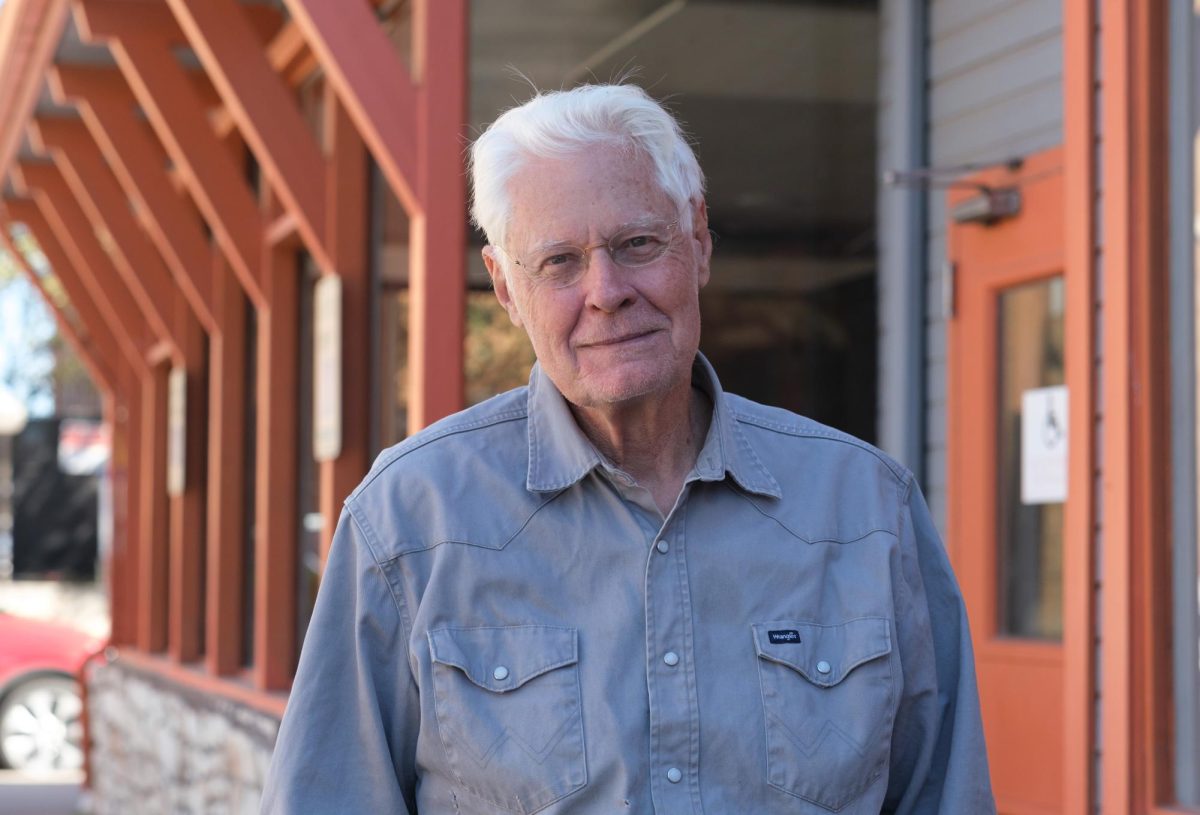
Five years ago, the entire Texas power grid came within roughly four minutes of complete collapse. Now, Charles J Petrie, Jr. (M.S. and Ph.D. in Computer Science, ‘91) explores what could have been in his new novel, “Dark Texas.” Ahead of the book’s release on Feb. 10th, The Daily Texan sat down with Petrie to discuss writing his first novel and the state of the Texas power grid.
The Daily Texan: In the novel, you describe (the story) as, “the plausible worst case scenario.” What was it about the (2021 winter) storm and the magnitude of the event that inspired you to write this story?
Charles J Petrie Jr: The magnitude of the storm was significant, but it was the magnitude of the frailty of the infrastructure that got me…Officially, we came within four minutes and 37 seconds of the entire ERCOT power grid collapsing. Unofficially, if you talk to some power engineers privately, you will find out we were probably closer than that to a complete collapse. So I looked at two things. One is, how frail was the infrastructure? How fast would it have recovered? And two, what would the consequences have been for the people of Texas? … The ERCOT grid served 26 million people, and after I looked into this and did a lot of research, just guessing, I think at least 10 million people would have died…Everything I looked at was worse than anyone could imagine, and it’s still there. Not much has changed.
DT: You also wrote in the acknowledgements that Dr. Ross Baldick (professor emeritus of
electrical engineering at UT) helped you out with the novel. Can you tell me more about the role that he played in helping you understand the mechanics?
CJP: He’s the one who really made me understand that it might have even been worse … This is not speculative. This is all real stuff. I’m not doing science fiction here.
DT: Did you face any challenges writing this, as (“Dark Texas” is) your first novel? Was there anything that you came across that surprised you?
CJP: Here’s the thing that surprised and continues to surprise me, because I’m writing the sequel, and it’s even more now… (it’s) how much the characters start writing the book, and how much I’m writing things without knowing why I’m writing them. And it doesn’t become clear why I wrote that until much later in the book. I’m writing conversations, like even now in the sequel, I’m typing, and I go, why did she say that?… It’s just amazing.
DT: What do you hope people will take away from “Dark Texas?”
CJP: What I would love is for this book to raise questions and for there to be a panel. I would love that UT hosts a panel of experts on the topic of, ‘Is Petrie’s scenario plausible, or is he just crazy? And if it is plausible, how have things improved? Could this happen again?’ I would love for a panel to talk about that …What people need to understand is we were riding on the knife edge of a catastrophe that would have been written about for the next 100 years, and I guarantee millions of millions of people would have died.