Next to UT students Ahmed Essawi and Jack Lasco’s apartment door in West Campus, a mix of running and biking shoes is sprawled across the floor. The washing machine, spinning with power, is filled with tri suits, Nike Dri-FIT shirts and Speedo swimming tights.
Rice cakes and carbohydrate gel wrappers are stagnant in the trash can after being consumed during a four and a half hour bike ride from the previous day.
Triathletes across the world aim to hear the four magical words “You are an IRONMAN.” Achieving this feat requires completing a 2.4-mile swim, a 112-mile bike ride and a 26.2-mile run in less than 17 hours. Lasco and Essawi yearned to hear the same phrase.
“Fitness has always been something that I’ve always been very interested in,” Essawi, a computer science junior from Houston, Texas, said. “I raced the (Austin) marathon, and kind of fell in love with (endurance sports).”
Lasco, an aerospace engineering junior from Houston, Texas, joined Essawi, his roommate and close friend throughout college. The two sought races that would push them to the limits mentally and physically. After deciding between either running an ultramarathon, a race where participants run anything longer than a marathon, or doing an IRONMAN, the two decided on the latter option.
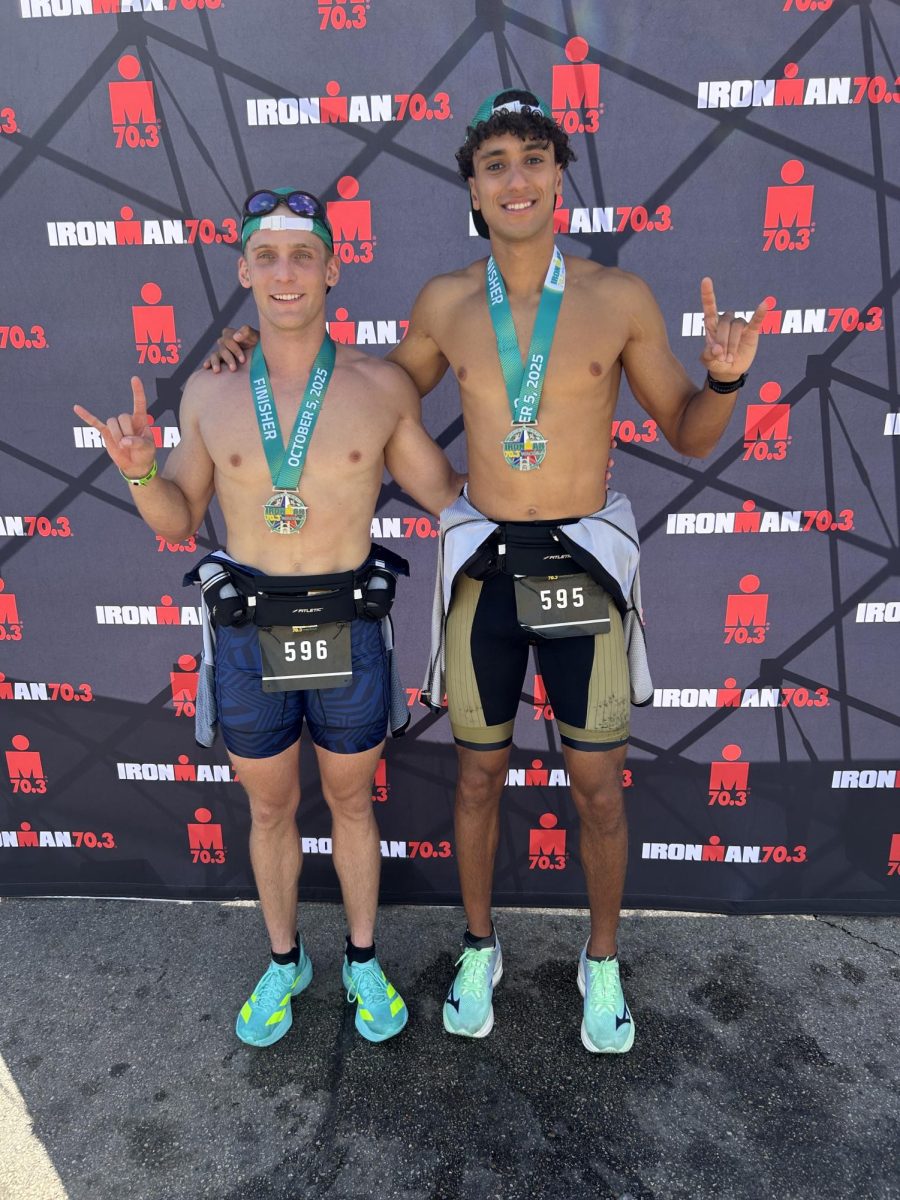
To prepare for the IRONMAN, they completed the 70.3 IRONMAN in Waco, Texas, this past October, where they swam 1.2 miles, biked 56 miles and ran 13.1 miles.
The best way to improve race time is by attempting a shorter distance triathlon, according to a 2021 study by eight professors from Brazil, Canada, Greece and Switzerland. The mean performance time should decrease approximately from 12:06:38 to 11:15:21.
With the IRONMAN requiring athletes to become proficient in three sports, it is no surprise to hear that both Essawi and Lasco are training an average of 18-20 hours each week for the intense environment.
“You kind of get used to being constantly fatigued,” Essawi said. “As long as you’re prioritizing getting your sleep in as much as you can and eating right it’s pretty manageable.”
When managing the difficulties of balancing training, social life and studying for academics, the athletes harped on time management.
“At the end of the day, you know, life is about sacrifice, so you’ve got to put your priorities in order,” Lasco said.
Taking the step to sign up for the race was a leap of faith for Essawi and Lasco, but it was a decision that ultimately proved to be a positive experience. Even through the hours of training and the constant 5 a.m. wakeups, the ability to push past their comfort zone has led them to have no regrets in signing up for the race.
“I think it very much is a life-changing choice, in a sense that you really do prove to yourself what you can do,” Essawi said.
Essawi and Lasco remark on the hardest part about the IRONMAN being signing up for the event itself, rather than the training. They advise those thinking about doing any sort of race to sign up and “get the ball rolling.”
Essawi and Lasco will put their training to the test in the Memorial Hermann IRONMAN Texas in The Woodlands, Texas, on April 18.