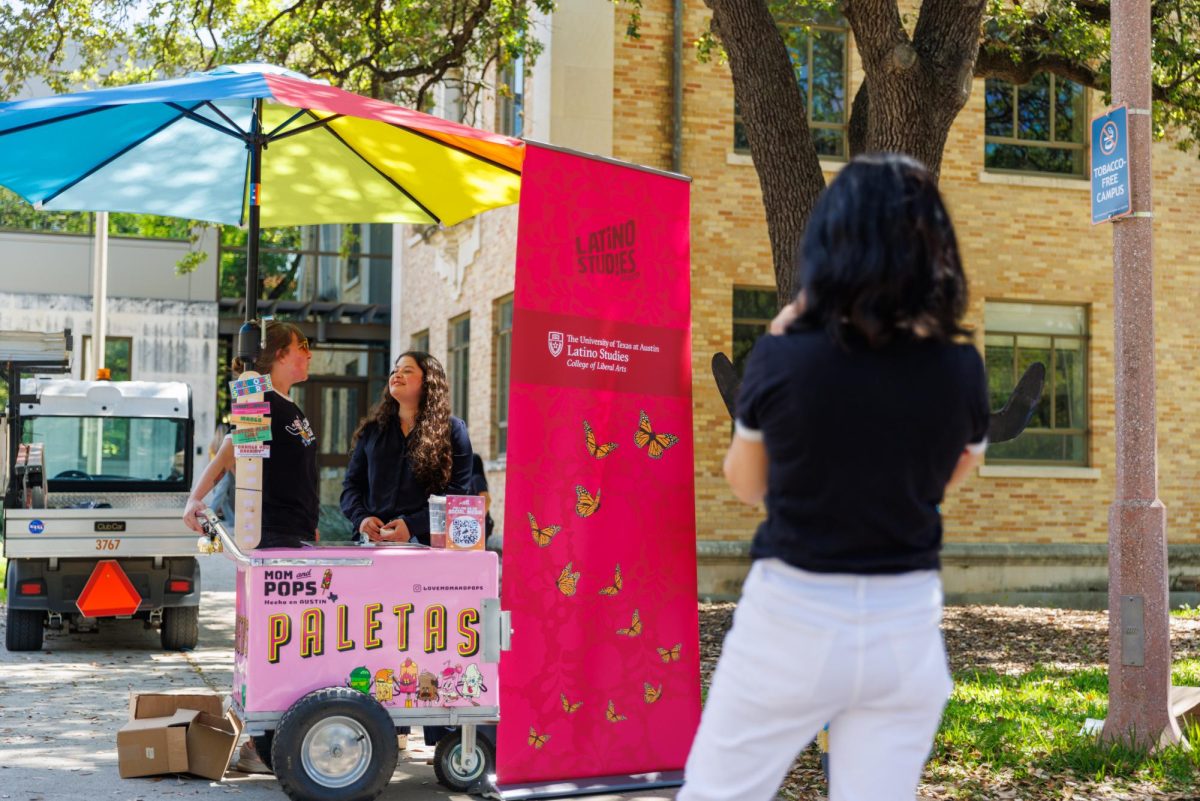
A pastel-pink paleta cart sat under the shade of a festive rainbow umbrella, greeting students at the corner of Whitis Avenue and 24th Street this Tuesday. As part of Liberal Arts Week, Latino Studies staff handed out free paletas, a traditional frozen Mexican dessert.
“We picked paletas because (they’re) something that reflects Latino culture,” said Monica Flores, Latino Studies’ communications program administrator. “We want to share a little bit of that culture with the people around us.”
Frankie Martinez and Kaitlyn Bicen, radio-television-film juniors from San Antonio, Texas, stood among many students looking to beat the heat. Bicen said that as a kid, she used to eat paletas made with natural fruit and water.
“There was always a paletero that would pass by my house, or the ice cream man that came with the truck,” Bicen said. “I would always get one.”
Martinez said the dessert also played an integral part in her childhood, often hearing the little bell of her local paleta cart.
“You always knew the paleta man that was around your corner,” Martinez said. “Sometimes, when we don’t have enough money to buy one, he’ll just let it slide, and we’ll repay him. … That paleta man was part of your community.”
For Martinez, paletas represent more than just a sweet treat, but also a symbol of community.
“Paletas are a sign of hard-working people,” Martinez said. “Latinos are known for being hard-working and doing everything they can to provide for their family, so paletas are a great way to show your Latino-ness.”
At the event, Bicen picked up a café con leche paleta, a flavor which she had never tried before, while Martinez opted for piña colada.
“My grandma really likes piña coladas,” Martinez said. “It reminds me of home.”
Beyond icy treats, the event featured tables advertising Latino Studies classes and the student group Cornerstone, which helps register people to vote.
“We’re a shining example of what liberal arts can offer someone,” Flores said.
Flores said when students take a course in the Latino Studies program, they often feel inclined to enroll in another one.
“It’s like a discovery for them,” Flores said. “(The classes are) rich, they apply to their lives, they open up their worldview a little bit. Students have shared that taking these courses (has) been life-changing for them.”
Martinez said events celebrating Mexican culture are important. She said the University’s diverse student population must support one another, especially in light of UT’s plan to consolidate Mexican American and Latina/o Studies with three other departments.
“In times of adversity, everyone needs to stand together and show that … we’re not all separate people,” Martinez said. “We’re a community.”