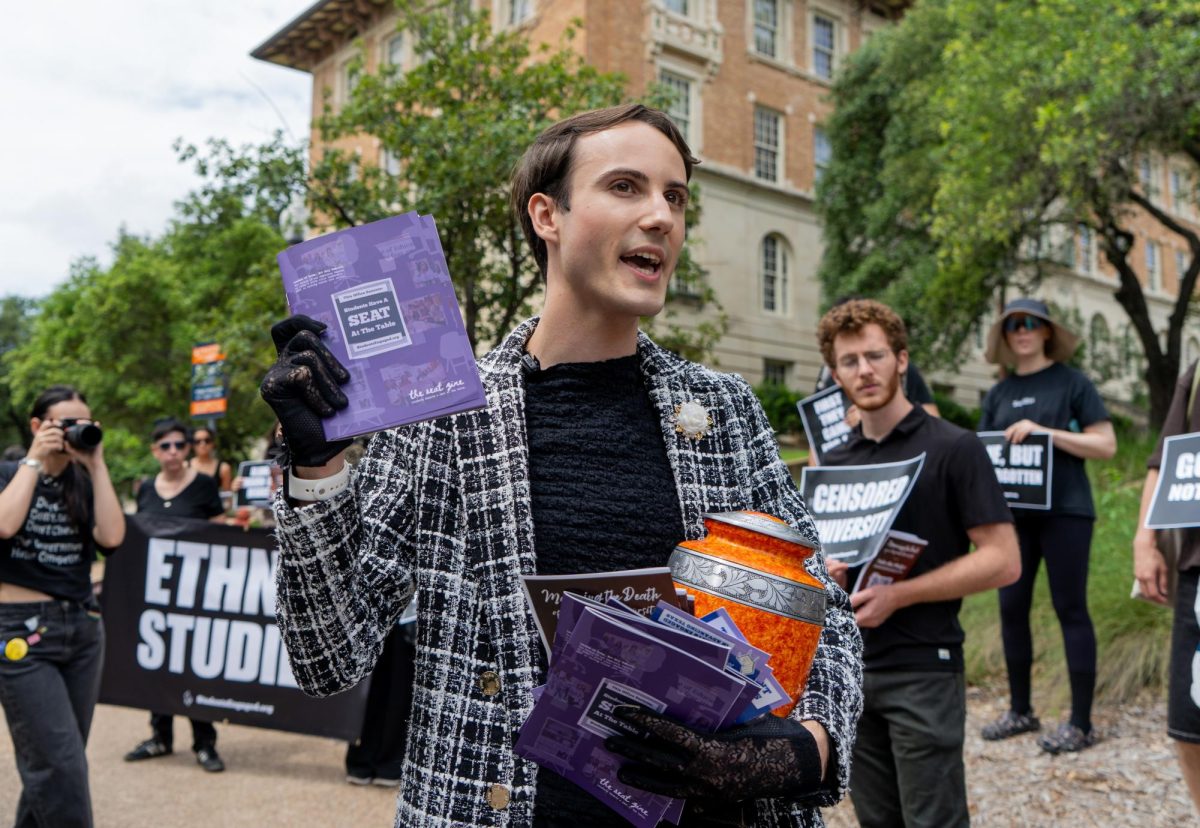
The College of Liberal Arts will consolidate seven ethnic and area studies programs, along with the Department of Women’s, Gender and Sexuality Studies, into two departments, according to an email from President Jim Davis sent to students, faculty and staff on Thursday.
Three departments — French and Italian, Germanic studies, and Slavic and Eurasian studies — will merge into a new Department of European and Eurasian Studies.
The University will also consolidate four other departments — the Department of African and African Diaspora Studies; the Department of American Studies; the Department of Mexican American and Latina/o Studies; and the Department of Women’s, Gender, and Sexuality Studies — into the Department of Social and Cultural Analysis.
What will change for students, faculty and staff?
Students currently enrolled in these programs will be able to continue their courses of study in the new structure, Davis wrote. Although some academic programs, like the Women’s and Gender Studies major, share a name with a department, removing a department is not the same as removing a major.
The University will review majors, minors and courses in these areas to determine what the new departments will offer, Davis wrote in the email. UT spokesperson Mike Rosen said there is no set timeline for when these new departments will begin operating.
The University does not need approval from UT Systems Board of Regents or the Texas Higher Education Coordinating Board to change department structure, Rosen wrote. However, UT “likely” requires approval from the THECB to change the focus or purpose of a degree, according to the THECB.
Rosen did not respond to questions about whether any faculty or staff will be laid off as a result of this restructuring. The two new departments would house 152 faculty members total, said Mary Neuburger, chair of the Department of Slavic and Eurasian Studies.
Karma Chávez, professor of Mexican American and Latina/o Studies, said placing multiple departments under one umbrella could reduce the amount of resources allocated to each department. Rather than having four separate chairs who could each request funding from the college, a new consolidated Department of Social and Cultural Analysis would have dozens of faculty all competing for the same funding channel, Chávez said.
“(With) 85 (professors) in a new department in four different areas, we’ll have to first negotiate among ourselves to figure out what our priorities are,” Chávez said. “Then, instead of us having four asks for four chairs, we’ll have one ask.”
Chávez said it is also unclear how private donations to the consolidated departments will be impacted. For instance, her department has two endowed chairs, an estate gift and other private endowments that are now in limbo.
Neuburger said it would be logistically difficult to house all the program benefits — such as study abroad opportunities, lectures and symposiums — these departments offer in one department.
Neuberger said consolidation will ultimately hurt students’ academic experience and that smaller departments like hers supplement larger programs, such as government or history, by offering more specialized education.
“If students in a major can study a region from every different disciplinary angle, they come out with a much deeper understanding of it, because each discipline asks different kinds of questions, looks at different periods of time,” Neuburger said.
Why is the University restructuring?
Davis wrote that the restructuring is meant to remedy “inconsistencies and fragmentation” across the College of Liberal Arts. The college contained 26 departments, 23 centers and 770 faculty members in fall 2025, according to UT data. The College of Natural Sciences, UT’s next largest college, had 12 departments and five other administrative units for 650 faculty members in fall 2025.
When asked why other smaller departments, such as the Classics Department, were not consolidated, a University spokesperson said it was an “outlier based on area of study.”
The consolidation aligns with University officials’ calls for changes in higher education. Broadening “narrow” degree programs in UT’s curriculum has been a priority for the administration, Davis said at his inauguration speech in October 2025.
“Many subjects worthy of research and teaching do not necessarily need to be isolated as their own small academic departments,” Davis wrote in the email. “Instead, these subjects can continue to be researched and taught in the broader context of other fields.”
The announcement comes after months of speculation among students and faculty that these programs would be cut or merged. In October, COLA created a faculty committee to develop new structural models for the college because it had become “overly fragmented,” Daniel Brinks, associate dean of the College of Liberal Arts, said.
Lauren Gutterman, an associate professor of American Studies who was on the committee, said the group was “loose” and an ineffective outlet for faculty to voice their concerns. She said the committee’s agendas were either “vague” or simply didn’t exist. Gutterman said the committee met four times, with its final one occurring at the end of fall 2025.
“The plan that Dan Brinks, associate dean, proposed at the end of those four meetings was not significantly different than the plan that he had proposed at the first meeting,” Gutterman said.
Many of the merged programs span back decades, with American studies first coming to UT in 1941. Although the Department of Women’s Gender and Sexuality Studies has only existed since 2023, UT has offered related courses since 1972.
“The department as it exists today is the result of … generations of labor, of intellectual and administrative labor on the part of scholars, staff and students,” Gutterman said. “It’s really sad to see the department that we have built being closed.”