Grade school feels like an eternity ago, but I can still hazily recall the various academic topics I studied that created a foundation of knowledge for future learning. But how often do we consider the effect of that distant educational foundation on our current beliefs?
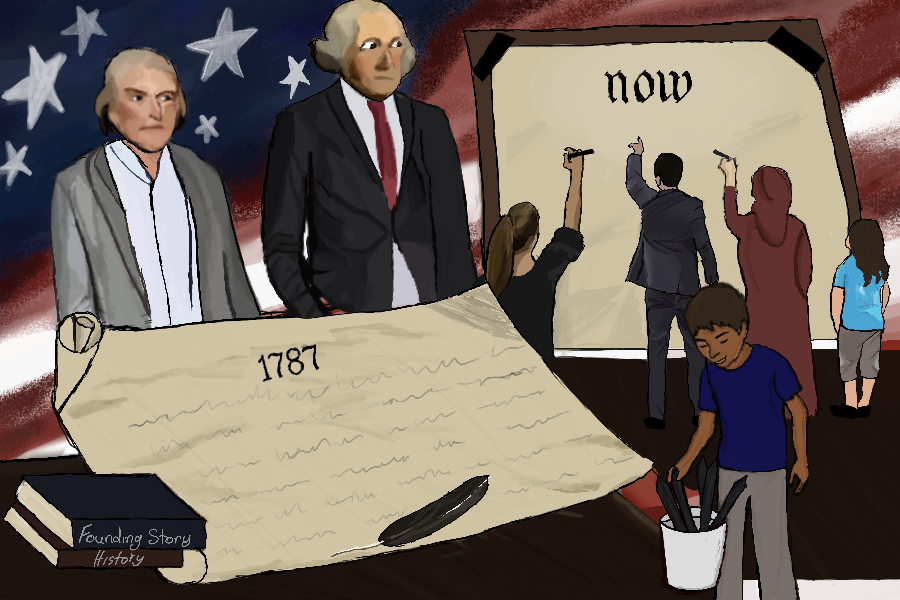
Levels of education can certainly affect political beliefs, but the quality of education in grade school can also affect our political and ideological beliefs, specifically through the history education we receive. History curriculum varies across the U.S., meaning that our fundamental conception of historical fact may have been ideologically infused with the politics of the state. In Texas specifically, recent bills such as Senate Bill 37 threaten the independence of education from political alterations, a concept that is particularly dangerous when applied to the subject of history.
Last year, the Texas State Board of Education changed the curriculum in social studies to focus more on U.S. and Texas history, at the expense of global history and cultural studies. This year set in motion a remodel of state social studies standards. Recently, the board assembled a panel of advisors to remodel the state social studies standards, but three-out-of-nine were associated with far-right activism, and only one is working in a Texas public school district.
“I have seen parts of the (rewritten) curriculum for public school education in the fourth and seventh grade social studies, and it’s worse than it is already. And that’s a result of these bills,” said Walter Buenger, history professor emeritus. “That is Orwellian, in the sense of ‘those who control the present control the past, and (those) who control the past control the future.’”
Texas public school teachers are also constrained by Texas Essential Knowledge and Skills, which dictate what content instructors must cover in order to prepare students for the end-of-year test.
“The biggest bias in Texas is that history is taught to be geared towards the STAAR test. That is not how historians or professors at the university level advocate for the teaching of history at all,” said Kara Alexandra Culp, history PhD student and former Texas high school teacher. “They advocate inquiry based learning, where you’re actually learning to critically analyze documents.”
Additionally, the University recently announced the consolidation of numerous departments within the College of Liberal Arts, which reeks of political influence on higher education, a product of SB 37.
“(The consolidation is) not necessarily erasing the past, but it’s certainly obscuring the voices,” Buenger said. “When history is politicized in the way that Orwell wrote about, it is to project onto the next generation an image that diversity doesn’t exist.”
Upon this realization of just how easily our education can become politically distorted, our responsibility to become aware of why we hold certain beliefs is vital in recognizing our own biases. Knowing this, Buenger explained what students need to practice when confronting politics and history.
“Another word I like besides nuance that I like is skepticism. Not (an) automatic rejection of something, but sort of thoughtful skepticism. … Show me the evidence that you’re not just simply reacting to the political climate of the time,” Buenger said.
When we confront topics this way, we hone the ability to question the source of information and the potentially partisan motivations behind them that we may have absorbed in the process. On a large scale, this awareness can lead to the preservation and continued education of accurate history; acknowledging the good and bad.
Thomas is a government freshman from Frisco, Texas.