When I was in elementary school, my teachers spoke to me about great men.
Men who worked tirelessly to create the opportunities that I have today, who built the very foundation where I learned to thrive. In my eyes, they did no wrong — great men don’t inflict pain on others.
It wasn’t until I allowed my curiosity to drive my education that I learned that history isn’t so black and white. My entire perspective changed when I discovered that our founding fathers, the very people who wrote the Declaration of Independence, were somehow capable of owning enslaved individuals. Despite their insistence that “all men are created equal,” they did not apply their philosophy to those working their land. When retelling history, people often exclude facts that cast leaders in a negative light out of fear of ruining their legacy, often enforcing a stigma that influential people are above accountability.
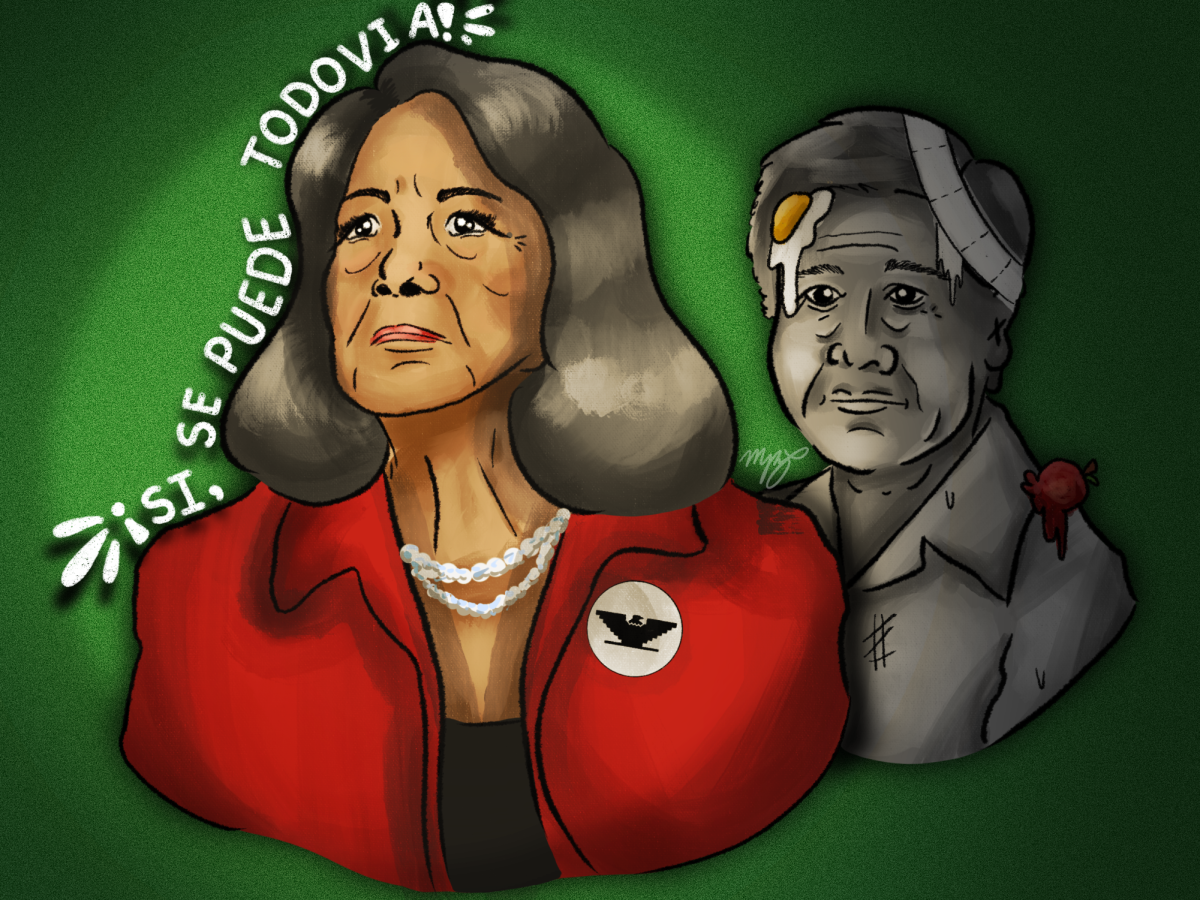
On March 18, 2026, an investigation by The New York Times exposed César Chávez as a groomer and sexual abuser. The Mexican American civil rights activist cultivated an image of a charismatic man, despite molesting and raping young girls.
“At school, they always taught me César Chávez was this huge, good person helping the Hispanic community,” psychology senior Ivette Flores said. “It was very shocking to see that women had these very harmful claims.”
Chávez, born in 1927 to a Mexican American family of migrant farm workers, experienced many hardships. He struggled with working long hours for little pay while enduring the poverty, discrimination and unsafe working conditions that many other Latino families and farmers experienced during that time.
In 1962, Chávez co-founded the United Farm Workers, alongside Dolores Huerta and Gilbert Padilla, to fight for the legal protection of farmworkers who were treated as disposable labor. Through nonviolent protests, Chávez was able to pressure growers into signing contracts that guaranteed better pay and safer worker conditions for farmworkers.
The movement demonstrated that even the most marginalized workers could elicit change, and deeply transformed people’s perception of the Mexican American community. Back then, Mexican Americans often felt invisible, but because of the farmers’ movement, workers came to view their labor as valuable and their voices worth hearing.
Despite Chávez’s contributions to furthering farmworkers and establishing the Mexican-American community as a reputable force, his character is far more complex. He was also a man who caused immeasurable harm to children, capable of securing unwavering rights while using his authority to coerce those under him.
The NYT investigation also included a disclosure from Dolores Huerta, who stated that Chávez raped and impregnated her. This was a secret she kept for 60 years to prevent damage to the farmworker movement — her life’s work.
Immediately after news broke out, marches to honor Chávez were called off. Multiple states said they would rename streets and schools named in his honor. Politicians such as Gov. Greg Abbott released a statement immediately following the article that Texas will no longer observe the César Chávez holiday.
Amid the cancellations and renaming of landmarks, this moment allows space for a greater conversation: how history is taught moving forward.
At UT, students should be taught the entire story. Simplified tales with heroic narratives leave students unprepared and ignorant of the complexity behind historic figures. Interpreting history means understanding that the truth exceeds preserving comfort. By equipping students to acknowledge both achievement and accountability, we do not erase impact; we actively create an environment that fosters critical thinking and open conversation on community impact.
“I think what it does is it draws attention to much larger social concerns, even outside of the Latino community,” said Rachel González-Martin, folklorist and associate professor of Mexican American and Latina/o Studies. “How we as a society value people (and) … understand the passes or social blind spots we have to people in power.”
History is littered with strategically made heroic tales creating narratives of people who demanded change. However, it is important to understand that the story is never black and white. People are complex beings and understanding that allows students to denounce ignorance and embrace transparency. Moving forward, UT should keep the history while expanding the narrative, allowing students to fully understand the tales before us, especially in light of the recent investigation on César Chávez.
Huerta is a government junior from Victoria, Texas.