The philosophy degree initially attracted me due to the lack of modernity in the study. It placed me in a new world, one distinctly prior to the world we actively engage with.
But it was never fully separate.
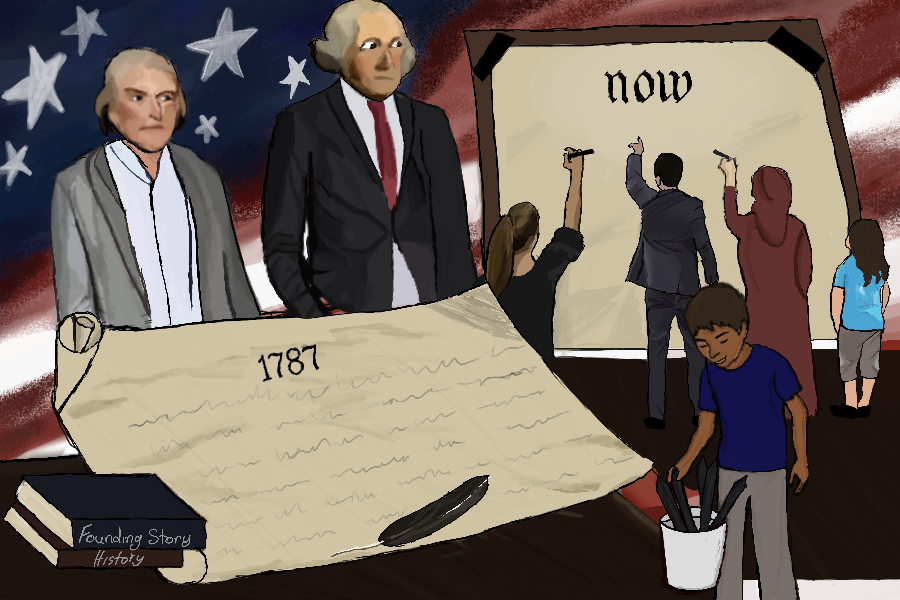
Many texts, from Hobbes, Kant, Fichte, Plato and so many others continue to shape how we think about ethics, morality, justice and democracy today. But as the criteria for civic education changes and the College of Liberal Arts undergoes restructuring, what an “ideal” humanities education looks like has become increasingly unclear.
A recent policy change at Texas A&M resulted in a course’s removal of certain Plato passages from its curriculum due to its mention of race and gender. Because the course wasn’t part of the core curriculum, it didn’t qualify for exemption and the passages were removed. At UT, with three history courses losing their status as core courses, it seems new policies around our curriculum in civic education have set more limitations than signs of additions or growth. In light of legislative and structural changes to civic education in Texas, students should find ways to prioritize their civic literacy, and take their education into their own hands.
Martin Peterson, A&M philosophy professor speaking in his capacity as an individual, spoke about his experience after facing administrative changes to his course.
“I have discussed sensitive moral issues for students for several decades now, and 12 years here at A&M and I’ve never experienced any difficulties doing that to them in a respectful manner,” Peterson said.
As a philosophy major, this change has been especially concerning to me. Philosophy rarely if ever provides easy, simple answers. Instead, the study teaches us to sit with the discomfort of ambiguity and question our own assumptions in light of challenging hypotheticals or alternate theories that question common modern dialogues. That is precisely what makes philosophy vulnerable in a political climate wary of dissent.
A&M might have a notably more conservative reputation than UT, but this issue is relevant on UT campus as well. Similar concerns are emerging on our own campus after three history courses saw drops in attendance after their core designations were removed. The decision concerned several faculty members, and history PhD candidate Kevin Gibbs contributed to the Texan with his perspective.
An anonymous history PhD candidate also commented on why this decision felt so concerning.
“When we talk about American history, there’s a main narrative with American history that has always been taught,” he said. “And I think these types of courses, like what my buddy was teaching, it gets in (a) very nuanced, important, diverse view of American history that allows students to learn many more things that are outside of this kind of allowed narrative.”
History and philosophy teach students how to evaluate authority, and understand how political narratives are constructed. With these disciplines losing institutional protection, students are left less prepared by their education to engage meaningfully with democracy. Civic literacy seems to be only sparingly built into our degree plans.
However, there are important steps students can take to support their own education and practice responsible citizenship by taking on the task of staying informed. Peterson discusses how he thinks students should go about this.
“You just have to figure out what it is that the university doesn’t want you to read, and then you can go and find it yourselves and read it,” said Peterson. “If it’s so sensitive that it has to be banned, it’s probably an interesting text.”
“Ask questions, get to have a desire to know and to interrogate things on a deep level, like, for example, watching the news. That’s what I have my students do,” the history PhD student said.
As students, taking conscious steps to stay informed about both current events and curriculum changes allows us to take our education into our own hands. Don’t let constant changes to the humanities, both in how they’re discussed and how they’re structured, divert your attention away from what really matters.
Tanya Narwekar is a philosophy and economics senior from Coppell, Texas.