After more than a year in office, UT President Jim Davis sat down with The Daily Texan on Thursday for his first interview with outside press.
In the 30-minute interview, Davis discussed the consolidation of ethnic and gender studies departments, artificial intelligence, a recent UT System Board Regents policy on how professors should approach controversial topics and more.
Find the full video of the interview here, along with the transcript.
Artificial intelligence
Davis discussed the need to prepare students for a workforce that includes AI and to extend AI that is helpful, functional and good. Davis, who graduated from UT with a bachelor’s of arts in history, also emphasized the need for “human intelligence” in conjunction with AI.
“What (employers are) looking for are people of curiosity who can be part of their company, people who have an ability to see ideas from different perspectives, and they locate a lot of that in the humanities,” Davis said. “While AI is arising and becoming a new thing in our world, the human intelligence is also rising, which makes me very happy as a (former) liberal arts student.”
In February, the UT System Board of Regents signed off on a new UT School of Computing, which will bring together the School of Information, the Department of Computer Science and the Department of Statistics and Data Sciences. In a University-wide email announcing the change, Davis wrote that the new school will improve students’ career paths in artificial intelligence, computer science and other related fields.
Federal funding
The beginning of President Donald Trump’s second term created an environment of uncertainty for federal research funding in colleges nationwide, following executive orders and grant cuts. Davis said UT’s federal funding increased over the last year, which was a “surprise for a lot of people.” The launch of the UT medical center will likely be the biggest driver of future federal funding, he said.
Davis also addressed the Trump administration’s “Compact for Academic Excellence in Higher Education,” sent to UT and eight other institutions in October 2025. The proposal would prioritize federal funding for universities that signed on in exchange for implementing certain policies. These policies included a 15% cap on international student enrollment, five-year tuition freezes, placing a stricter definition of “gender” and changing rules that “purposefully punish” conservative ideas.
Davis said the compact has not been on his “radar” since October because he did not perceive it as something to sign or reject, but rather to provide feedback on. He said he provided that feedback last year as he was asked, but did not continue to “negotiate” beyond that.
“There’s not a thing for me to sign,” Davis said. “There’s no place for me to put my orange pen on the bottom line. There wasn’t in October, there wasn’t in November and there’s not now.”
Consolidation of ethnic and gender studies departments
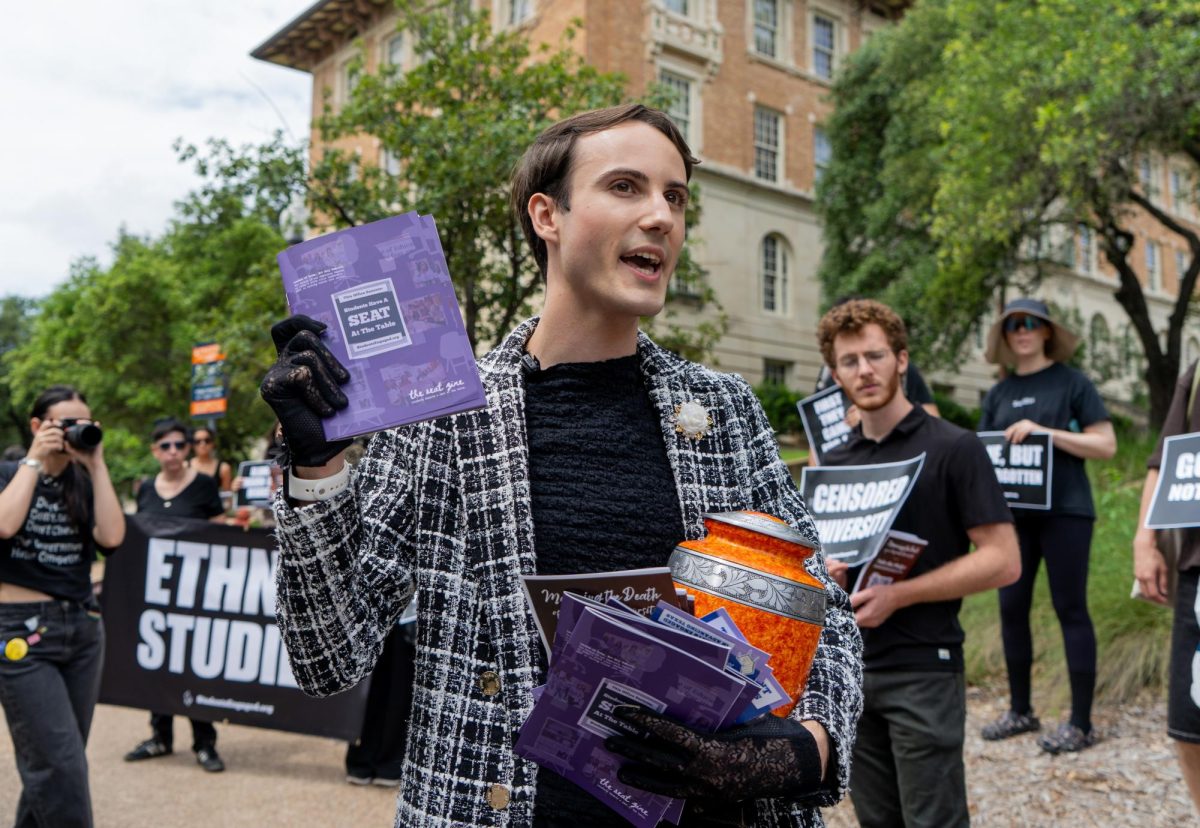
In February, Davis announced in a campus-wide email that seven ethnic, area and gender studies departments will merge into two new departments. The change will go into effect in fall 2026, according to an April 2 email from David Sosa, interim dean of the College of Liberal Arts.
The Department of European and Eurasian Studies will merge French and Italian, Germanic Studies, and Slavic and Eurasian Studies. The Department of Social and Cultural Analysis will combine American Studies, Mexican American and Latina/o Studies, African and African Diaspora Studies, and Women’s, Gender and Sexuality Studies.
The merger is meant to fix “inconsistencies and fragmentation” across the College of Liberal Arts, Davis wrote in his email.
Chairs of these departments have expressed concerns that the consolidation will result in a loss of funding and resources for their areas of study. Davis said he could not anticipate whether they will lose resources in the future, but no funding channels have changed as of now.
“Imagine this as being like a pie divided into five pieces, and then you put the pie together again,” Davis said. “There’s not a difference in the scale or scope or volume of that, and nothing has changed in terms of the funding streams going into that particular group.”
Faculty councils
In compliance with Texas Senate Bill 37, UT abolished its elected faculty council in August 2025. In its place, Davis announced a 60-member faculty advisory council and a smaller faculty advisory board in September 2025, the members of which are appointed.
A 2025 Daily Texan survey found that while only 4% of undergraduate faculty felt the old faculty council had an outsized impact on decision-making at UT, about 39% said it at least allowed for meaningful faculty input.
“The faculty council process, (from) my observation … didn’t invite a lot of candor,” Davis said. “It invited some discord, and sometimes, there were lots of expressions of feelings, but I didn’t observe a lot of coming together to (solve) our problems from that process.”
Davis said the new model is “not intended to be representative,” but rather “stewardship of the whole.” He pointed to working faculty groups on academic integrity and the core curriculum as success stories of this new model.
Housing affordability
Davis pointed to housing scholarships and the construction of new residence halls as ways to improve housing affordability both on campus and in West Campus. A new residence hall on Whitis Avenue is currently under construction, set to open fall 2027.
“Our method to influence (affordability), from an economics perspective, is to grow some supply,” Davis said. “So adding another net 800 beds in the fall of 2027 will be a positive step.”
Controversial topics
In February, the UT System Board of Regents approved a policy regulating controversial topics in classrooms. The policy mandates that professors do not “coerce” or “indoctrinate” students when addressing these topics.
When asked to specifically define the term “controversial,” Davis said it was a “work in progress,” but reiterated the language of policy, which defines it as “areas where people of good faith can hold differing convictions.”
When asked how this policy would be enforced, Davis said he is pulling together a group of faculty to address that question. In response to concerns about free speech, Davis also said faculty do not need to censor themselves in the classroom to adhere to this policy.
“Whether you say that’s controversial or not controversial is not really the test,” Davis said. “The real test is: are we offering a multitude of legitimate and obviously held opinions so that a student can bring her opinion to that classroom and be part of learning something important?”