Different events. Weather. The track itself.
Various factors play into the outdoor and indoor performances in track and field, and Texas athletes have to prepare as best they can to combat these variabilities.
Yet, graduate student Kelsey Daniel doesn’t see a difference in preparation from season to season. In fact, he really doesn’t see much difference beyond the physical boundaries.
“I mean, it’s the same preparation that goes in, all I can say that’s different is the facility,” Daniel said. “There’s no wind to affect you, so besides the wind, it’s basically the same.”
Even though indoor meets may prevent weather interferences, for senior Kody Blackwood, it prevents him from running his main event — the 400-meter hurdles.
In the NCAA, there are 11 men’s and women’s events from the outdoor season that are not in the indoor due to the difference in time results. Time is affected by the track’s texture and shape, which in turn affect the biomechanics of an athlete running that event.
“Outdoor times are going to be faster just because you’re not having to go around twice,” Blackwood said. “The indoor track is banked, and then the outdoor track (is) flat. So usually indoor times are slower than outdoor times.”
An indoor track is 200-meter and banked, meaning it has similar dimensions to a bowl, in addition to a slight upward tilt. The tilt decreases time, and studies show that there’s an average benefit for both men and women of roughly 1-2% in 200-800-meter competitions compared to an outdoor track, despite having to make a second round.
“It’s a big transition especially in the 400-meter,” Blackwood said. “Outdoor, you stay in your lane the whole time. And indoors, you have to think a lot more tactically, and the 400 is already a very tactical and strategic race. If you don’t get in front like you’re supposed to at the beginning of the race, it can be really hard to get back.”
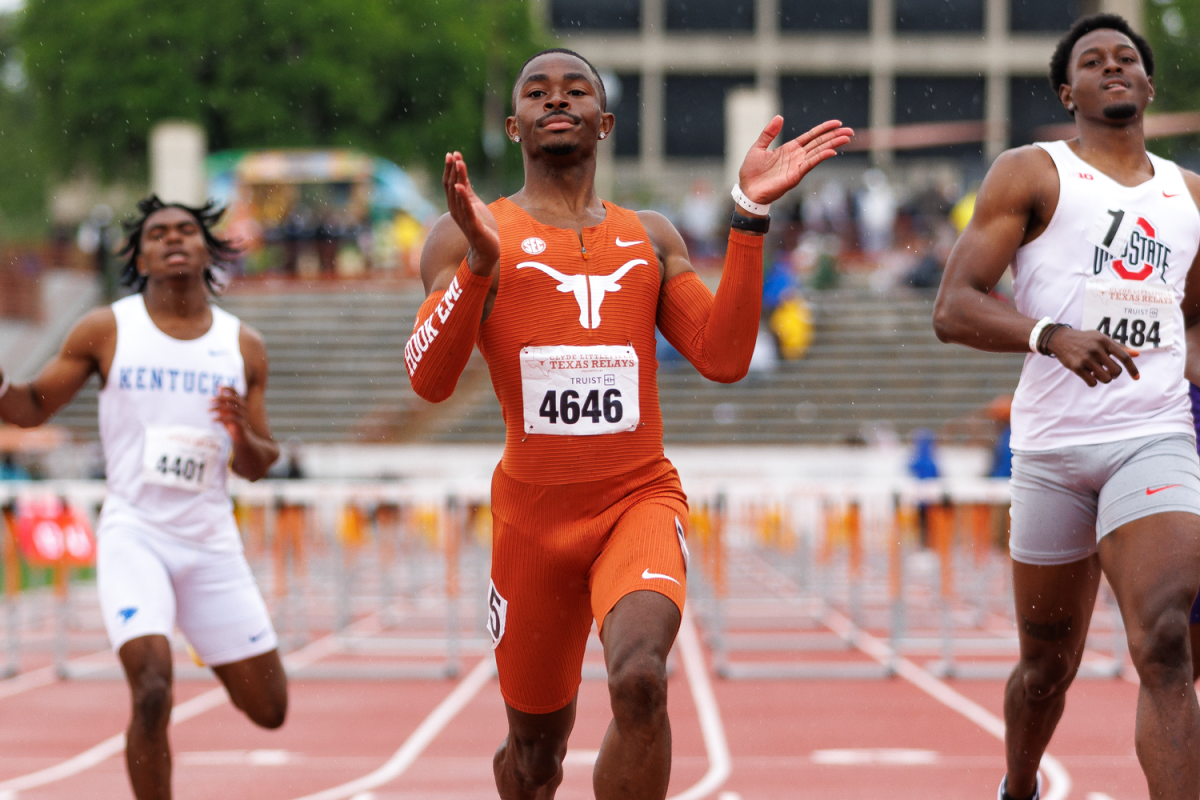
The differences aren’t strictly physical, and the mental preparation for transitioning between seasons can scrap hours of practice. Blackwood recalls having his 400-meter hurdle race affected by the outdoor weather at a Clyde Littlefield Texas Relays meet two years ago.
“Right before I got on the line, Coach Flo was like, ‘the wind’s blowing way too hard, you’re not gonna be able to make it,’” Blackwood said. “So I had to change my race plan on the spot. Today at practice, the wind was blowing a lot again and he was just like, ‘If that happens again, you’re going to do this race plan, and if the wind’s good, you’re going to do (that) race plan.’”
A race plan breaks down a specific race — detailing target split times, pacing and mental cues. Similar to a football playbook, track stars obey the plan and decide which “play” is best based on the environment.
“Everyone really knows, and myself, that outdoor is where I really shine,” said Blackwood. “Honestly, everyone kind of prefers outdoor, it’s like kind of a joke that no one really likes indoor that much.”
Daniel can agree on that, and appreciates the fan attendance for the outdoor competitions.
“Outdoor attracts a lot more fans, there’s a lot more events, it’s a lot more competitive outdoors than it is indoors,” Daniel said. “Especially for the NCAA, (in) Eugene, (Oregon), there’s a lot of people that come out to watch.”
The Texas Longhorns are just getting started with the outdoor season. With seven invitationals lined up for April and preliminaries throughout May, the ultimate goal is Eugene for the NCAA finals in the fresh Oregon air.