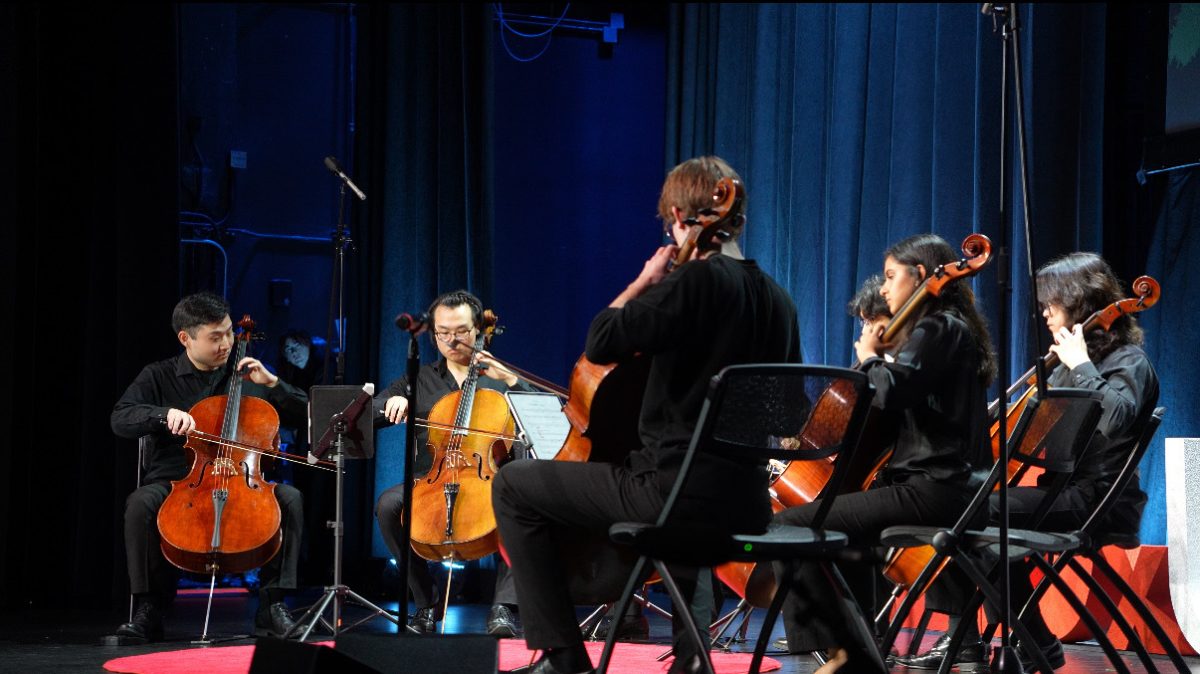
Often the site of suites and symphonies, Bates Recital Hall tends to bring in buttoned-up crowds. On Monday, UT Conjunto’s galloping accordions and Spanish-sung serenades made the Butler School of Music’s cavernous auditorium sound more like a South Texas dance hall in the 1960s.
Conjunto, a lively fusion of Mexican folk music and polka that peaked in popularity in the mid-20th century, emerged in the Rio Grande Valley when Central European immigrants made their way to Texas more than a century ago. UT’s conjunto program, established in the Butler School of Music in 2006, introduces students to the style through experience and immersion. Program director Susanna Nevarez, who joined UT this semester, said some of her students came into the program with minimal experience.
“I’ve taught them some songs,” said Nevarez, a lifelong conjunto accordionist. “Now they’re playing them on their own, and I don’t have to teach them. It’s kind of like seeing a little bird get its wings.”
The Nov. 10 show featured an 11-song program highlighting dance styles from around the world, including the Colombian cumbia and the Mexican huapango. JJ Barrera, an adjunct professor who helped found the program in 2006, said the wide range of styles he learned when he started playing conjunto made him a more adaptable musician.
“The best thing I ever did was when I started listening to conjunto music,” said Barrera, who started out playing in rock bands in the 1960s. “You got all these different beats that you can incorporate, even to rock and roll.”
Beyond instruction, UT Conjunto provides its students with community. Lead singer Emily Castillo-Espinoza, a third-year graduate student in Latino studies, joined in spring 2025, more than a year after moving to Texas from Illinois.
“There’s a sense of familiarity that comes with playing the music that we grew up listening to,” said Castillo-Espinoza, the daughter of two Mexican immigrants. “I feel very connected to my parents, even from Texas.”
Castillo-Espinoza said her parents introduced her to conjunto through artists like Flaco Jimenez, whose incorporation of country and rock elements worked alongside San Antonio’s annual conjunto festival to spread the style to international audiences.
“Conjunto music is for everybody,” Castillo-Espinoza said. “If you like the beat, you like the rhythm, you can go ahead and start dancing.”
Despite its universal appeal, Nevarez said Austin’s conjunto scene continues to fade. She said the city’s rapid expansion has driven a substantial portion of conjunto musicians out of the area, but hopes her efforts to promote conjunto through UT’s program spark the local community.
UT Conjunto plays again Dec. 5 at Central Market on North Lamar Boulevard in a performance featuring other ethnomusicology programs, including ensembles performing Caribbean and Middle-Eastern music. Castillo-Espinoza said more performances at other venues may be on the way.
“Conjunto music will not be erased,” Castillo-Espinoza said. “It won’t disappear. We are its practitioners.”