Content warning: This story contains discussion of pedophilia, sexual assault, harassment, rape and suicide.
A former UT Classics professor requested over $10,000 from Jeffrey Epstein’s charitable organization while teaching at the University, according to recently released documents from the Department of Justice.
Professor Thomas K. Hubbard requested the money for a conference held in April 2016 named “Theorizing Consent: Educational and Legal Perspectives on Campus Rape.” Hubbard said he received no money from the J. Epstein Virgin Islands Foundation. Attendance at the conference was required for students in Hubbard’s Mythology of Rape class, according to its syllabus.
Hubbard said the money from the foundation, requested in 2015, would fund the conference, allowing students to “interrogate the concept of sexual consent” in the wake of new Title IX policies from the U.S. Department of Education that Hubbard claimed were too damaging, according to the proposal. Hubbard said the point of the conference was “to demonstrate that any topic, no matter how sensitive, should be open to balanced scholarly inquiry.”
“(The enforcement of the policies have) prematurely terminated the careers of too many promising students who, because of the disciplinary expulsion, are unable to continue their education at any university,” Hubbard wrote to the foundation.
Hubbard taught at UT for nearly 33 years. His classes included Latin and Greek courses alongside classes about “Child and Adolescent Sexuality” and the “Mythology of Rape.” Hubbard was tenured in 1993 and left the University in 2021 after UT agreed to a $700,000 settlement with him. The agreement required that Hubbard drop lawsuits he had filed against UT students and retire immediately, according to the settlement document.
The request for funds, released late last month, was mailed by Hubbard just over seven years after Epstein pled guilty in 2008 to solicitation of prostitution with a minor, according to DOJ indictments.
“The Epstein Foundation had a long record of supporting various academic interests,” Hubbard told the Texan in an email statement. “I was not then and am not now aware of any evidence that Jeffrey Epstein was a ‘pedophile’ in the technical sense; his sexual preference appears to have been for young women aged 16-22, which would at most reflect partial ephebophilia. Although most of the women who were involved with him at that age retrospectively regret it, I am unaware of any evidence that the contacts were non-consensual at the time. Some were self-conscious sex workers who recruited others into his orbit and are now making cynical claims of victimization to cash in on his estate and business partners, as reported by Michael Tracey and other credible journalists.”
In 2019, Epstein was charged with sex trafficking of minors, according to the DOJ. He died by suicide one month after his arrest while in detention, leading a federal judge to dismiss those charges, according to NPR.
“Like over 1,000,000 Americans, he did have a conviction for a sex-related offense, but from what I could see in 2015, it was for something that would not even have been illegal in most European countries and resulted in a very short sentence,” Hubbard continued. “Given his own brush with the law, I believed his Foundation might have been interested in furthering critical discussion of the contours of consent and rape. They weren’t.”
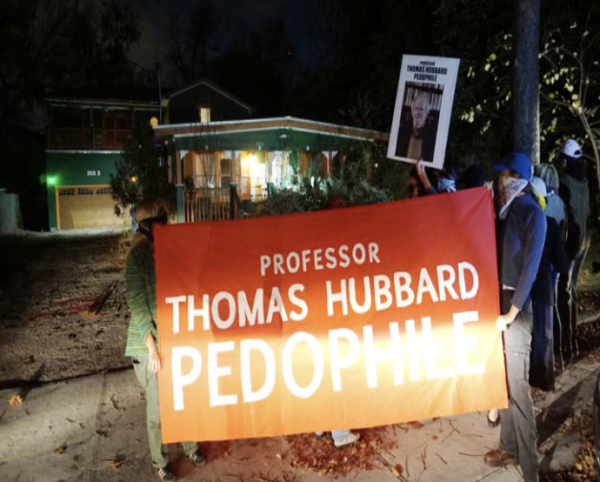
During Hubbard’s tenure at UT, some students held protests in opposition to Hubbard’s curriculum and course discussions that they said promoted pedophilia, according to court documents. A 2020 review of Hubbard’s course curriculum by three College of Liberal Arts professors found that Hubbard had not “exceeded the boundaries allowed by academic freedom.” However, they recommended that Hubbard undergo trauma-sensitivity training, according to the review.
Hubbard denied the student protesters’ claims in three lawsuits he filed against at least three UT students while employed as a professor.
He accused the students — Zoe Thomas, Sarah Blakemore and Hollie Green — and 10 unnamed individuals of libel, claiming they damaged his reputation as an academic, according to court records. Hubbard cited in the lawsuit a flyer that Blakemore distributed in one of his classes that described a planned rally calling for him to be fired. He also cited Twitter posts by Green that described Hubbard’s discussion of rape in classes.
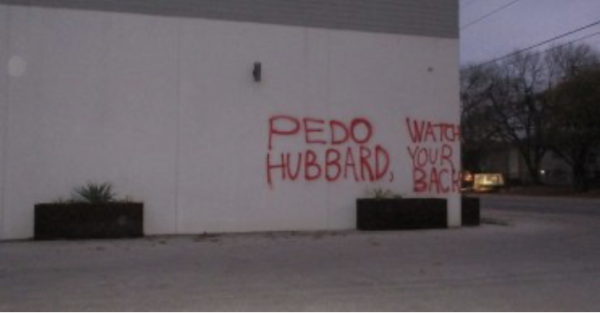
Hubbard’s house and neighborhood were vandalized by what he said were members of “Fire the Abusers” — which Hubbard identified as a student-led movement — including red spray paint that spelled “child rapist” and “watch your back,” according to court filings.
The three suits were dropped in July 2021 after Hubbard reached a $700,000 settlement with the University, in which he agreed to retire immediately and terminate all legal action against UT. The settlement also ended Hubbard’s libel lawsuits against students, including his case against Blakemore.
Thomas declined to comment “out of concern for professional retaliation.” Blakemore also declined to comment, and Green and her attorneys did not respond to requests for comment.
According to the agreement, Amanda Cochran-McCall, then UT’s Deputy VP for Legal Affairs and deputy general counsel, approved the settlement in 2021, working under Jim Davis, who led Legal Affairs for the University at the time. Davis is currently UT’s president, and Cochran-McCall is now UT’s Vice President for Legal Affairs.
In a sworn deposition, given under oath in May 2021, Blakemore said she had lunch with Davis and one of his deputies the same day as the distribution and texted Davis’ personal phone number to set up a meeting where she informed him of her actions, according to the deposition.
Davis told Blakemore the University “had had issues with Hubbard before” and told her “your rules of engagement are clearly helpful in getting your voices heard,” according to court documents.
Blakemore also had personal discussions with then-President Fenves, who later released a statement calling Hubbard’s writings “outrageous” and told Blakemore she “shouldn’t worry” about the lawsuit, according to court documents.
A University spokesperson declined requests to comment for this story.
In 2009, Randy Diehl, then-dean of the College of Liberal Arts, sent a letter following a meeting with Hubbard. Diehl reiterated department conduct standards and wrote that a student complaint alleged that Hubbard had met and confronted the student about a negative course instructor evaluation, according to the emails.
Hubbard was approached about the prospect of early retirement shortly after. He then requested a centennial professorship, which comes with an accompanying endowment used at the professor’s discretion, a $10,000 raise and a salary of $250,000 per year through 2012, at which point he would retire and drop existing legal claims against UT, according to the emails.
The emails show that Diehl denied those stipulations. Hubbard remained at UT for 12 more years. Hubbard received a centennial professorship in 2014 and said he used funds from that role to pay for the 2016 Theorizing Consent conference.
Diehl declined to comment for this story.
After the settlement with UT, Hubbard relocated to California, where he currently resides.
You can send tips about this story and other stories to Projects, the Texan’s investigative and long-form team, at [email protected].