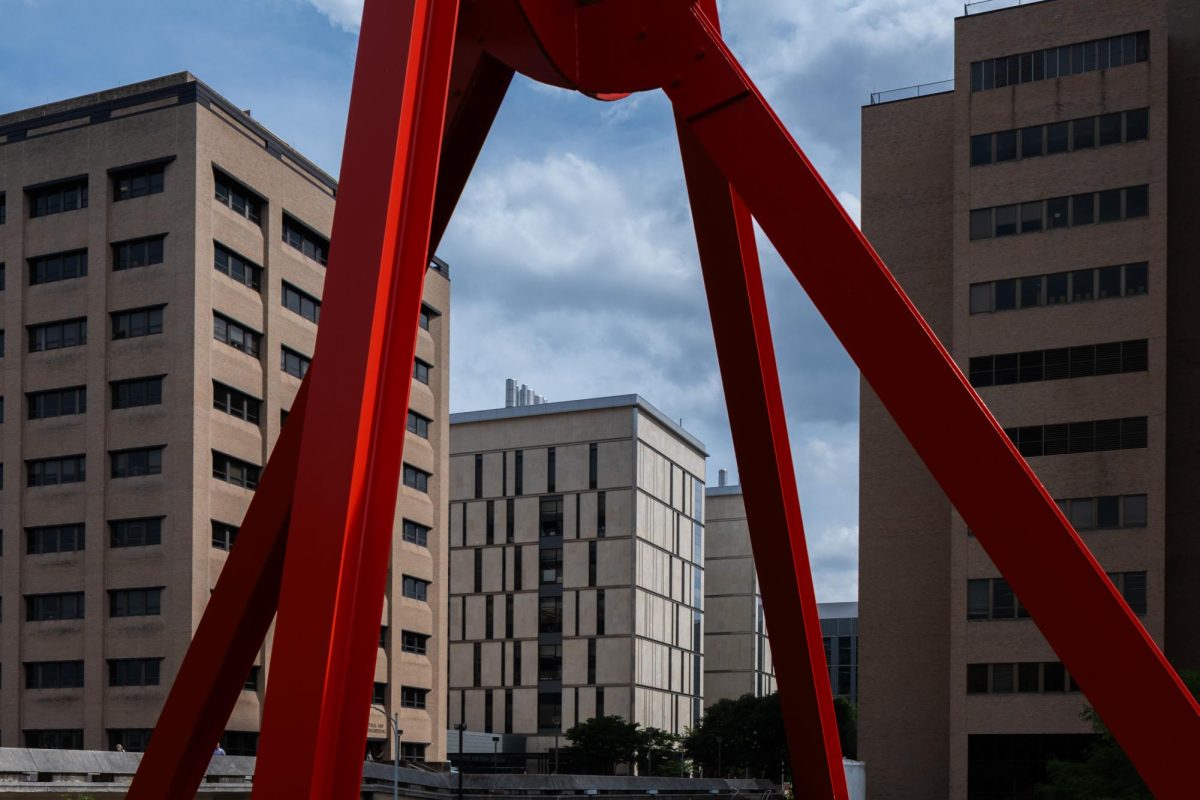
A large, rectangular block of limestone sits on the north side of campus, plain and heavy against Speedway. Students know the building as the Physics, Math and Astronomy building. But before 2020, the building was called something else.
When the building was first constructed in 1972, it was named after Robert Lee Moore, a former UT math professor. In 2020, the UT System Board of Regents voted to change it to the PMA due to Moore’s controversial views, namely his outspoken support for segregation.
A short stroll away, other names like Painter and Littlefield remain on UT buildings. These names, though printed on maps and syllabi for years, have been surrounded with controversy because of ties to their historical namesakes.
All naming decisions go through the UT System Board of Regents. During the University’s early days, the board named buildings based on the academic purposes they served, said Jim Nicar, a UT historian and author of the UT History Corner. The campus was filled with functional labels: a Main building, a chemistry building and a law building, Nicar said.
A functional name wasn’t intended for honorifics, meaning they didn’t require explanation or defense, Nicar said. In this “boring” naming era is one exception, he said: Brackenridge Hall, the first men’s dormitory on campus, long known as “B. Hall,” which was constructed in December 1890. The dormitory was named after its founder, regent George Brackenridge, who served nearly 26 years across several terms.
Brackenridge gave $17,000 to the University to build inexpensive housing for the “poor boys in the state,” Nicar said.
“The regents named it for Brackenridge, hoping that he might give some more money for a women’s dorm, which actually, he did,” Nicar said.
This set a precedent for the future of building naming on campus. By the 1920s, UT’s naming conventions shifted once again. Buildings began to carry names that honored the professors and notable alumni.
Garrison Hall is one example, Nicar said. The building was constructed in 1926 and named after George Garrison, who was a history professor and the first history department chair at UT.
Then came Gregory Gym in 1930, named after Thomas Gregory, an early UT graduate and regent. Nicar said Gregory started a $500,000 fundraising drive of alumni pledges called the Union Project that reshaped the center of campus in 1928. The stock market crash of 1929 left those who had pledged to the Union Project scrambling.
“There are other people who literally missed meals … to pay for their pledges,” Nicar said.
In the 2000s, the system shifted to its modern naming practices, primarily naming buildings after the University’s donors.
This change came to UT as part of a national shift. As public universities faced rising costs and state appropriations leveled off or declined completely, private money became essential to continue construction, Nicar said. Buildings like the Gates Dell Complex and the Blanton Museum emerged during this time.
While building names have shifted to reflect the names of major donors, there has also been a movement to rename many older buildings, like the PMA.
Rory Malek, a UT alumnus, was a former member of the Natural Sciences Council and was responsible for writing legislation for People for PMA, the organization that pushed for the building’s name to change.
“The PMA building was kind of a communal space,” Malek said.
Malek said some students were concerned that a building that shaped their daily routines carried the name of someone with a troubling legacy.
But other contested names have not followed PMA into neutrality.
The name Littlefield, for example, can be found on a cluster of landmarks across campus. A hall, fountain, cafe and mansion carry the legacy of George W. Littlefield, a former Confederate officer and an early donor who ardently supported the South, even after the conclusion of the Civil War.
Painter Hall’s name also remains contested. Dr. Carma Gorman, an associate professor of art and art history, said Painter’s name survives because of his controversial role as the defendant in Sweatt v. Painter (1950), a landmark case regarding the desegregation of UT.
The UT System has a rule that any building named after a UT staff member should occur at least five years after the individual’s death. The Board of Regents broke this rule in 1974 by naming the remodeled Physics building after Painter only a year after his death, Gorman said.
“In his role as UT’s president, Painter fought to maintain UT’s racially discriminatory admissions policies and its status as a segregated campus,” Gorman wrote in an email.
A walk from PMA to Painter Hall, to Littlefield Home, to the Blanton Museum traces the eras of UT’s naming history. UT’s naming story is an evolution of what a name is for: from function to institutional identity and lineage, to revenue, and a return to original names as controversy follows the problematic namesakes of the campus’s past.
“History is messy,” Nicar said.