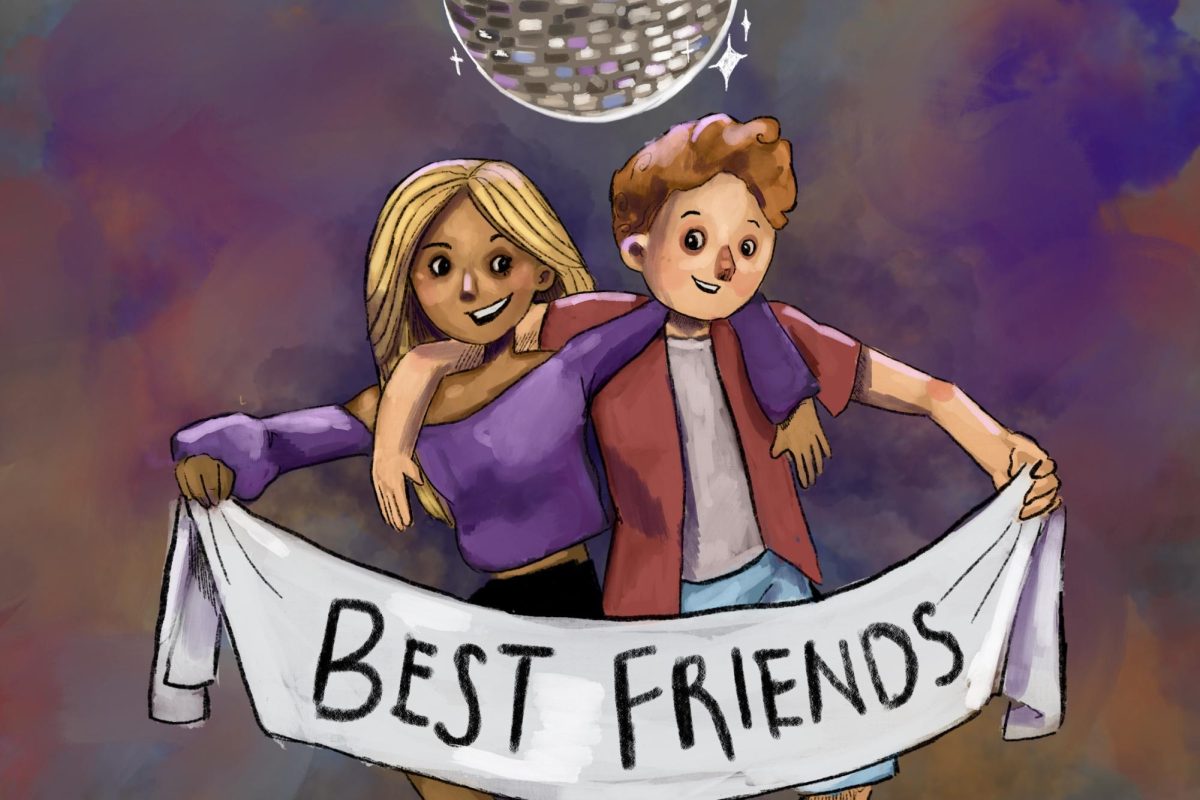
When I first watched Sex and the City, I was annoyed by the portrayal of Carrie Bradshaw’s friendship with her best Judy, Stanford Blatch. Carrie, a male-centered, shoe-obsessed, annoying blonde girl, and Stanford, her fashionable gay friend whose only purpose was comedic relief. My friendships with women often surpass the well-known caricature and become a safe place for us to be our truest selves.
If I could paint you a picture, it would be two fairies harvesting flowers or two unicorns lying down beside one another. These friendships between gay men and women often become fortresses of safety from all things patriarchal.
I was very close to my mother as a child, fascinated by her makeup, clothing and attitude. While we still share a great relationship, adulthood has placed distance between us. I fled the coop, as one does. Since then, I find many of my girl friends have voluntarily picked up the torch, becoming a sort of guardian angel for me, guiding me throughout the many horrible decisions I’ve made during my time in college. I love them deeply for that.
“You know, it’s a way of constructing some solidarity between people with disadvantages in (a) patriarchal society,” said Héctor Domínguez-Ruvalcaba, professor in the College of Liberal Arts with expertise in queer studies. “Since you enter school … you are seeing this patriarchal structure functioning in the classroom.”
Dominguez highlights how, as children, we become part of a structured utopia in the eyes of the patriarchy: where boys wear blue and girls pink, where it would be a shame if poor little Tommy was caught playing Barbies. Gay men and women are marginalized in a world full of gender constructs, and both face exclusion that transforms into empathy for one another.
“I think I’m a lot more comfortable with my female friends than male friends,” said Jesus Menchaca, psychology and linguistics sophomore. “It might have just been because I was singularly raised by my mom.”
Menchaca is able to offer us a view of the comfort these connections bring. Like Menchaca, my mother was the more prominent parental role during my development, and it seems that once us rainbow-feathered chickadees leave the nest, we find women, not to replace our mothers, but to provide that safe feeling of femininity.
And it seems the feeling is mutual.
“I’ve never felt safe with straight men,” said Caressa San Miguel, psychology sophomore. “With (gay men), I feel completely safe with them to be myself, (and) I know they’re not going to try anything with me either.”
San Miguel explains the difference in comfort level when it comes to men and raises the concern that straight men are only nice to women because they want to sleep with them. I find myself often being that barrier when I go out with my girl friends, finding myself pretending to be their boyfriend or simply telling a guy to back off, and I have no problem with that.
“Society has a lot of education (on) gender,” said Dominguez. “Still, there is this tendency of structuring society in a heterosexual way.”
I find that my friendships with women are often challenged by our common enemy: the patriarchy. However, when they are nurtured in a space of support, like a gender-neutral restroom at a gay club, where we can share those moments together, they surpass a level of being transactional and become sanctuaries.
They become a space where femininity is celebrated and being recognized is a given.
Espinoza is a rhetoric and writing and journalism junior from Laredo, Texas.