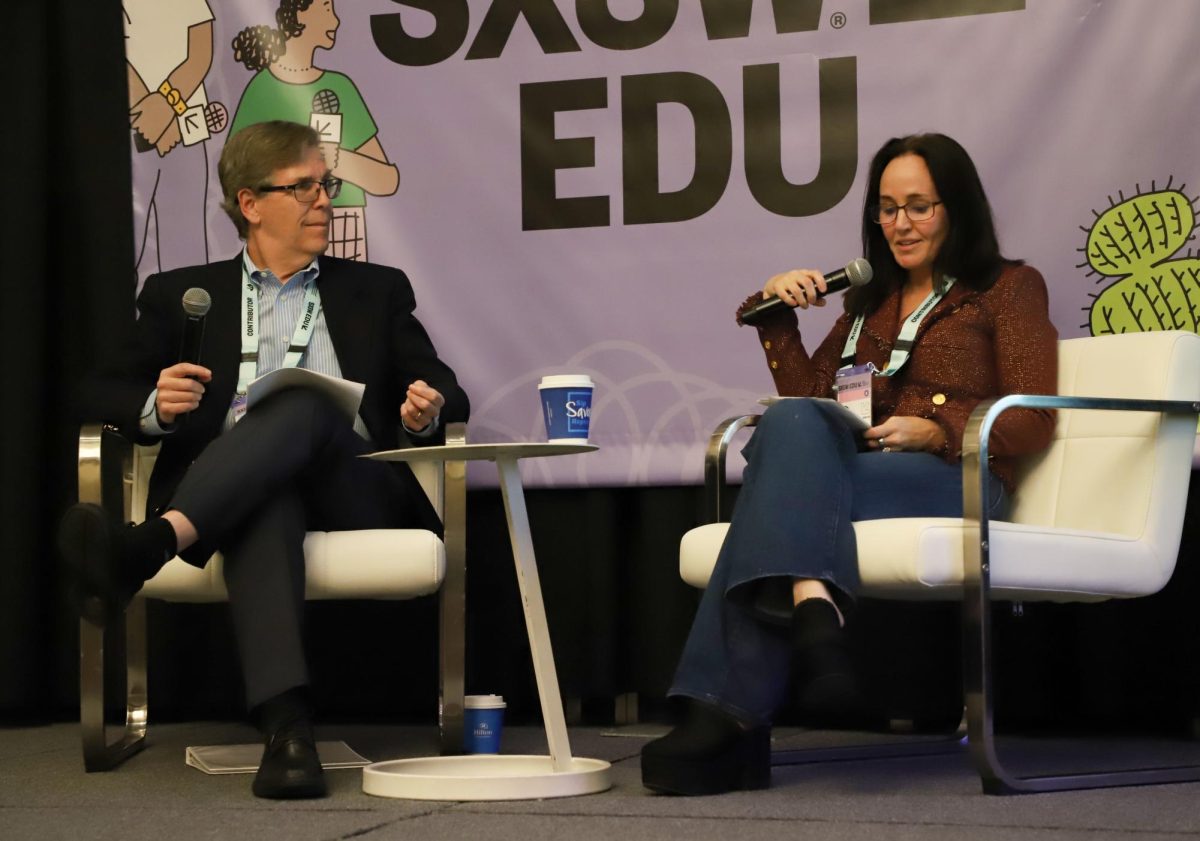
Dana Suskind, pediatric cochlear implant surgeon and early childhood researcher, spoke at SXSW EDU on Monday in a conversation titled, “Born to Be Wired: 4 Rules for AI in Early Childhood.” Interviewed by education specialist Michael H. Levine, Suskind opened the conversation by describing how the rapid incorporation of artificial intelligence into daily life will turn human relationships into a luxury experience.
“Today, we assume that all children are human-raised,” Suskind said. “But as AI moves into the nursery, into homes, into the classroom and playroom, the assumption may not hold for long.”
Suskind laid out a framework for promoting human interaction in childrens’ lives, pulled from her upcoming book, “Human Raised: Nurturing Connection, Curiosity, & Lifelong Learning in the Age of AI.” The framework starts with “human connection,” which AI can now easily resemble.
“We have technology that can mimic the nurtured human interaction that only humans could provide in the past,” Suskind said. “Children don’t learn from screens. It doesn’t open up the social gate. But now, these technologies, literally, they (have) found the key to the social gate.”
Another part of the framework concerns “owning imperfections.” Suskind said that while parents may want to replicate the perfection and agreeability of AI technology, in reality, their small mistakes and lapses in judgment prove crucial for child growth.
“There’s something incredibly seductive about these AI companions that are always agreeable,” Suskind said. “But the truth of the matter is, humans are glitchy and they’re imperfect. If our children learn from perfection, I’m not sure what that means for us as a human species in the future.”
Levine seconded the harm from how agreeable AI technology seems, such as how ChatGPT and other chatbots often give highly positive, complimentary responses to users.
“(AI) doesn’t disagree with me,” Levine added. “Disagreeing does not have to be disagreeable, and in fact, it does build civic muscle.”
Both speakers agreed that AI could become a source of social inequity. When new forms of technology emerged in the past, Suskind said only wealthier families would have access to them. However, as AI becomes more ubiquitous, wealthier parents are starting to raise their children away from technology, while lower-income families are forced to rely on it.
“My concern is that these human-interaction-rich childhoods will become one of those with privilege and everyone else will get the inexpensive substitute,” Suskind said. “Rather than technologists working to alleviate so many of the burdens that parents and caregivers are experiencing, so that (they) can be present.”
As the conversation shifted to an audience talkback segment, Charlotte Guinn, a daycare owner from California, thanked the speakers for highlighting the need for a strong foundation in a child’s formative years.
“I always say, ‘Oh, I am not an early childhood educator,’” Guinn said. “I am a brain developer. … The house will fall without (the) foundation, but you guys put the icing on the cake.”