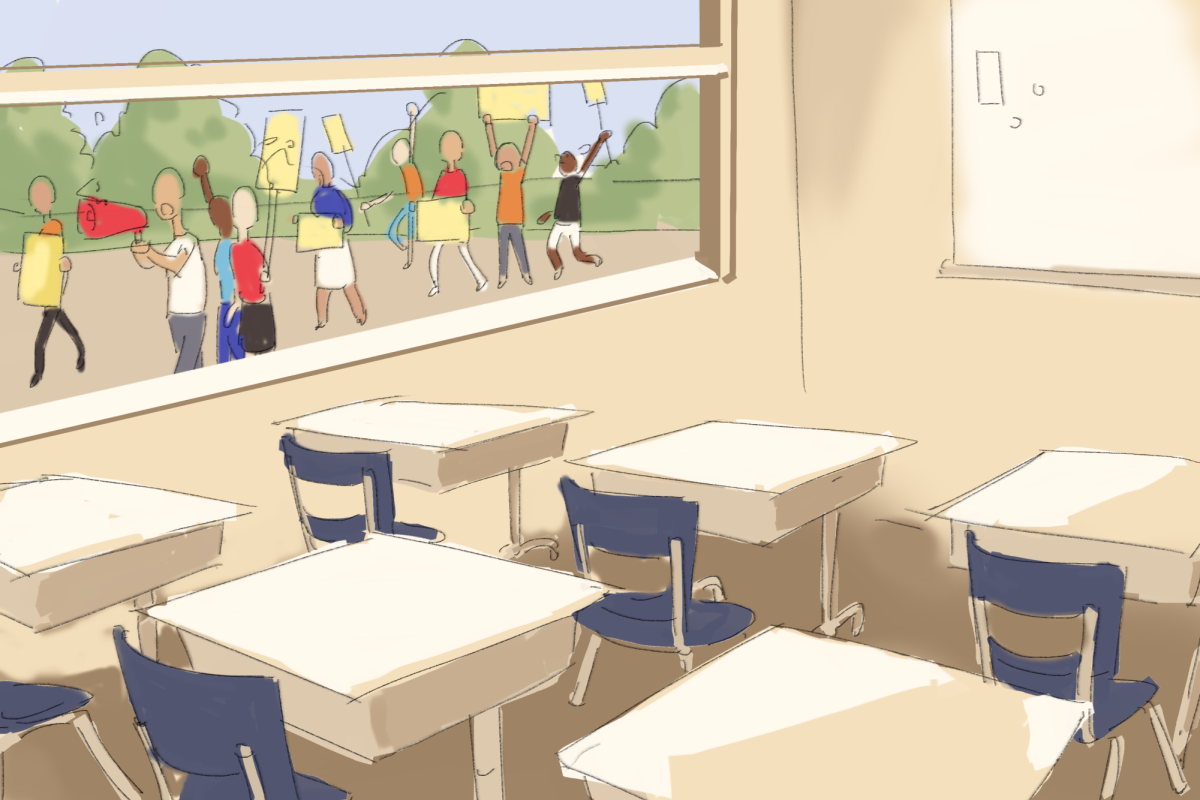
Over the past couple months, thousands of students have participated in anti-ICE walkouts across the U.S. They come in the wake of the mass deportations conducted by ICE, along with the deaths of Renee Good and Alex Pretti. Around 500 students within the Hays Consolidated Independent School District in Kyle, Texas, who walked out of their classes to participate in a downtown protest. Police arrested two minors at the event, gaining the attention of Gov. Abbott.
Gov. Abbott promptly posted on X about the situation, threatening both legal action and funding cuts to schools and faculty who allow walkouts to happen.
“It’s about time students like this were arrested,” Abbott wrote. “Harming someone is a crime — even for students. Disruptive walkouts allowed by schools lead to just this kind of chaos. Schools and staff who allow this behavior should be treated as co-conspirators and should not be immune for criminal behavior. We are also looking into stripping the funding of schools that abandon their duty to teach our kids the curriculum required by law.”
The Kyle Police Department has since clarified the arrests were unrelated to the walkouts. Regardless, schools should not be punished if their students decide to independently organize a walkout as a protest event. While the First Amendment does not consider walkouts a form of protected speech, it is one of the few ways that students can participate civically as a collective voice. In 2021, students made up almost ¼ of the U.S. population over the age of 3, and walkouts have, for decades, been some of the most influential forms of protests.
“A lot of these students are … children of immigrants, and they feel it is their turn to raise their voices, for their parents, for people that are not able to to be on the streets, that are afraid to be in the streets, that have been deported before,” says Daniela Renovales, outreach and partnerships lead for Lincoln-Goldfinch Law. “(They want to) let the community know how they’re feeling and that they are outraged about what’s happening with the current administration.”
Walkouts work for a variety of reasons, but one of the most important is that they hinge on the withdrawal of participation in everyday business. The more people who refuse to engage with the current system, the more those in power are inclined to take notice. Although walkouts are not protected free speech, as they disrupt school functions, that is exactly the point — to protest through disruption.
Abbott also wrote that “AISD gets taxpayer dollars to teach the subjects required by the state, not to help students skip school to protest. Our schools are for educating our children, not political indoctrination.”
However, to punish teachers and school districts is both an irrational and unbeneficial decision. While Abbott frames teachers as co-conspirators, the reality is that they have little control over the actions of students. Legally, teachers cannot physically stop or restrain students from leaving. As this is the case, it makes no sense to punish school districts and jeopardize students’ education for something the school has little control of.
“It is extremely important for elected officials on the state and federal level to be very judicious about the pronouncements that they make about free expression,” said Brett Harvey, a Harvard law graduate and associate general counsel for Mississippi State University. “Students, teachers, regular people in all walks of life, often don’t have the resources or the time to litigate, whether they keep their job, or whether they are criminally or civilly liable; and so what they will tend to do in most cases is to over-correct and to self-censor when they believe that there are threats of litigation and consequences.”
To punish students for exercising their right to protest actively discourages them from participating in politics. Rather than penalizing them for their engagement, this crucial form of free speech should be legally protected and should not be subject to politically-induced retaliation.
Gray is an anthropology, government and philosophy junior from Baytown, Texas.