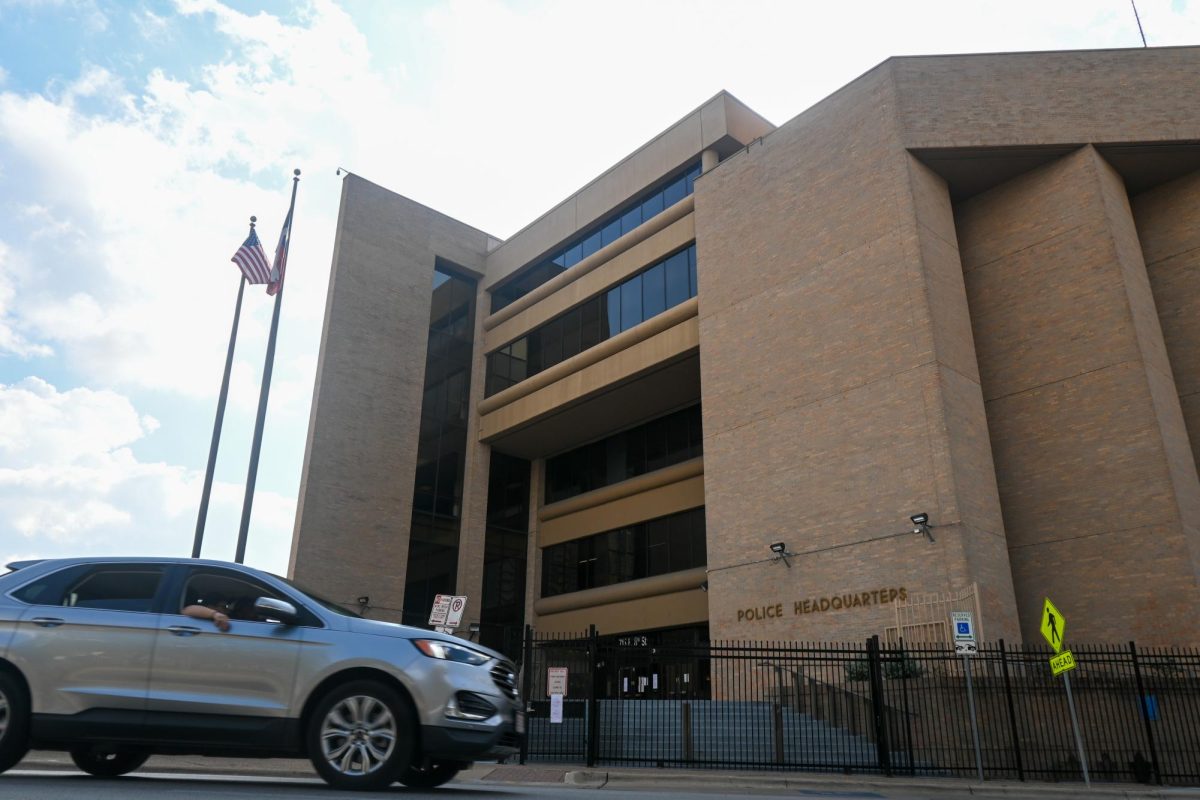
This episode of The Texan Explains looks at the recent overturning of the Texas Dream Act and the uncertainty it creates for undocumented students at UT. Reporter Miranda Liguez speaks to news staffers Maryam Ahmed and Catherine Li as they break down the legal developments and share students’ experience navigating this moment.
Miranda Liguez: A federal judge struck down the Texas Dream Act, leaving undocumented students uncertain about their future. I’m your host this week, Miranda Liguez — and this is The Texan Explains.
Since 2001, the Texas Dream Act allowed undocumented students to pay in-state tuition if they met certain residency and affidavit requirements. On June 4, a federal judge overturned the law, hours after a lawsuit was filed and two days after the Texas legislative session ended. Associate News Editor Maryam Ahmed broke the story. I sat down with her to hear more about what this meant for UT students.
Liguez: I’m here with Maryam and I just wanted to ask you, before we get into exactly what the federal judge striking down in-state tuition for undocumented students means, what exactly is the Dream Act?
Maryam Ahmed: Okay, so the Dream Act was passed in the 2001 legislative session, and what it basically did was allow undocumented students to receive the benefits of in-state tuition as long as they had lived in Texas for three years before going to college. And two, that they signed an affidavit saying that they would apply for legal status as soon as they were able.
Liguez: What exactly was the rule prior to two weeks ago regarding students going to the University of Texas at Austin and applying for the Dream Act?
Ahmed: What that looked like was undocumented students who maybe their parents brought them to the United States as children and they were able to go to college at a much better rate than maybe out-of-state tuition, making college a lot more accessible. For a community that is obviously very present in Texas and it allows them— and it had allowed them to go on— to get bachelor’s associates degrees to pursue higher paying jobs with maybe a little more stability.
Liguez: Got you. What were some of the legal arguments in proposition to it getting denied?
Ahmed: Yeah. One thing that was cited in the motion to strike down the Dream Act was basically that it violated a federal law, which like point blank states that people that are not legally authorized to be in the United States can’t receive in-state tuition, essentially. And then that was one of the reasons and the lawsuit argued that Texas had been violating that federal law for years. But the other reason was a couple of executive orders recently signed by President Trump. One of them basically said that we should avoid spending, like, taxpayer dollars on people that aren’t legally authorized to be in the United States as opposed to people that are citizens. And by technically cutting down tuition rates, that is in a way spending tax dollars on people that aren’t citizens.
Then, the other executive order was just to strike down any laws that favored non-citizens over citizens. That executive order explicitly stated such as providing in-state tuition to undocumented students, which directly implicates the Dream Act.
So those are the main rationales for striking down the Dream Act. One that had, that it violated federal law. And two, these are this pair of executive orders from Trump.
Liguez: While the legal battle over the Texas Dream Act continues to unfold, the consequences are already being felt by students on campus.
Senior News Reporter Catherine Li spoke with one undocumented UT student about what this decision means for their education—and their future.
Liguez: Thank you, Catherine, for being here. I want to talk a little bit more about what exactly this means for the student population. Obviously, this is a huge, breaking news subject. We know that there’s now a counter suit, but what have you heard from the student side?
Catherine Li: So, the reality is that as of right now, institutions are still thinking about what that timeline for compliance will look like, both for students who have already begun their college education as well as students who are incoming and starting their first year. On June 11th, there was a group of students who filed, or are represented by a Latino civil rights advocacy organization known as the Mexican American Legal Defense Fund, and what they wanted to do was join in on the lawsuit currently against the Texas Dream Act. What’s outlined in that motion, I think, really captures the challenge right now for students because there were students from across the state that joined onto this motion, and the data states in that motion as the attorneys outline that for some students, their tuition per credit hour would increase as much as nine times. That was an aggregate figure that they pulled. But here at UT, as people may already be aware, the median figure for in-state tuition is around 11 to $12,000. Out of state tuition looks at around 42, $43,000. So, the difference is immense.
I think in my perspective, what is so significant about the Texas Dream Act is that Texas was the first state to pass legislation like this that gave undocumented students access to in-state tuition rates.
Texas set the precedent since 2001, when Texas first passed this act. It was signed into law by Republican governor Rick Perry with a lot of bipartisan support. And then since 2001, there have been 11 states in total that have followed suit, and some examples of states that have enacted similar legislation include California, Illinois, New York, among others.
This was a 24 yearlong policy that allowed students to have access to these tuition benefits. There are also figures from a prominent advocacy group known as Every Texan that stated that in 2021, students who qualified for the Texas Dream Act contributed more than, I believe it was $80 million in tuition and fees to Texas public schools, which underscores just how deep their impact is, both on the Texas higher education landscape, but also the economy and also when they graduated college, how they entered the workforce have contributed further.
Liguez: And that’s The Texan Explains for the week of June 22nd. I’m Miranda Liguez.
The Texan Explains is a production of The Daily Texan Audio Department. If you like this episode, make sure to subscribe to The Daily Texan on your streaming platform of choice and follow us on Twitter @texanaudio. This episode was hosted and edited by me, Miranda Liguez.
Special thanks Maryam Ahmed and Catherine Li for their reporting. Cover art is by the Texan’s photo department and music is by Top Flow Productions. To read the news stories in this episode or see more from the Texan, head on over to www.thedailytexan.com. Thanks for listening, and I’ll see you next week.