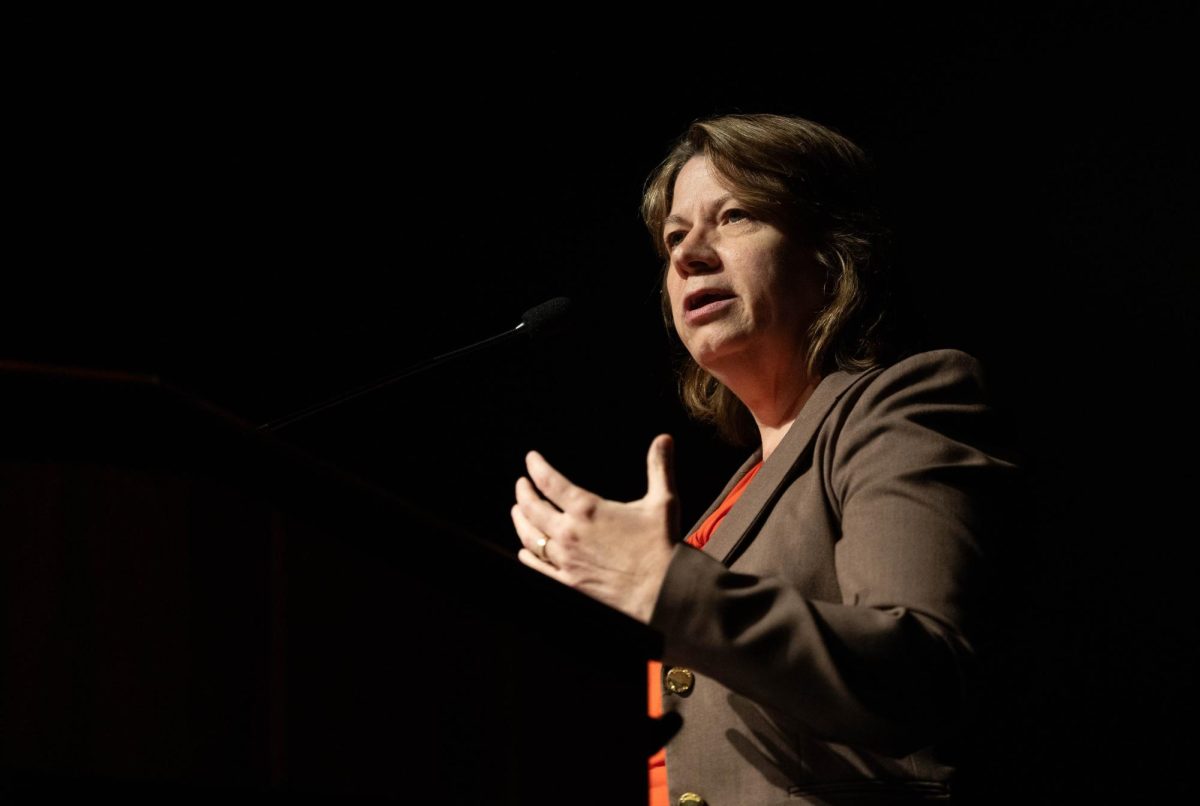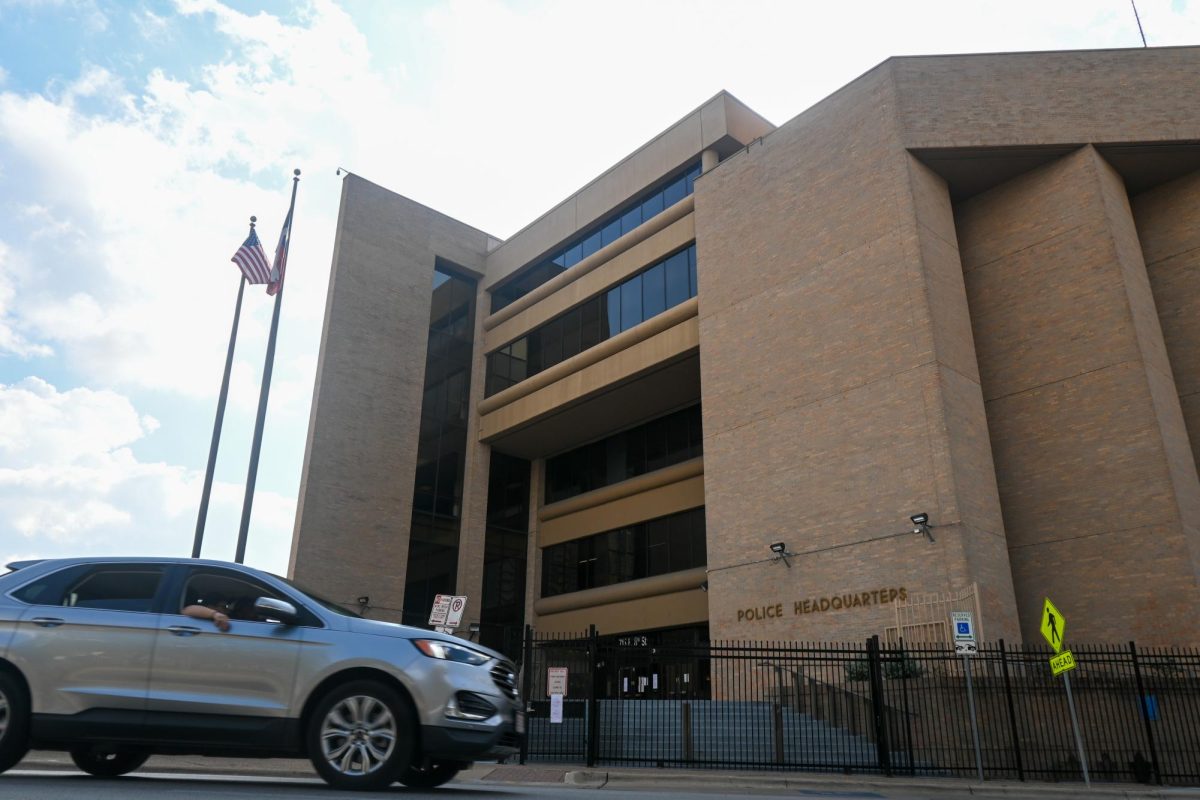
Join Senior Audio Editor Natalie Gonzalez as she sits down with Anjum Alam and Ellie Symons to discuss their recent story, “APD updates policy for handling ICE warrants after months of public concern.”
Hosted and produced by Natalie Gonzalez. Reported by Anjum Alam and Ellie Symons of The Daily Texan news department. Cover photo by Senior Photographer Tessa Harfenist. Music by Blue Dot Sessions.
[Intro music]
Natalie Gonzalez: I am your host, Natalie Gonzalez, and this is the Texan Explains. Today we’re going behind the headlines of a new police policy that’s about more than just paperwork. Joining me are the two reporters who wrote the story.
Anjum Alam: Hi everybody. My name’s Anjum Alam and I’m a senior news reporter at the Texan. I cover public safety, immigration, and the environment.
Ellie Symons: Hi, my name is Ellie Symons and I am a general news reporter.
Gonzalez: Okay, before we start, do you think you could give a little context of the story that you wrote?
Alam: Yeah, absolutely. So, this story was about a new policy put forth by the Austin Police Department. It comes after months of concern about how APD will be working with immigration enforcement, if at all. Prior to this, they had no policy written into place, is our understanding. This policy basically provides a kind of map for officers and their supervisors to follow when interacting with ICE and when they come into contact with something called an administrative warrant.
Symons: Basically, this policy is coming out after months and months of people wondering what’s going to happen because of all the administrative warrants that were coming out from ICE specifically. And Lisa Davis, the police chief, kept on talking about, ‘here’s what APD should be doing, here’s what we should be doing,’ and I know at least I had pitched many times that we should try to report on this because people care about what APD is gonna be doing to handle the situation. But without a concrete policy, we can’t really tell our readers anything that’s gonna actually happen because of it. So when this was published, it was good to be able to actually tell readers what’s going on and give them the knowledge of how everything’s gonna be handled.
Anjum: Yeah. That’s obviously a very key part of this story, is what is an administrative warrant is. Prior to this year, most people did not hear about them. Most law enforcement did not hear about them. And that is quite literally, as Mr. Woodward explains, as Chief Davis explained in the press conference, one of the reasons why we are getting, or requiring, this policy to be here in the first place.
Over the past year, around 700,000 administrative warrants had been put into the system. And so what an administrative warrant is: it’s a warrant, a non-criminal warrant that is usually signed by a federal official. So for example, an ICE official will sign it. It’s typically not looked at by anybody other than that person. And it’s very different from a criminal warrant, or as it’s also known, a judicial warrant, which is signed by a judge.
And those judicial criminal warrants, those are the warrants that police officers can act upon. The reason why this became an issue that the
police need to look at was, whenever police were, say, looking up the names of a person and an administrative warrant would pop up, they
wouldn’t be familiar with it. They wouldn’t know what it looked like. They wouldn’t know the difference between a criminal warrant, because it just wasn’t in the policy like it is now.
That’s something that Mr. Woodward said was really good. It was the fact that now there is a clear definition in the departmental policy of what exactly distinguishes an administrative warrant from a criminal warrant. So that’s something that police have now and the situation that Ellie was talking about where a woman and her 5-year-old daughter were deported came up because the police looked up her name and they saw an administrative warrant, and it goes from there. And so providing that definition was really important for the story. That was something that we kind of expanded upon during edits.
Symons: Yeah, I was just gonna say that, because they pop up whenever you search someone’s name in the database, that means that if, like we explained in the story, if you are a bystander, your name might get searched and that administrative warrant from ICE would pop up. So it’s very important that people know what the difference is, and that police know what the difference is. I mean, I’m assuming they would know the difference, but let’s say they see that pop up, don’t know what to do with it, and they would be searching anyone’s names. It could be a bystander, it could be someone that’s reporting a complaint, like Daniel Woodward said in the story.
Alam: A victim.
Symons: Yeah, a victim.
Alam: It could be a victim. And like he specifically cited, in situations of domestic violence, whenever you’re looking up the names of all parties involved, because that’s how they’re typically navigated, it’s just, it doesn’t necessarily… The police are not just looking up the names of people who they suspect are committing crimes, they’re looking up the names of all people involved. And it’s just really important that people understand that administrative warrants are not for criminals.
Symons: And you don’t want people to be afraid to report a crime just because they think they could be in the database.
Alam: Absolutely. Community trust.
Symons: Yeah, so the first thing that we did is sit down. And I emailed APD, I requested for comment in their media request box, and I emailed them specifically as a follow-up. We talked to sources that were able to explain everything to us, interviewed an immigration lawyer and we did get comment from other government sources. So we were able to include that in the article. And because we got that balance
of the experts and the actual government sources, we were able to not include the APD source because they weren’t responding to us. So
we needed to make it happen somehow.
Gonzalez: And then Senate Bill four is designed to prevent local agencies from interfering with immigration enforcement. When you report on the legal limits of what police can do with administrative ICE warrants, do you ever worry that your coverage could be misread by the state as interference?
Alam: Yeah, in particular with Texas SB 4, that’s a law that comes from 2017, and sometimes people refer to it as the “No Sanctuary Cities” law. Just for some context, Police Chief Lisa Davis has said in the past that in her ideal world, Austin would be a sanctuary city. So it’s important to understand that when the department is coming out with policy like this, even though maybe they wish they could do more, they wish they could do differently. They, like all other enforcement agencies, have to operate within the bounds that they are allowed.
So, we thought that incorporating the context of SB 4 would be really important. Just because, you know, one of the key things that we try to do is answer the “why?” Why, why is the agency writing it in this way? Why can they not just say outright, an officer cannot contact, it’s because the law prevents them from doing so and they are a law enforcement agency, so, they of course have to follow that.
Symons: One of the situations where there was lots of public concern around it was when a mother and her five-year-old child were deported to Honduras. And the 5-year-old was considered a US citizen, because of her birthright citizenship. So this was because APD used an administrative warrant to detain them, and then eventually they got deported by ICE. So it obviously caused a lot of community uproar because they were not criminals in the sense that APD was going to arrest them for something other than the administrative warrant.
So people were really worried that this could just start happening to anyone because there was no clear ICE policy laid out, and because of that, people kept asking, Police Chief Lisa Davis, like, ‘what’s going on?’ What is APD’s official standing? And at a recent town hall, I know a lot of people viewing the town hall were really concerned and saying things to her, and she was doing her best to defend APD, but with no clear policy, people were still wondering what’s going on. And they had to make a clear policy because of Texas legislation.
Gonzalez: For Anjum (Alam), how did you navigate the phrasing of the story to ensure you didn’t paint a target on the chief of the city while still accurately reporting that they are prohibiting certain detentions.
Alam: I actually really like this question. So like we said, APD did not respond to requests for comment. They are pretty good at getting back to us for things like this, and they’re very willing to work with the press. And like you said, the main reason, people ask, ‘why would you reach out if you know?’ Or if you have a good feeling that they might not respond, it’s because everyone deserves every opportunity to maybe speak on behalf of themselves. And I think a really good thing that we were able to do was, we mentioned these months of public concern. Well, one of the last press conferences prior to this policy being released was in February. And I’d worked on another story with another one of our amazing reporters, and she had a recording of that press conference, APD conference. So we were able to use the chief’s words from there. And I feel like I’m a big fan of that, like whenever people won’t speak from themselves — well you did it before, you know, I can find it and put it in the relevant context so we explain really clearly.
This was from a. press conference prior to the policy being released. This was the most recent press conference. So we try to also get the most up-to-date information. We’re not going to quote something from 10 years ago, that doesn’t make sense, that’s not relevant. So I feel like just finding the ways where we can fill, where reporting gaps, as best we can. And so, like you said, not hearing back from APD, we used the policy itself to kind of speak on behalf of them. And then we had, prior on-the-record information from that press conference that we were able to use.
Gonzalez: Is there anything listeners should keep in mind after reading this article?
Symons: I mean, honestly, even though I would always advocate for them to read The Daily Texan and read Anjum’s writing, I think they should keep checking up on these policies and keep doing their own research because, I mean, not that anything has changed since the article was published, but things could change and it’s really important that everyone stays informed.
Alam: Yeah.
Symons: Yeah.
Alam: And just know that these are times that can be like, it feels like we’re getting new information every single day about something new, about the world, about the country, and much less our own city that we live and work in. So I just trust that we are trying our best to responsibly report and provide valuable information every day.
Gonzalez: Yeah. And that’s the Texan Explains for the APD policy. I’m Natalie Gonzalez.
The Texan Explains is a production of The Daily Texan Audio Department. If you
like this episode, make sure to subscribe to The Daily Texan on your streaming platform of choice, and follow us on Twitter at @Texanaudio. Special thanks to The Daily Texan News Department for the reporting on APD policy update. The cover is by The Daily Texan photo
department, and music is by Blue dot Sessions.
To read new stories about policy affecting students, or see more from the Texan, head on over to www.thedailytexan.com. Thanks for listening.