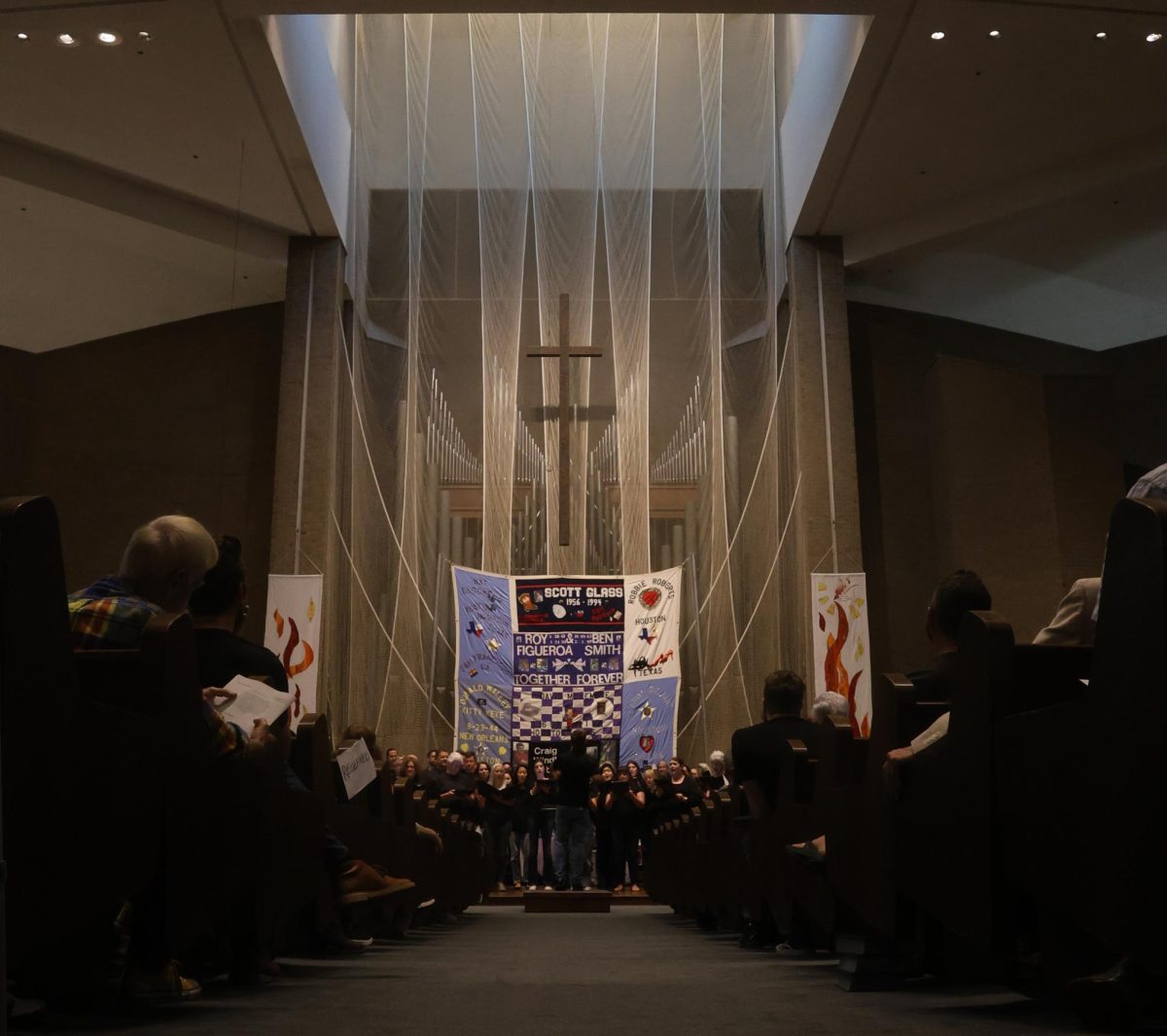
As soft piano music echoed through the First Baptist Church of Austin, the congregation rose and pairs walked down the chapel’s center aisle, holding individual AIDS Memorial quilt panels. Each panel measures 3 feet by 6 feet, the size of a human casket, representing a life lost to AIDS. The panels are handmade by friends, family, coworkers, strangers, healthcare workers or even by the patient themselves in hopes of being remembered after passing.
After a week of showcasing 34 blocks of the national AIDS Memorial Quilt, the largest exhibit in Texas history, the First Baptist Church of Austin held a service of remembrance on Aug. 24, signaling the end of the exhibit. Cleve Jones created the first AIDS Memorial Quilt panel in 1987, honoring his friend Marvin Feldman. Now, over 50,000 panels exist, paying tribute to lives lost. Over 270 individuals, mostly Texans, are represented by the 34 blocks displayed on each of the four floors throughout the church.
“I hope that the people who have lost people that they love to AIDS will have a chance to remember them and the joy that they brought to their lives,” said event co-chair Leslie Moore.
Before personal testimonies, Rev. Dr. Griff Martin called the congregation to say the names of those they lost to AIDS. As the sound of names filled the chapel, one woman in the second-to-last row honored all of her lost patients.
“We want to let people know that (AIDS) is no longer a death sentence,” said event co-chair Dave Anderson. “We’ve had some sentimental moments and some magical moments here … Just a moment ago, a young student said, ‘My uncle David’s quilt is in here.’ And I said, ‘Let’s go say hi.’”
Anderson said he wants to reach a younger audience with the message that treatment and knowledge are necessary for change. He said this generation is demanding their causes as a result of society’s political and social growth.
“It’s amazing that we no longer say AIDS, but we say they’re living with HIV, just as if they’re living with diabetes,” Anderson said.
Throughout the service, performances from the Austin Gay Men’s Chorus and Conspirare highlighted the importance of music in inspiring hope. Lauren White, a singer and quilter, attended both the exhibit and service to support her friends in the Austin Gay Men’s Chorus and Conspirare. Tearing up, White said she felt connected to the cause as she grew up with musicians as family, many of them being queer.
“Exposing (my sons) and not making (HIV) seem weird or shameful, and explaining to them that these things happened and now we have progressed in society (is how I hope to raise them),” White said.
At the end of the service, Rev. Dr. Griff Martin shared a final sentiment of hope.
“May we remember, and by doing so, may the restorative presence of those who we have loved and lost fill us,” Martin said, “and may we hope by living lives full of prophetic actions that (we) will better our world.”