Minority students may get left behind in efforts to build an empowered mindset around math. However, education leaders from Chicago, Los Angeles and Philadelphia want to change that possibility across school districts, believing anyone can understand math if taught properly.
The three panelists explored results from the National Math Improvement Project, which analyzed six of the country’s largest and, by extension, majority-minority public school districts: Houston ISD, Miami-Dade County and New York City, as well as each leader’s district. The study spanned the last three years in an effort to improve math literacy. On Wednesday, March 11, in a SXSW EDU session titled “Solving the Math Problem: Leading Change in K-12 Systems,” the panel discussed solutions.
Corey Morrison, executive director of STEM for Chicago Public Schools, said it’s important for teachers to identify as “math people.”
“Focusing on math identity first, at the adult level, I think it’s been our key to shifting this change,” Morrison said.
Educator Dia Bryant, who interviewed the panelists, said that students who take Algebra 1 by eighth grade prove more prepared for rigorous math courses in high school, bypassing the need to waste funds on college remedial courses. She also acknowledged that taking Algebra 1 by Grade 8 is not a one-size-fits-all model.
Morrison agreed, adding schools must teach interrelated learning strategies in earlier grade levels to prepare students for algebra.
“There’s this fluency in talking around conceptual abstractness that is algebra,” Morrison said. “It’s not a course, it’s a way of thinking.”
Besides that early exposure, Frances Baez, chief academic officer of the Los Angeles Unified School District, said it’s useful for students to take a math class each year in their areas of interest, and that school districts should navigate local policy to make that happen.
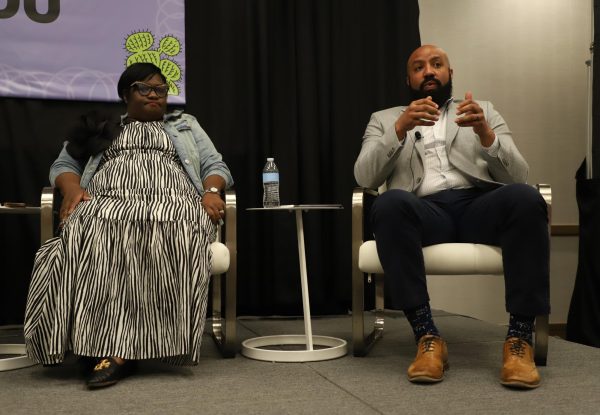
“Four years of math is critical for students to have post-secondary success, but how we’re going to get there is every district’s own personal experience, given the context that they’re in,” Baez said.
Nyshawana Francis-Thompson, chief of curriculum and instruction in Philadelphia’s school district, said access to complex math courses promotes economic opportunities and allows students to deconstruct data and statistics around what’s happening in their communities.
“We want to make sure that we’re giving them the tools to also understand their context,” Francis-Thompson said. “Our election system is heavily rooted in math, so when we don’t take this opportunity to make math important, there are so many other implications that we’re not even talking about.”
Morrison said math is a civil rights issue, with math literacy having the power to break cycles of poverty in cities such as Chicago.
“Math elites dictate who gets to have access to what kinds of math,” Morrison said. “If we disrupt that, and everyone has access to rich, comprehensive math education … they can be activated for their environmental justice. They can be activated for their community, and can be activated for any other initiative that makes life valuable, worth living.”