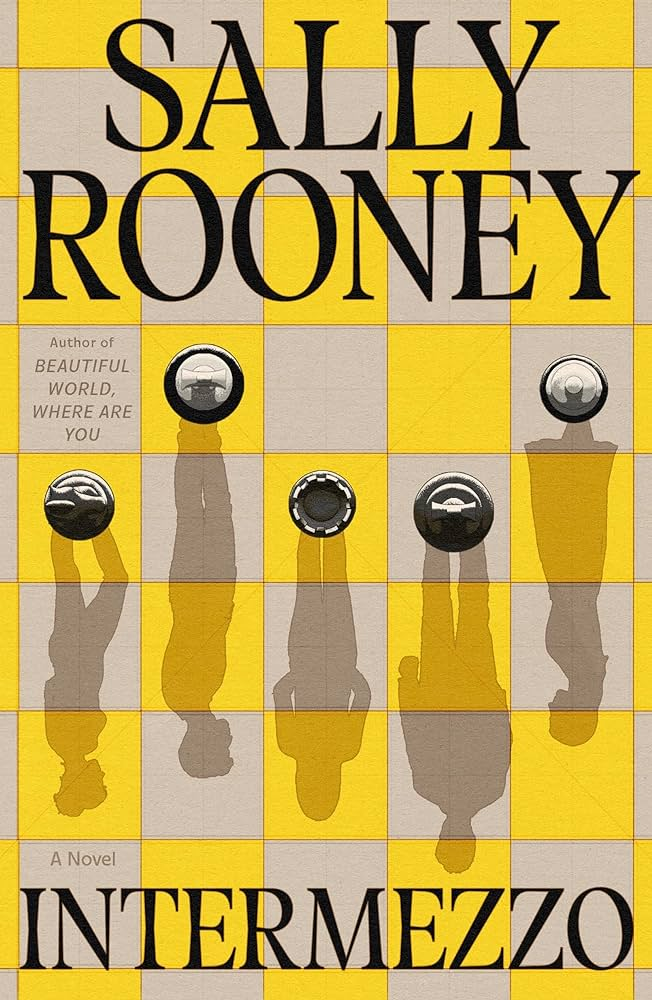
Sally Rooney messes with readers’ psyches once again. Known for “Normal People” and “Conversations With Friends,” the Irish author’s latest book is a philosophical, contemplative piece on the nuances of love, platonic and familial relationships, grief and polyamory.
“Intermezzo,” released Sept. 24, follows brothers Ivan and Peter Koubek. 32-year-old Peter feels stuck choosing between two women: Sylvia, his first love, which ended after a car crash that left her critically injured, and Naomi, a college student, closer in age to his 22-year-old brother than to him. Ivan, a competitive chess player, falls in love with Margaret, an older woman he meets at a chess event. Taking on new and questionable romantic partnerships proves overwhelming for the brothers, on top of navigating their own complicated relationship with one another after their father’s death.
In many ways, the novel feels similar to Rooney’s previous works -– a Dublin man in his thirties, an ailing woman, a younger woman, an affair. Still, this work feels more introspective, diving deeper into philosophy than her previous novels, quoting works from Ludwig Wittgenstein, Susan Sontag and various pieces of classical literature. Rooney explores new stylistic choices, playing with imagery and story structure.
The alternating third person perspectives of Ivan and Peter each chapter allows the reader to see the humanity of both characters. Rooney examines each of their morals of their age-gap relationships, their relationships with one another and their overarching views on life, religion and society. The novel is significantly longer than Rooney’s other works at 448 pages, which leaves time for building tension between characters.
Rooney writes vividly about the anxiety both characters face in revealing their relationships to their friends and family. In a scene where Margaret introduces Ivan to her friend Anna, Rooney conveys Margaret’s fear in introducing the pair:
“Resounding now the music beats over them both, insisting, cresting and then falling to silence. Margaret waits, watching, fluttering sensation, and finally, into the silence … uncertainly trilling itself into the dark, a tentative descent.”
Rooney consistently uses an apprehensive writing style in order to depict the characters processing grief slowly while everything moves too quickly around them, forcing readers to experience the anxiety with them. The slow pacing of the book makes it hard to get into, but by the end, it feels almost worth waiting for. “Intermezzo” comes together as a grown-up version of Rooney’s “Conversations with Friends,” “Normal People” and “Beautiful World, Where Are You,” bundled into one.
4 ½ king’s gambits out of 5