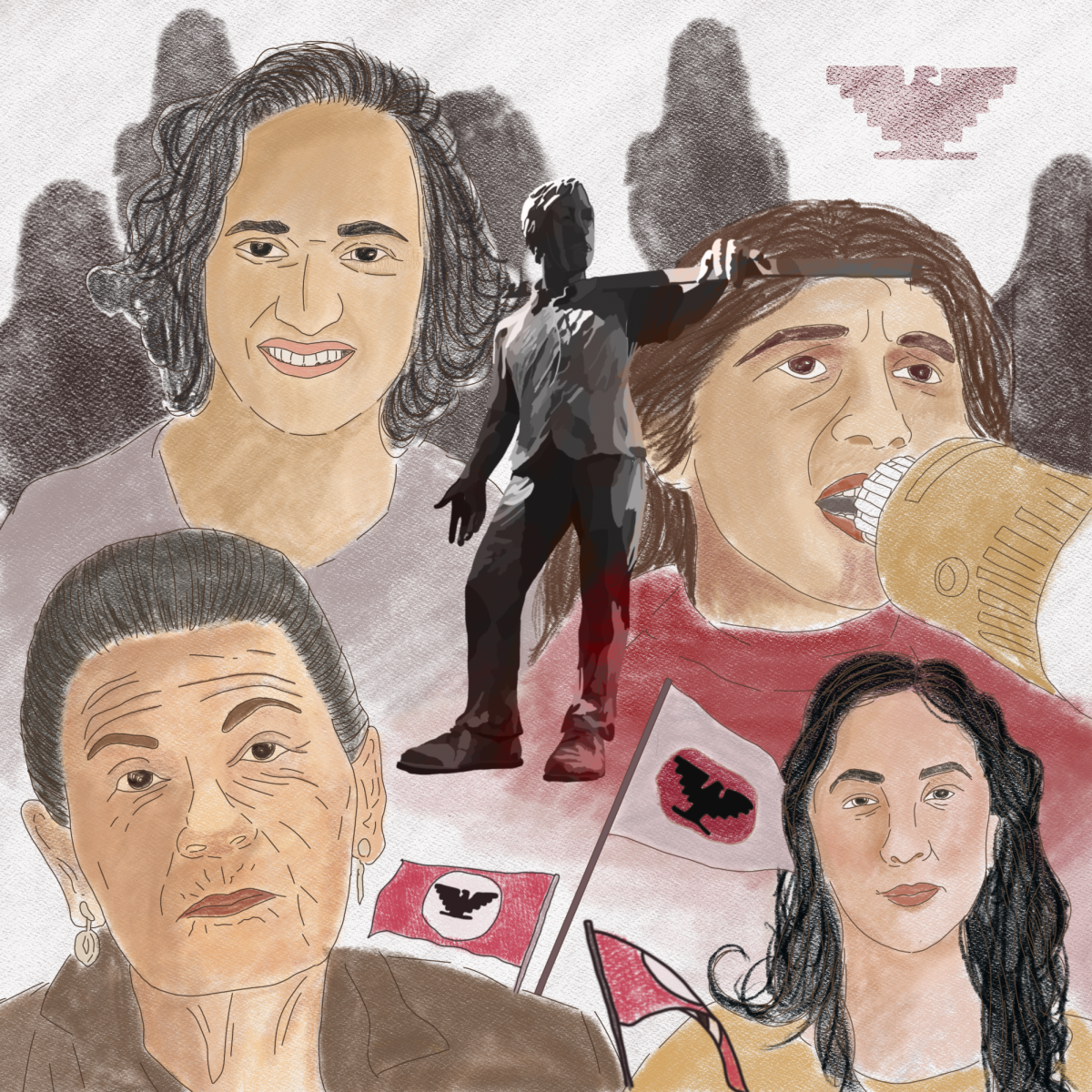
Editor’s Note: This article’s illustration has been updated from a previous version that included the phrase “ICE OUT.” The Daily Texan remains committed to non-biased reporting, and does not editorialize in our news illustrations. The text has since been removed from the illustration. The Texan regrets this error.
A Honduran woman called the Austin Police Department to report a disturbance on Jan. 5. Instead, the call would ultimately lead to her deportation, along with her 5-year-old daughter, a U.S. citizen.
“There’s already been kind of a general sense of distrust with the police for a long time,” said Daniela Silva, Austin policy coordinator for Workers Defense Project. “I’ve heard stories of workers who are in construction and they’ll get to work at 4 a.m. and sleep in their car because they’ve learned when ICE sets up their cars to look for people.”
One month later, on Feb. 5, the Austin City Council held a forum at Duvall Elementary School in Northwest Austin, where several council members and Austin Police Chief Lisa Davis faced a tense crowd demanding answers and solutions.
“To me, the message from that night was loud and clear: the city of Austin is not doing enough,” wrote Council Member Vanessa Fuentes via email response. “(Immigrants) simply want to feel safe living their lives – going to school, buying groceries, going to work – all without fear,” she added.
City officials explained officers at the scene had detained the mother and child after ICE filed a request for a warrant that was not yet approved by a judge. According to Council Member Mike Siegel, the discretionary nature of these warrants was misunderstood by officers on the scene, raising questions about the true understanding of Texas Senate Bill 4.
SB 4 is a state law restricting how far local governments can go in limiting cooperation between police and federal immigration authorities. The law prevents Austin officials from fully prohibiting contact between the APD and ICE.
“Folks are especially distrustful of calling them (APD) even in a case of an emergency because they don’t know if when they ask for help ICE is then going to show up and harm them,” said Silva.
Chas Moore, co-founder of the Austin Justice Coalition, said that Austin should push back against SB 4 by minimizing, or ultimately ending, all cooperation between local police and federal immigration authorities. The key to restructure trust between immigrants and APD, according to Moore, lies in stopping all cooperation.
“I know what the law says, but I’ve always questioned, and challenged all of us, to question the law,” Moore said. “I don’t think that just because something is law that means we need to follow it.”
Moore said the issue with APD and ICE cooperation goes beyond officer training or procedural reform. The coalition has helped organize demonstrations against ICE and the APD following the incident, and has worked alongside the Texas Civil Rights Project to advocate for changes to APD’s general orders regarding interactions with ICE.
Moore said local city officials should take a clear moral stance against all cooperation between the APD and ICE, even if it means challenging a state law.
“This is their moment as they are the current elected leadership of the city of Austin, ” he said. “I just think they have to dig deep within themselves to see how far and how much they want to stand up.”
Austin City Council Member Zo Qadri, who represents the University of Texas’ district and therefore a large student and immigrant population, said the law uses immigration status as a way to terrorize the Hispanic community.
“Just because something’s legal doesn’t mean it’s right, it doesn’t mean it’s just or humane,” said the council member.
When asked about cooperation between ICE and APD, council member Qadri said he opposed any collaboration between the two agencies as he is “point blank against ICE,” and does not believe the agency should exist.
For Qadri, the question of compliance ultimately comes down to the responsibility of local leadership to refuse to follow the law.
“We have a moral responsibility to protect Austinites,” he said. “If we’re not willing to fight for our constituents, then why are we serving in office?”
Other activist organizations, such as Workers Defense, have focused on aiding the community while also staying within the legality of SB 4. Silva explained that while much of the ongoing debate is centered on whether or not to follow SB 4, what the law actually does is allow local police to cooperate with federal immigration authorities. It contains relatively few situations in which cooperation is strictly required.
“It’s up to the officers themselves on whether or not they’re going to enforce immigration law,” she said.
Chito Vela, Austin’s mayor pro tem and former immigration attorney, said the debate over how Austin should respond to ICE-APD cooperation often overlooks the people most affected by the policy: the undocumented community.
“I can just rally and shoot the finger at the president and ICE, but I don’t think that’s what the undocumented community wants,” he said.
Vela said many immigrants are less concerned with political confrontation and far more focused on avoiding contact with the deportation system altogether. For Vela, there is no hope in restoring trust between the APD and the Hispanic community, most specifically those without a legal status in the country.
“It’s been broken so deeply and fundamentally,” he said, when referring to the trust between Hispanics in Austin and the APD. “I don’t see how we (city council) fix what President Trump has broken.”
Vela said calls for dramatic political confrontation with federal immigration authorities often miss what undocumented residents themselves are actually asking for.
“We could have a city council meeting where we stand up to ICE and everybody will be hugging afterwards, it’ll be fists in the air and stuff. What about the second move and third move after that?” Vela said. “Then what do we do when 2,000 ICE agents show up in Austin?”
For Vela, the limits facing Austin are legal as much as political. The city cannot prevent federal immigration agents from operating locally, he said, and any response from the city government must take into account if the undocumented will be harmed.
“My goal is to make it through the next three years with as few deportations as possible in Austin, Texas. Punto,” Vela said.
The management team of The Texan en Español is composed of: Director Dieter Mouchkatine, Editorial Director Héctor Yunta Rico, and Associate Director Julia Frías-Aguilar.